 Vietnamnet.vn

 Podcast



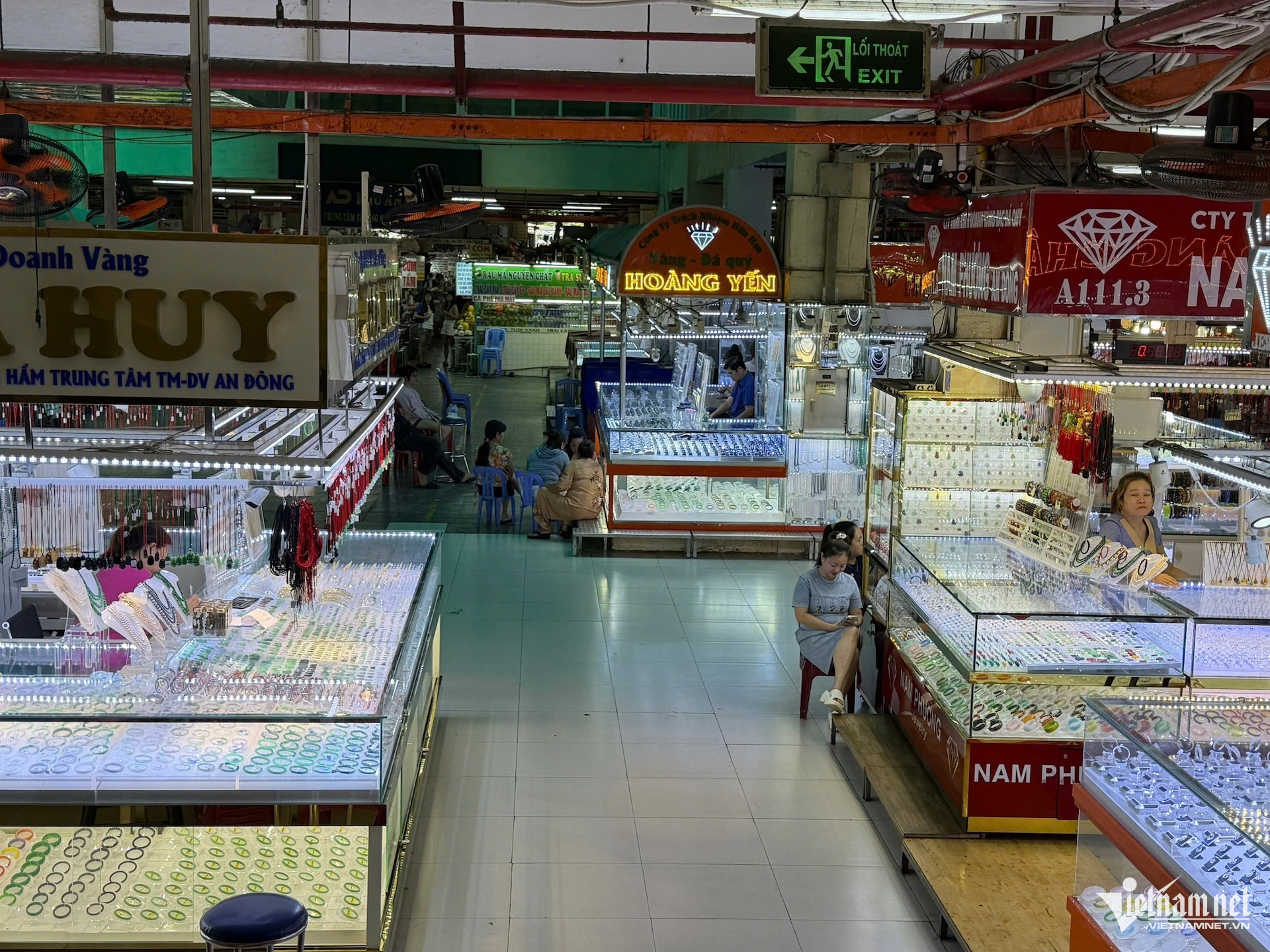
Observations recorded near Ben Thanh Market on September 24 showed several brands, including Chinh Tam, Hoang Thu Jewelry, Thien Thien Ngoc, and Que Jewelry, reopening to customers.
At An Dong Plaza Shopping Center, a major hub for trading, exchanging, and manufacturing gold, silver, gemstones, and jewelry, most diamond and jewelry stores have reopened for business.
In late July and mid-August, brands such as Hoang Yen and My Kim temporarily closed for personal reasons or vacations, but have now resumed operations.
Diamond brand Cashion reopened on September 19 and introduced a buyback policy based on two groups of invoices. For invoices issued prior to July 19, buyback terms and rates remain unchanged from original purchase conditions, though payments are divided into five installments spanning 120 days. For invoices issued from July 19 onward, products will be considered for buyback or exchange at a negotiated price after inspection.
Notably, Cashion implements strict conditions and procedures regarding buyback policies. For customers lacking invoices, the brand assists with transaction lookups upon receiving complete transaction information, executing buybacks only after successful verification.
For diamonds certified by PNJ Lab (P-Lab) or non-GIA/IGI certification bodies, Cashion applies a flat fee of VND100,000 per certificate regardless of size. For GIA/IGI-certified diamonds, fees vary by diamond size, ranging from VND1.5 million to VND18.2 million.
Recently, PNJ issued an announcement stating that its Board of Directors approved a policy to shorten payment periods when the company buys products back from customers.
However, PNJ has not yet announced the specific new payment period, saying the adjustment will be applied flexibly to different product lines based on the company’s actual financial situation.
PNJ and Cashion are not the only ones. Many diamond shops have resumed operations but have also tightened their buyback policies.
Market not recovered
Economist Le Ba Chi Nhan said the reopening of diamond brands is a notable sign, but there is not enough basis to conclude that the market has recovered. Instead, it is primarily a decision made at the individual business level.
If actual purchasing demand has not increased correspondingly, reopening does not mean the market has entered a new growth cycle.
Vietnam’s diamond market is being affected by domestic demand and fluctuations in the international market.
In the first half of 2026, De Beers’ average price for rough diamonds fell 32 percent year on year, while trading conditions remained difficult, particularly in lower-value segments.
In Vietnam, the issue also involves consumer confidence and diamond liquidity. According to Nhan, after a period of increased demand to sell or exchange diamonds, the market needs time to re-establish price levels, buyback mechanisms and consumer expectations.
“The important benchmark is not how many brands have reopened, but how many actual transactions are taking place and whether liquidity has improved sustainably,” he stressed.
He said that if the number of buyers increases in the coming months, secondary-market transactions recover, buyback and exchange times become shorter, and the gap between purchase and resale prices narrows, then a genuine recovery could be discussed.
For now, reopening should be viewed more as a sign that businesses are restructuring and stabilizing their operations than as a reliable indicator of a recovery across the entire market.
In reality, along An Duong Vuong Street in An Dong Ward, many shops remain open but business activity is still subdued. Many brands, including Kim Chau, Ngoc Tam, Kim Ly, Kim Khiet and Ngoc Chau Au, remain closed, while notices announcing their expected reopening dates have also been removed.
Nguyen Van Dung, chair of the HCMC Association of Fine Arts and Jewelry, said that although brands have reopened, new purchases remain slow. He said the diamond market, as well as the gold market in HCMC, still shows no signs of recovery.
Looking toward the end of the year, experts expect the diamond and gemstone market to become increasingly segmented across different product categories. Products from reputable brands, with transparent origins and internationally recognized certification and designs intended for genuine jewelry demand are likely to maintain better transaction levels.
"The last months of 2026 will serve as a pivotal phase. The market may not experience sharp price increases, but it will likely undergo a gradual restructuring toward greater transparency and divergence, while placing higher emphasis on genuine utility, origin, and liquidity for individual products. This phase will also establish the foundation for determining market trends in 2027," Nhan said.
Thu Ha
.svg)
