 Vietnamnet.vn

 Podcast


A national scientific conference titled Vietnamese Buddhist Culture in the Digital Era: Current Practices and Development Directions was held at Tam Chuc Pagoda in Ninh Binh province on the afternoon of October 17.
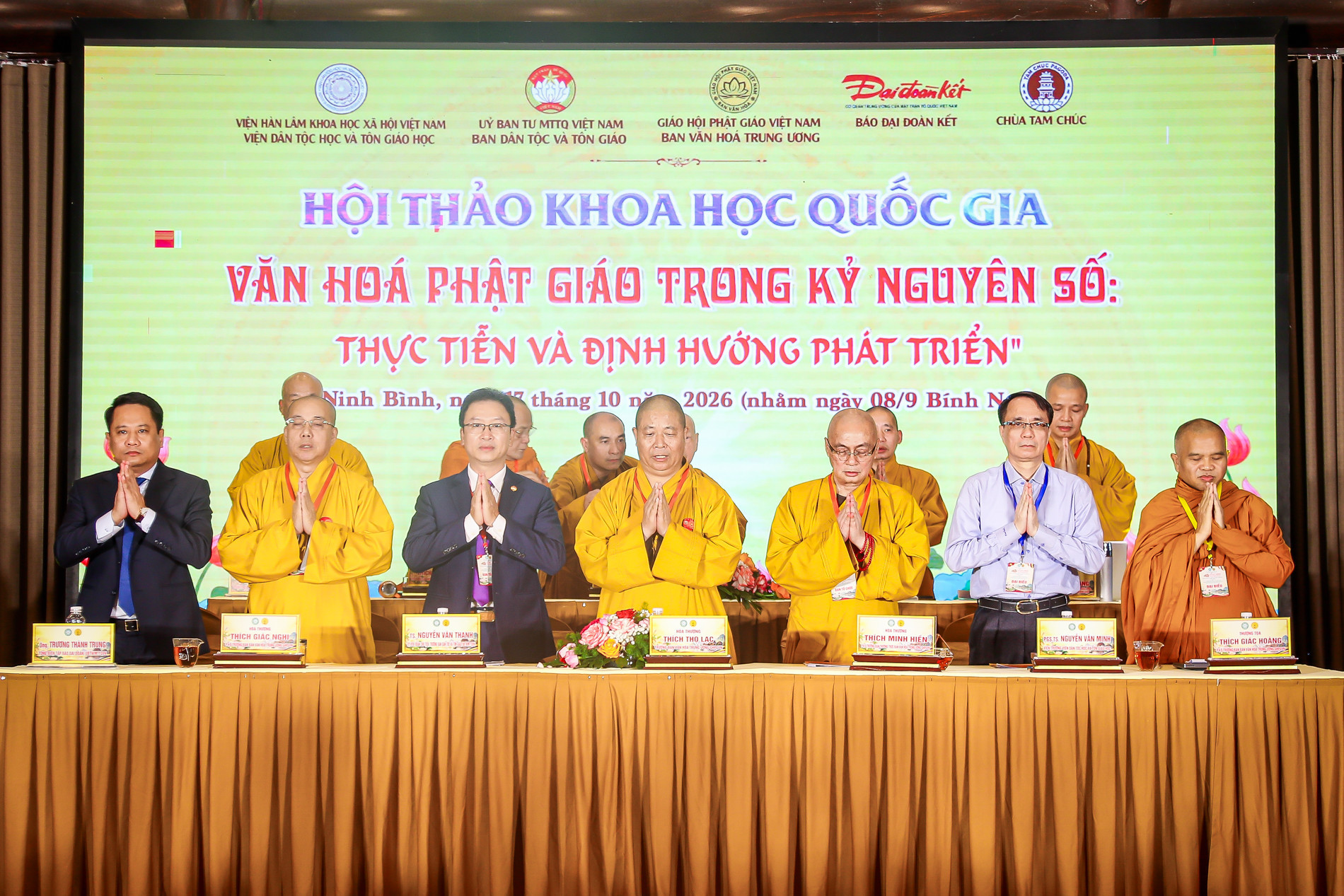
Opening the conference, Venerable Thich Minh Hien, Deputy Head of the Central Cultural Affairs Committee of the Vietnam Buddhist Sangha (VBS), said digital transformation was directly affecting cultural and spiritual life.
Buddhist scriptures are being digitized, religious ceremonies are livestreamed, Buddhist communities are interacting online, and artificial intelligence (AI) is beginning to play a role in interpreting religious teachings.
These developments require digital transformation to be considered not merely as a technological tool but also in terms of preserving and promoting the fundamental values of Buddhist culture.
The key questions concern which values must be protected, which aspects are changing and which risks of cultural erosion need to be identified promptly.
Delivering the conference's introductory address, Associate Professor Nguyen Van Minh, Director of the Institute of Ethnology and Religious Studies under the Vietnam Academy of Social Sciences, said Buddhist cultural values had become deeply embedded in Vietnamese thought, lifestyles, traditions and customs.
Throughout history, Buddhism has made practical contributions to the country's development, defense and nation-building.
According to Minh, Buddhist culture has helped cultivate morality and character, promote national solidarity, harmony and peace, and advance literature, art, architecture, education, knowledge, charitable activities and social welfare.
The conference took place as Vietnam undergoes rapid transformation across virtually every sector.
Against the backdrop of the Fourth Industrial Revolution and the National Digital Transformation Program through 2025, with orientations toward 2030, established under Prime Ministerial Decision No. 749/QD-TTg, core technologies have developed rapidly.
These include AI, big data, 3D scanning, digital twins and virtual reality.
Such technologies are creating new opportunities for Vietnamese Buddhism to modernize the dissemination of its teachings, preserve cultural heritage and reach domestic and international audiences, particularly younger generations.
They can also contribute to Vietnam's development in the new era.
Challenges facing Buddhist heritage preservation
In his presentation, Most Venerable Thich Hue Vinh identified numerous challenges facing the preservation of Buddhist culture in central Vietnam.
These range from climate change and natural disasters to urbanization and tourism development, which are transforming traditional cultural landscapes.
According to the monk, climate change and natural disasters are accelerating the natural deterioration of ancient architectural structures.
Even nationally recognized special heritage sites, such as the Dong Duong Buddhist Monastery, are suffering serious degradation.
The site faces a risk of collapse due to the combined effects of time, natural conditions and wartime damage, making urgent restoration and conservation planning necessary.
Urbanization and tourism development also threaten to alter cultural landscapes and encourage commercialization, potentially undermining the authenticity of Buddhist heritage.
Meanwhile, Vietnam continues to face shortages of specialists in Buddhist studies, classical Chinese and Nom scripts, archaeology, architectural conservation and heritage management.
Existing human resources have yet to meet the growing demands of research and preservation.
For intangible heritage, traditions such as Buddhist chanting, the Luc Cung Hoa Dang ceremonial dance, Buddhist calligraphy and traditional rituals risk disappearing unless they are promptly documented and passed on to younger generations.
To address these challenges, Most Venerable Thich Hue Vinh proposed an integrated heritage management approach combining conservation, research, digital transformation, education and sustainable development in accordance with the Law on Cultural Heritage.
He called for improvements in management mechanisms, stronger research efforts and the development of a national project to preserve and promote Buddhist heritage in central Vietnam.
Such a project would require cooperation among the Vietnam Buddhist Sangha, government agencies, local authorities and research institutions.
He also proposed establishing a Central Vietnam Buddhist Heritage Research Center and developing a unified database to overcome fragmented heritage management.
In her presentation, Interpreting Buddhist Heritage in the Context of Digital Transformation: The Monastic Dance Exhibition at the National Museum of History, Nguyen Thi Thu Hoan, Deputy Director of the National Museum of History, examined the opportunities and challenges of using technology to interpret Buddhist heritage.
She noted that over nearly 2,000 years of development, Vietnamese Buddhism has created an extensive cultural legacy.
This includes pagodas, towers, statues, reliefs, inscriptions, ceramics, musical instruments, rituals, music and numerous other artistic traditions.
However, wars, natural disasters, historical upheavals and the passage of time have destroyed or damaged much of this heritage.
Most Buddhist architectural structures dating from the Ly Dynasty have not survived intact.
Digital transformation now offers new opportunities to preserve, interpret and disseminate Vietnam's Buddhist heritage through modern methods.
Nevertheless, experience from the exhibition Monastic Dance: Buddhist Art of the Ly Dynasty - Heritage and Technology at the National Museum of History demonstrates that the fundamental value of digital transformation does not lie in technology itself.
Rather, it depends on connecting technology with scientific research and thoughtful approaches to heritage interpretation.
From this perspective, digitizing Buddhist heritage is not simply about applying modern technical solutions.
It is also a process of reconstructing cultural memory and creating new ways for heritage to remain relevant in contemporary life.
Technology cannot replace genuine spiritual cultivation
Delivering the concluding remarks, Most Venerable Thich Tho Lac said the conference had featured an introductory report, five presentations during the first session, thematic discussions during the second session and numerous contributions from Buddhist dignitaries and researchers.
These discussions, together with 45 papers published in the conference proceedings and 15 papers published in the fourth 2026 issue of the Journal of Ethnology and Religious Studies, provided a relatively comprehensive overview of Vietnamese Buddhist culture in the contemporary context.
Participants agreed that Buddhist culture is an integral component of Vietnamese cultural identity.
Values such as compassion, karma, the six principles of harmony, contentment and the socially engaged spirit of the Truc Lam Zen tradition remain important spiritual resources.
They continue to contribute to personal development, family culture, environmental protection and sustainable development.
The conference emphasized that digital transformation offers unprecedented opportunities to preserve, digitize, interpret and disseminate Buddhist heritage.
At the same time, it presents substantial challenges.
These include the dilution and commercialization of Buddhist teachings, the emergence of "virtual spiritual practice" that may weaken the importance of direct religious experience, and the growing divide between in-person spiritual engagement and technology-mediated experiences.
Participants stressed that technology should remain a means of supporting Buddhist practice rather than replacing genuine spiritual cultivation and realization.
They also invoked the Buddhist principle "The Dharma flourishes through those who practice it," emphasizing that the value of Buddhist culture is ultimately demonstrated through the moral character and conduct of its practitioners.
Another concern is that Buddhist heritage digitization remains fragmented, with no common standards and limited interoperability among institutions.
Issues surrounding copyright, the rights of heritage-holding communities and appropriate limits on presenting sacred cultural values in digital environments also require further research.
In addition, quantitative surveys of audiences and comparative studies across regions and Buddhist traditions remain insufficient.
Based on the conference discussions, Most Venerable Thich Tho Lac said the VBS Central Cultural Affairs Committee would consolidate the findings and submit proposed directions to the VBS Executive Council for consideration.
These proposals include completing a project identifying the distinctive characteristics of Vietnamese Buddhist culture and studying the development of a unified, interoperable Buddhist heritage database.
They also involve training professionals with expertise in Buddhist teachings, science and technology.
Closer cooperation with research institutes and universities will be encouraged to translate research findings into practical policies and action programs.
Trong Tung

