 Vietnamnet.vn

 Podcast



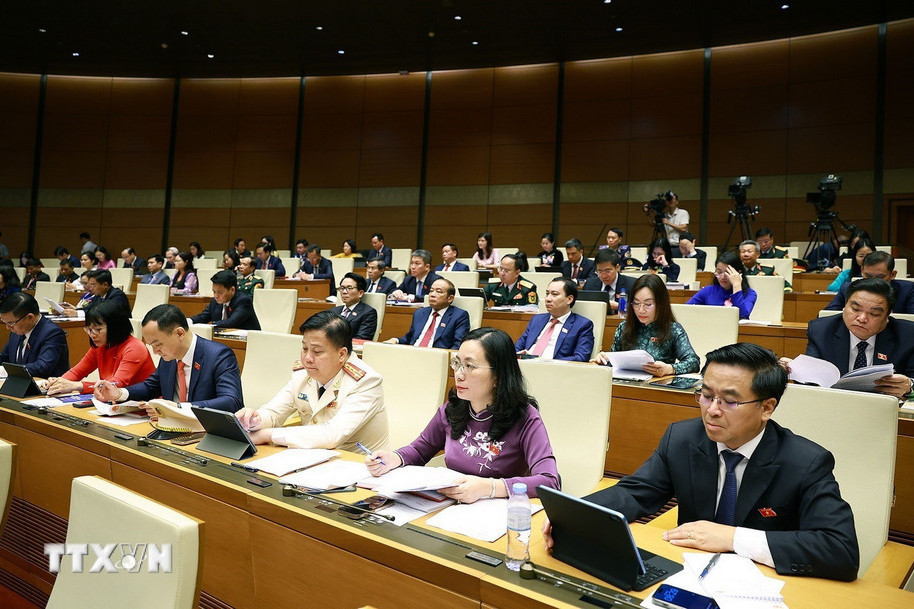
On April 6, when assuming responsibility as head of the 16th NA, Man made a term-long commitment: to continue innovative legislative thinking, to be “prudent in method but decisive in action,” and to focus on completing the institutional regime so the country can achieve fast and sustainable development, meeting the demands of international integration.
He affirmed that the NA will match words with actions, act immediately, act correctly, act effectively, and act to the very end.
Amid the solemn atmosphere of the hall, this was not merely an inaugural statement by an individual, but also a political promise for the entire new NA term to the people and the business community. To put the country into a high-growth trajectory, there must first be an institutional runway that is wide enough, clear enough, and safe enough for development.
The directive speech of Party General Secretary To Lam at the opening session of the NA set the vision for institutional reform of this term.
He requested that the legal system truly become the institutional foundation of development, a tool to protect human rights and citizen rights, and a driving force to promote innovation, release productive forces, and open new development spaces for the country.
The General Secretary remarked that although the legal system has been significantly perfected, there is still a state of overlap, contradiction, and lack of connectivity. There are regulations that are not clear, not stable, and have not kept up with reality, increasing compliance costs, slowing development opportunities, and making things difficult for the people, businesses, and the enforcement agencies.
Therefore, the NA needs to direct a total review of the legal system, perfect the structure of the national legal system, and resolutely overcome the situation of "constricting laws," overlaps, and pushing responsibility to sub-law documents. It must be ensured that laws, once enacted, enter into life, are easy for the people to understand, easy for businesses to implement, and easy for state agencies to apply.
In particular, the General Secretary stated that there must be a fundamental innovation in law-making thinking toward constructive development. Laws are not just managing what already exists, but also opening the way for new things; not just adjusting existing reality, but also constructing the future. It must not only "open the road" but also "repair the road."
For new issues, new fields, new models, and new productive forces, there needs to be an appropriate approach, boldly piloting with control, creating room for innovation, and enhancing national competitiveness. The legislative process must be truly scientific, democratic, and transparent, listening to the voices of experts, scientists, international experience, businesses, and people.
The General Secretary said that every law must stem from the national interest, from the legitimate interests of the People, resolutely preventing and combating group interests and local interests, and all negative impacts that distort policies.
There must be a strong shift from the mindset of "making enough laws" to the mindset of "making laws for development"; from "good law on paper" to "good law in life”. The effectiveness of implementation and the satisfaction of the people and businesses must be the highest measure of legislative quality.
Placing those two speeches side by side, the role of the 16th NA appears very clearly: The NA designs the institutional runway for a new growth cycle of the country.
Strong will
This becomes even clearer when looking back at the Conclusion of the Second Conference of the 14th Party Central Committee on April 2 regarding the Socio-Economic Development Plan, national finance, public debt borrowing and repayment, and medium-term public investment for the 2026–2030 period, associated with the goal of striving for "double-digit" growth.
Accordingly, institutional reform is placed in the position of a breakthrough growth driver, directly linked to the goal of striving for "double-digit" growth. The overarching spirit is to build a modern and competitive developmental institutional system that will establish a new growth model, support the restructuring of the economy, and promote industrialization and modernization.
A very noteworthy highlight is the strong shift of the state management method from "pre-inspection" to "post-inspection," associated with a system of standards, regulations, and implementation monitoring, while changing the measure of legal effectiveness from "good in text" to "good in life," taking compliance costs and the level of convenience for people and businesses as the substantive criteria.
Tu Giang
.svg)
