 Vietnamnet.vn

 Podcast



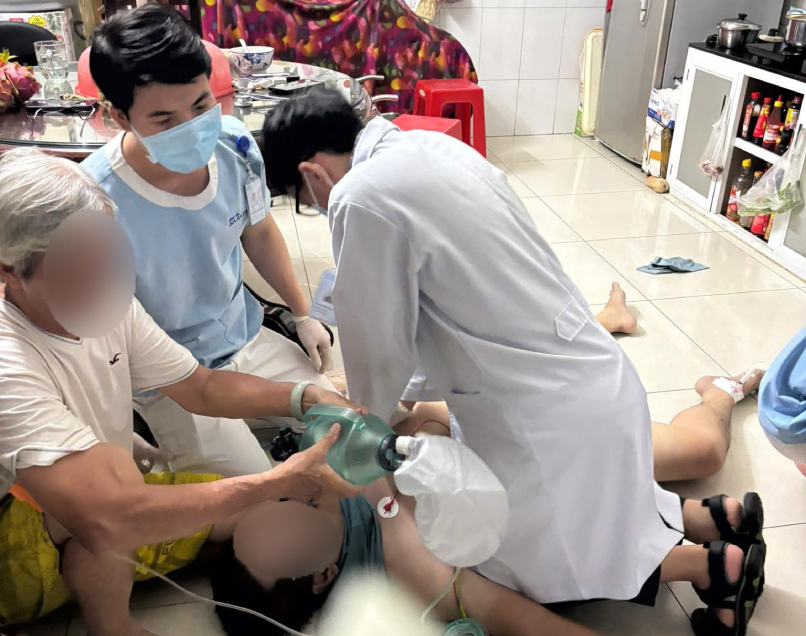
Dr Nguyen Thang Nhat Tue, who worked at HCMC 115 Emergency Center and is now Head of the Emergency Department at Gia An 115 Hospital, HCMC, said that in nearly 20 years of practice, there have been many times he had to tell families words that are never easy, like: 'We did everything we could…'
In the emergency room, where every minute and second can decide life or death, every doctor must may face breaking bad news about a patient’s condition to the family.
For doctors, no monitor alarm is more frightening than stepping out of the emergency room door, taking off a mask, and looking into the hopeful eyes of the patient’s relatives while the whole team has reached its limit. That is when doctors understand that bad news about the patient can shatter their loved ones.
And for Dr Tue, the hardest situations are when he must say what he does not want to say about children, young people, or cases where relatives die too suddenly.
Once, a young man was brought to the hospital by his family after he tried to commit suicide. The emergency team performed chest compressions, taking turns doing resuscitation for hours, but the patient did not survive. When the doctor stepped out to inform the family, the mother nearly collapsed to the floor.
She wailed, kept calling her son’s name, and rushed toward the emergency room as if she could not accept the truth. A moment later, the mother suddenly went silent, her eyes vacant, staring into space.
“Seeing the mother like that, I didn’t know what else to say,” Dr Tue recalled, adding “I could only offer words of comfort because I felt their pain.”
Those moments always leave a heavy feeling for emergency doctors because behind each case is a family, and a life that just ended.
Another case that still haunts Dr Tue today involved a 20-year-old girl with congenital heart disease who suffered cardiac arrest at home. When the emergency team arrived, doctors took turns doing chest compressions. At one point her heart started beating again, giving everyone hope.
The patient was moved to a stretcher to be taken to the hospital for further treatment. But then, an unexpected event happened. The girl went into cardiac arrest a second time. The doctors kept doing compressions in the ambulance late at night; no one gave up. The father sat beside her, quietly watching his daughter, then said in a hoarse voice: “Doctor… I know my child’s time is up. You don’t have to try anymore.” Those words left the whole team silent.
“Hearing that, my heart felt so heavy. It felt like I had not fulfilled my duty even though I knew I had done everything possible. What troubled me most was that the father did not blame anyone. He put his pain aside to tell the doctors, as if he wanted to ease our pressure,” Dr Tue recalled.
Saying it a hundred times still doesn’t make it familiar
In emergency medicine, the line between life and death is sometimes so thin that one small event can change everything. And doctors face that fragile moment every day.
With nearly 20 years in the field, Dr Tue believes delivering bad news is not just conveying medical data. It is a special communication skill that requires great empathy.
“If I’m too cold, the family will feel abandoned. But if I’m too emotional, I can’t stay clear-headed,” he said.
According to Dr Tue, not everyone can do this well from the start. Young doctors often feel huge pressure facing patients’ families. Sometimes just one poorly chosen phrase can make the pain of those left behind even more intense.
That is why, in severe cases, experienced doctors are usually the ones who speak directly with the family.
“This is a skill learned over time, and it’s not in textbooks. Each time I go through a situation, I learn more about choosing words, how to speak, and sometimes just the necessary silence,” he shared.
The hardest thing, according to Doctor Tue, is not telling the truth but choosing the right time to say it.
Some families still cannot believe the truth and cling to the last sliver of hope. Others panic to the point they cannot hear anything. So doctors must carefully observe the family’s mental state before speaking.
Phuong Thuy
.svg)
