 Vietnamnet.vn

 Podcast


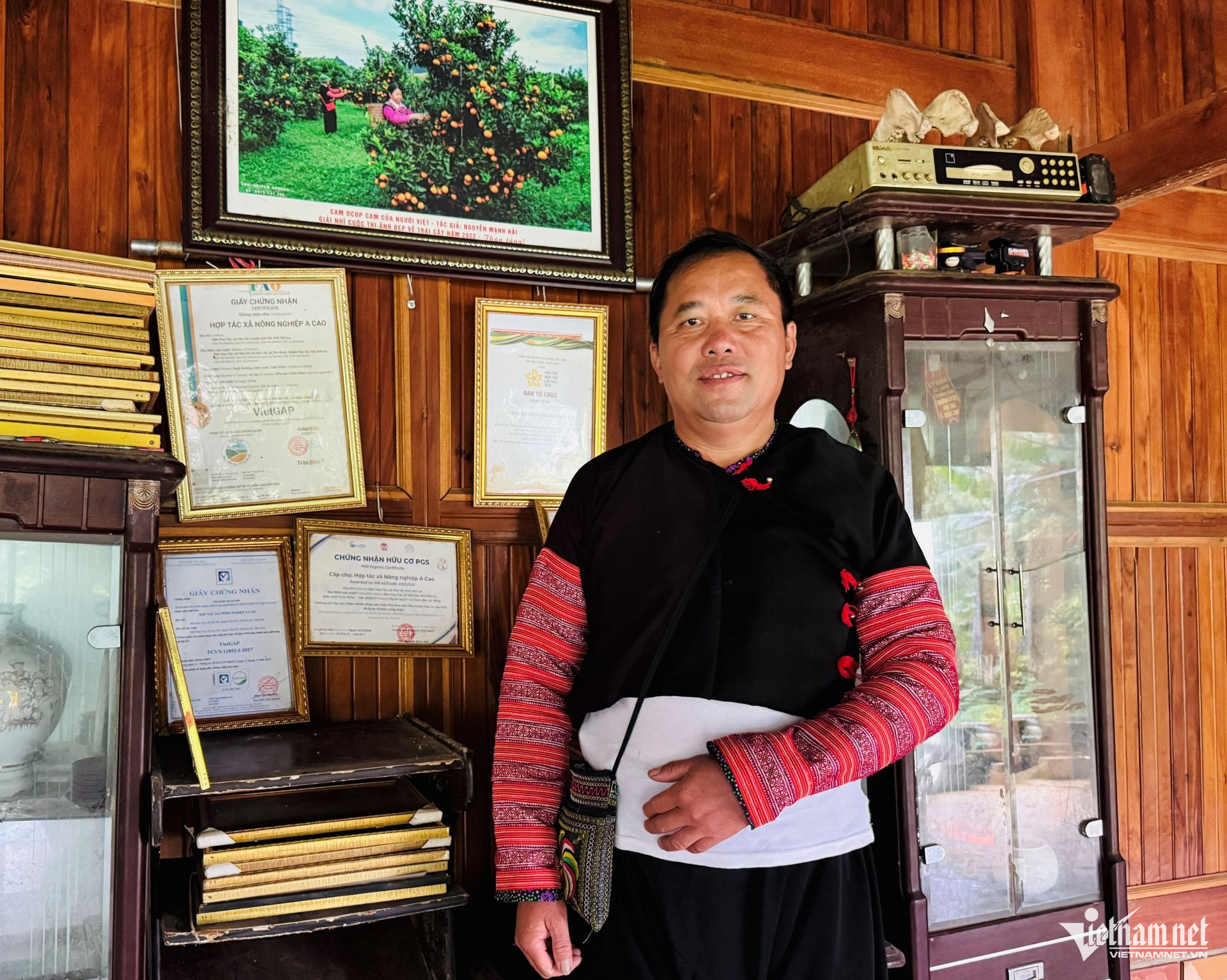
In 2018, while serving as Party Cell Secretary and head of Hua Tat Village, Cao made a decision that astonished the entire community. He resigned from his village administrative posts to dedicate himself entirely to founding the A Cao Agricultural Cooperative, boldly transitioning to organic agriculture.
Previously, routine spraying of chemical herbicides and pesticides was deeply ingrained in local agricultural practices. Since Cao’s cooperative model was launched and proved effective, the awareness of the Mong people in Hua Tat has shifted dramatically.
Villagers now understand that taking one step back allows them to take three steps forward. Accepting lower yields during the initial two years to clean the soil ensures agricultural produce commands higher value and achieves sustainable sales later on.
A Cao Cooperative brings together seven Mong member households managing a combined cultivation area of 15-20 hectares. All participating households have escaped poverty, generating an average annual income ranging from VND500 million to VND600 million.
Cao’s family bought three 2.5-ton trucks to transport clean produce directly to reputable food store chains in Hanoi and northern provinces.
Beyond selling fresh fruit, A Cao Agricultural Cooperative targets deep processing of herbal products, such as concentrated shampoos and body washes made from perilla leaves and sai dat (Wedelia chinensis), to increase value-added output.
Tilling land amid water scarcity, power shortages
Situated on steep highland terrain, Hua Tat frequently faces prolonged water shortages. From February to April annually, dry weather causes underground water sources to drop precipitously.
Furthermore, power infrastructure presents a major challenge, as the local electrical grid has not been upgraded over the years.
Cao calculated that relying on traditional overhead sprinkler irrigation would exhaust stored water reserves quickly. So he built 10-cubic-meter water storage tanks and installed water-saving drip irrigation systems.
"This method conserves every precious drop of water, eliminates the need to run electric pumps for extended periods, and saves significant labor spent carrying water manually," Cao shared.
The microbial remedy
Initially, Cao experimented with plum trees and more than 1,000 red-flesh and Dien pomelo trees. However, because Hua Tat has a cool climate, the pomelos turned out sour when harvested and fetched very low prices.
He decided to cut down all 1,000 pomelo trees, drawing a hard-earned lesson: “Don’t force the land to grow what you want. Grow what nature wants to nurture.”
He then switched to fruit varieties better suited to the local soil and climate, including Canh oranges, sweet tangerines, pears, crisp persimmons and improved avocado varieties such as 034 and Booth. He also intercropped tree tomatoes sourced from Da Lat to create a scenic landscape for visitors seeking hands-on experiences.
Thanks to its naturally rich sweetness, all 20-30 tons of tangerines from the orchard were later purchased by visitors and clean-produce stores within just a month and a half.
The most distinctive aspect of Trang A Cao’s farming methodology is his creation of "nature-aligned" microbial formulas derived from traditional Mong folk knowledge.
Instead of spending VND3-5 million per toxic chemical spraying session, Cao brews his own pest-repelling "vaccine" by fermenting galangal, pseudo-ginseng (tam that), female ginseng (Angelica sinensis), and rice wine starter, combined with microbes cultured from yogurt, molasses, and fish protein.
When sprayed, this herbal preparation does not eradicate insects indiscriminately; instead, it repels pests while protecting worker health and the surrounding ecosystem.
Additionally, he adheres to a principle of "coexisting with weeds." A Cao Agricultural Cooperative strictly avoids chemical herbicides, opting to clear grass using mechanical mowers three times a year.
The cut grass decomposes naturally into a thick, porous organic mulch, preserving soil moisture on sloped hillsides, preventing erosion during rainy seasons, and providing habitats for natural predators like ladybugs, spiders, and grasshoppers.
Evaluating A Cao Agricultural Cooperative’s model from the perspective of the Agroecology Learning Alliance in South East Asia (ALiSEA), Dr. Pham Thi Thu Huong, an agronomist at the Field Crops Research Institute, said: "The persistence of the Mong community alongside Cao in abstaining from chemical herbicides, formulating herbal microbial solutions from galangal and pseudo-ginseng, and applying water-saving drip irrigation represents a highly valuable innovation."
“Cao’s perseverance proves that when health is restored to the soil, the soil repays with the sweetest, healthiest produce," she said.
Binh Minh

