 Vietnamnet.vn

 Podcast



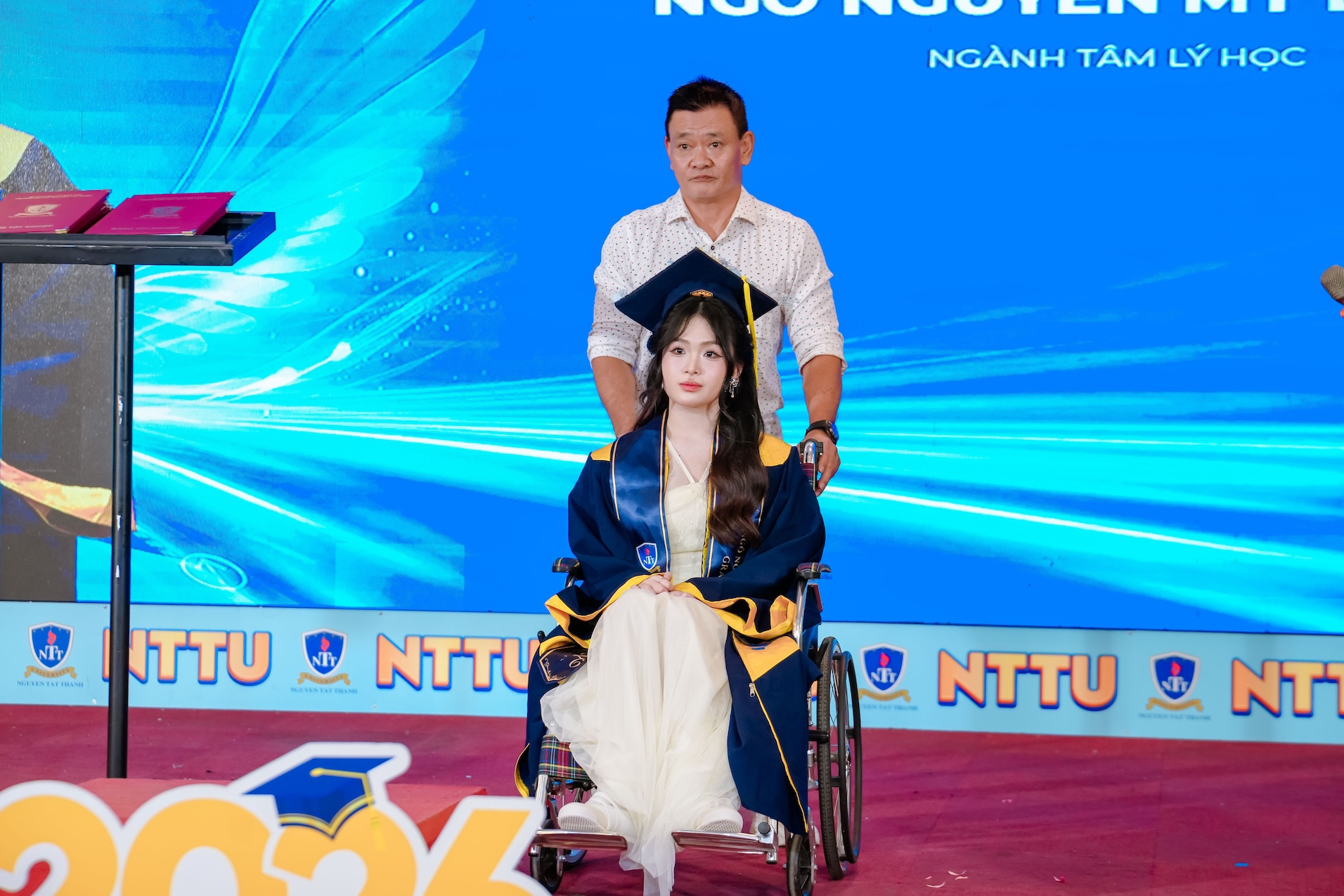
This time, the father did not merely drop his daughter off at class, but pushed her wheelchair onto the stage to receive her university degree together.
Ngo Nguyen My Duyen of HCMC recently received her diploma from Nguyen Tat Thanh University while sitting on her wheelchair alongside her father.
At around 18 months old, Duyen faced mobility difficulties. From then on, the girl's journey to school always featured her father's silhouette. From her early school days through primary, secondary, and high school up to university lecture halls, Dung remained her primary driver.
"Carrying her by motorbike was strenuous enough, and I had to haul a bulky wheelchair behind. On rainy days or during traffic jams, I had to exercise extra care so we both reached school safely," Dung recalled.
Yet what worried him even more was the fear that mobility hardships might one day force his daughter to drop out. "I simply thought, as long as Duyen still wants to study, I will make every effort to take her, no matter how hard it gets," he said.
While the father handled taking their daughter to school, Duyen's mother assumed daily caretaking duties. Husband and wife divided tasks, enabling their daughter to sustain her education like her peers.
Writing challenges
Entering university, Duyen encountered a different challenge. Weak hands caused her to write slowly, making essay exams a race against time. In several courses, Duyen grasped the material well, but worried about lacking time to present everything she knew.
Rather than dwelling on facing greater difficulties than others, Duyen focused on implementing tasks. Question by question, line by line, module by module, she gradually overcame them all.
Navigating campus grounds proved inconvenient at times, so lecturers and friends frequently provided support when needed. Yet that support did not imply Duyen sought priority or reduced academic requirements.
Dr. Le Thi Hang, Head of the Department of School Psychology and Organizational Personnel at Nguyen Tat Thanh University, said: "During lectures, Duyen was very proactive, showing no hesitation or self-consciousness. She actively spoke up and contributed to lessons. In group work, Duyen also contributed to completing joint assignments."
According to the lecturer, Duyen never treated her circumstances as a reason to demand special favor. She strived to complete all program requirements.
A degree for two
Following years of dedicated study, Duyen officially received her Bachelor's degree in Psychology.
"I remember the image of the father carrying his daughter to school and picking her up every day, rain or shine. The moment father and daughter stood on stage together, I felt that degree was not merely Duyen's achievement alone," Hang recalled.
On graduation day, Duyen expressed gratitude to her parents, who had created conditions for her to study with peace of mind along an arduous journey. Duyen hoped her Bachelor's degree would bring joy to her parents. "To reach this day required immense effort and love from my family," Duyen said.
Following graduation, the young woman aims to find a working environment suited to her mobility conditions while continuing to hone her professional skills.
"I understand a Bachelor's degree is merely the starting point, and I still have much to learn. I hope to find a suitable environment to further my professional development," Duyen shared.
Duyen hopes that, one day, when people seek her out to share life difficulties, she will have sufficient knowledge and skills to listen, understand, and support them.
Nguyen Kim Hong, President of Nguyen Tat Thanh University, noted that presenting a Bachelor's degree in Psychology to a wheelchair-bound student evoked special emotions.
"Throughout four years, she persevered through difficulties to complete her studies. Upon receiving the degree, her hands were still trembling. I bent down lower, carefully placing the degree into her hands, because I understood how much effort she expended to earn that moment," Hong said.
That moment also reminded him of times he signed student withdrawal applications. Each time, he questioned himself and reminded colleagues to thoroughly review each student's circumstances.
"If students must stop purely due to financial or health difficulties, let us find every way to support them. Do not let any student leave because they feel uncared for," Hong said.
Le Huyen
.svg)
