 Vietnamnet.vn

 Podcast



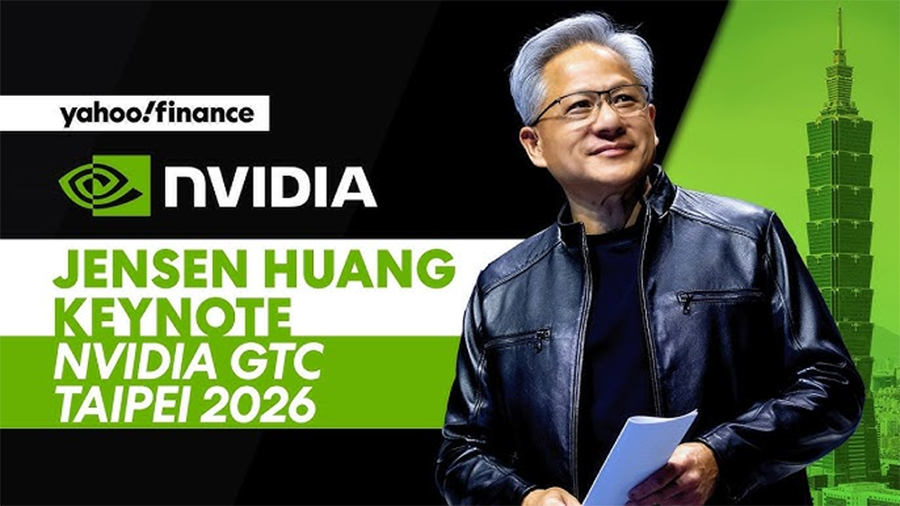
At a time when artificial intelligence is becoming the most important growth driver in the global technology industry, Huang’s presentation attracted intense attention from technology leaders, investors and developers worldwide.
Rather than focusing solely on new products, the Nvidia chief executive described a broader transformation in which AI systems can think, plan, act and generate measurable economic value.
Nvidia and Microsoft deepen strategic partnership
One of the biggest announcements from the event was Nvidia’s expanded collaboration with Microsoft to help build the next generation of personal computers.
At the center of this strategy is the RTX Spark Superchip, Nvidia’s newest processor based on the Blackwell architecture.
The chip is designed to power a future version of Windows capable of supporting AI agents - systems that can independently perform tasks on behalf of users rather than simply responding to commands.
According to Huang, tomorrow’s PC will no longer be a passive tool waiting for user input. Instead, AI will proactively manage tasks, gather information, analyze data, organize workflows and execute complex operations automatically.
The partnership also carries major implications for the PC industry. For decades, the Windows ecosystem has been dominated by processors from Intel and AMD. Nvidia’s deeper move into CPUs and AI-powered computing platforms could significantly reshape that balance.
The development may also increase competitive pressure on Apple, whose Apple Silicon processors currently enjoy a strong advantage in ARM-based computing.
The era of Agentic AI has arrived
A central theme throughout Huang’s keynote was Agentic AI - a new generation of artificial intelligence capable of reasoning, planning and acting independently.
While today’s AI chatbots primarily answer questions or generate content, Agentic AI is expected to move much further.
These systems can understand a user’s objectives, break tasks into multiple steps and complete entire workflows with minimal human intervention.
Huang argued that technology has reached an inflection point where AI is no longer merely a productivity tool but is becoming a true digital colleague.
Notably, Nvidia is embedding Agentic AI capabilities across nearly its entire product portfolio. From AI-powered PCs using RTX Spark to large-scale data center infrastructure, every major platform is being designed to support autonomous AI systems.
This transition represents a significant shift from the era of Generative AI toward what Nvidia describes as Action AI, where the real value comes from completing practical tasks rather than simply generating text or images.
AI is starting to deliver measurable profits
One of Huang’s most important economic messages was that AI has moved beyond experimentation and is beginning to generate tangible returns for businesses.
According to Huang, companies that successfully deploy AI - particularly Agentic AI systems - are already seeing significant improvements in operational efficiency and productivity.
Rather than merely saving time, AI is increasingly participating directly in revenue-generating activities, business optimization and workforce enhancement.
Huang described AI as a new form of economic infrastructure, comparable to electricity, the internet and cloud computing during previous technological revolutions.
He noted that properly implemented AI investments can now generate returns worth roughly three times their original cost, helping explain why major technology companies continue investing hundreds of billions of dollars in AI infrastructure and data centers.
Vera: Nvidia’s first CPU designed for AI
Alongside RTX Spark, Nvidia introduced Vera, a completely new CPU architecture built specifically for artificial intelligence workloads.
Historically, CPUs have been designed to serve human users performing tasks such as web browsing, gaming, content creation and office work.
Vera is different. It is designed for a world in which AI agents perform a growing share of computing tasks.
The processor uses Nvidia’s custom Olympus cores and features 88 high-performance processing cores.
It also incorporates Spatial Multithreading technology and LPDDR5X memory with bandwidth reaching 1.2TB per second.
The specifications highlight Nvidia’s ambition not simply to create a faster processor but to build a fundamentally new computing platform where AI becomes the primary user of the system.
Vera Rubin powers the next generation of AI infrastructure
Perhaps the most significant long-term announcement was Vera Rubin, Nvidia’s next-generation AI computing platform designed to succeed Blackwell.
Unlike products aimed at consumers, Vera Rubin is built for major technology companies, enterprises and hyperscale data centers.
According to Nvidia, it is the company’s first AI infrastructure platform developed entirely around the requirements of Agentic AI.
The system is designed to handle the rapidly growing computational demands of next-generation AI models, which require enormous amounts of processing power, networking bandwidth and energy.
Nvidia revealed that Vera Rubin has already entered full-scale production.
Several major AI companies, including OpenAI, Anthropic and SpaceX, are reportedly among the first organizations expected to deploy the platform.
Taken together, Huang’s keynote underscored how Nvidia is evolving beyond its traditional identity as a graphics chip maker.
The company is increasingly positioning itself as the architect of global AI infrastructure, spanning personal computers, specialized processors, data centers and autonomous AI ecosystems.
Hai Phong
.svg)
