 Vietnamnet.vn

 Podcast



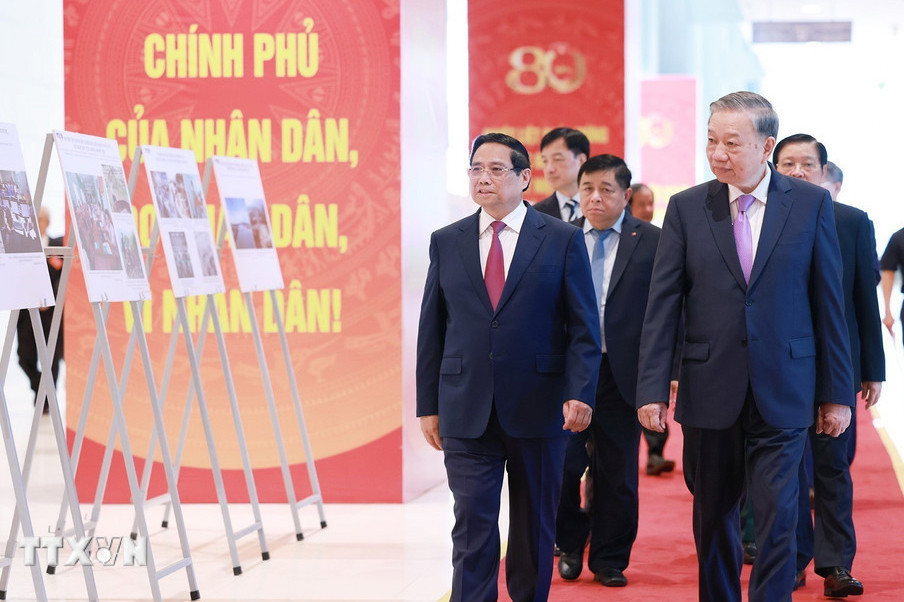
Prime Minister Pham Minh Chinh affirmed that throughout the past 80 years, the Government has consistently acted for the nation and its people.
The unbroken thread guiding every administration has been a steadfast principle: to take the people as the foundation, recognizing citizens and businesses as the center and driving force of all activities.
1945: Securing food and literacy for the people
On August 28, 1945, the Provisional Government was born in a perilous situation. The national treasury was empty, and the country was surrounded by enemies. Instead of clinging to power, the first Government chose to go directly to the people’s hearts: launching the “Eliminate Hunger” movement with “Rice jars to save the hungry,” the “Eliminate Illiteracy” campaign with mass literacy classes, and the “Gold Week” donation drive, which collected 370 kilograms of gold for the young nation in a short time.
Beyond food and literacy, the Provisional Government also organized the first general election on January 6, 1946, allowing citizens to elect their own National Assembly, which by November that year passed the first Constitution of the Democratic Republic of Vietnam. From the outset, the Government made clear that “the people are the root,” entrusting them with the right to decide the nation’s destiny.
In wartime: The people as the decisive force
During the decades-long resistance wars against France and the US, one truth became undeniable: the people’s strength is invincible. Guided by the Party and President Ho Chi Minh, the Government mobilized not only the military but also the people’s will and daily life through movements such as “All-people resistance, comprehensive resistance,” “Three readies,” and “Three responsibilities.” Every citizen became a soldier, every village a fortress.
When victory at Dien Bien Phu resounded across the world, and when the country was reunified on April 30, 1975, these triumphs were not just military victories but the achievements of the entire nation. The Government had succeeded in awakening and channeling the people’s power.
Doi Moi reforms: Returning rights to the people
After the war, the centrally planned system left Vietnam in crisis, with widespread hunger and poverty. Faced with survival, the Government once again turned to the people for solutions.
Directive 100 (1981) and Resolution 10 (1988), known as “Khoan 10,” returned land-use rights to farmers. As the Prime Minister recalled, “From a nation struggling with hunger, Vietnam became self-sufficient in food and began exporting rice just one year after Khoan 10 was implemented.” Trusting the people and restoring their rights transformed agriculture into the launchpad that turned Vietnam into one of the world’s leading rice exporters.
Thus, Doi Moi was not merely a shift in management systems but a historic political decision: to place faith in the people.
Integration and development: Businesses at the center
Entering the era of international integration, the Government extended the principle of “people at the core” to the economy, treating businesses as the central actors of development. The Prime Minister stressed: “Resources stem from thinking, motivation comes from innovation, and strength comes from the people and enterprises.”
From a country under embargo, Vietnam has risen to be among the world’s top 15 investment destinations and in the top 20 trading nations. These achievements were not the work of a rigid bureaucracy but of a Government that cut red tape, stood alongside entrepreneurs, and treated them as partners in nation-building.
Today’s Government: Acting decisively for the people and businesses
In its current term, the Government is implementing unprecedented administrative reforms: streamlining the apparatus, abolishing district-level governance, and establishing a two-tier system. The ultimate goal is not simply cost reduction but to ensure faster, more efficient service for citizens and businesses.
The Prime Minister declared: “For the people and enterprises: no refusals, no excuses, no promises without action. For the work: dare to think, dare to act, dare to take responsibility for the common good.” This has become both a declaration of action and a code of discipline, requiring officials to measure success by the satisfaction of the people.
Tangible results are evident: over 334,000 substandard houses eliminated five years ahead of schedule; administrative procedures significantly shortened; and strategic infrastructure projects – including high-speed rail, the Ninh Thuan nuclear power plant, and the North-South expressway – pushed forward to open new avenues for development.
Taking the people as the foundation – the source of future strength
The Prime Minister affirmed: “The revolution is by the people, of the people, and for the people. Citizens and businesses must be the center and driving force of all Government activities.” This is not only a lesson from history but also a guiding principle for the future.
Governments may restructure and reform, but the immutable principle remains: every policy and every action must serve the people’s interests and business growth. If the Government of 1945 secured food and literacy for survival, the Government of today strives for prosperity, strong enterprises, and a powerful nation.
Eighty years of Government – from the Provisional Government of 1945 to today’s reform-driven administration – form a continuous journey guided by the philosophy of “taking the people as the root.” The lesson of 1945 was that “a hungry people cannot sustain a nation.” Today’s lesson is that without the people and without enterprises, there can be no sustainable development.
The Prime Minister delivered a clear message: “I call upon all compatriots, soldiers, overseas Vietnamese, and the business community to uphold patriotism, self-reliance, and resilience, joining hands with the Government to build a strong, democratic, prosperous, civilized, and happy Vietnam.”
This is the pledge to the people: that the Government, today and in the future, will always act for the people, with the people, and alongside the people in shaping the nation’s future.
Lan Anh
.svg)
