 Vietnamnet.vn

 Podcast



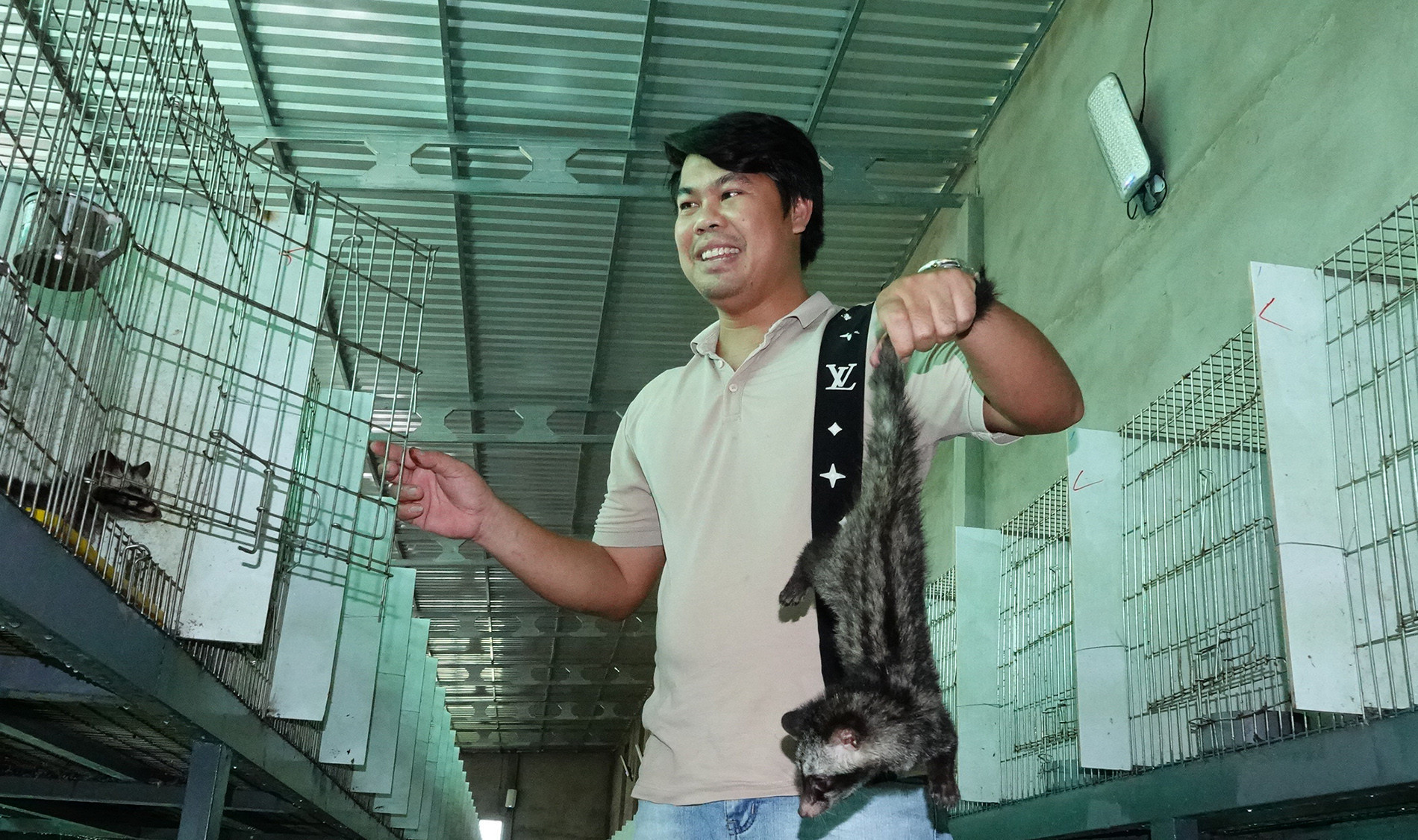
Hung, 41, from Phung Hiep Commune in Can Tho, previously operated a garment workshop in HCMC. His business acted as a third-party contractor, taking outsourced orders from larger companies.
Although the workshop generated a substantial monthly income, Hung said the business was constantly exposed to risks.
“The business was highly stressful because everything depended on customers. During disease outbreaks, operations stalled completely. The biggest concern was delayed payments, frozen receivables, and sometimes even bad debts,” he said, explaining why he became disillusioned with urban business life.
Leaving the city
In 2019, after noticing that a small group of civets he had been raising experimentally at home reproduced successfully, Hung made a bold decision: he shut down his garment workshop and invested VND500 million in a new venture back in his hometown.
The move met with strong opposition from relatives and friends. At the time, many argued that he had no livestock farming experience and was risking his savings on an unfamiliar wild animal species.
The transition was far from easy. Lacking experience, Hung initially purchased purebred wild civets, which failed to breed despite being raised for an entire year.
His farm also suffered from cross-infections that caused deaths and losses among the animals. At the time, breeding civets sold for more than VND20 million each, making the financial setback significant.
To overcome these challenges, he taught himself husbandry techniques and visited major civet farms around the country to gain practical knowledge.
After surviving the difficult start-up period, the business quickly began delivering results. By the second year, the operation was generating steady profits. As local residents saw his success, many who had previously doubted the model began seeking advice and following his example.
To date, Hung has expanded the model into a Civet Farming Cooperative featuring four breeding facilities, maintaining over 500 breeding parents. The caging system is engineered under the "cages above, pond below" model, forging an airy space that helps curb disease outbreaks. The pond area underneath is utilized to raise fish and generate biological waste, establishing a closed-loop cycle.
Hung said what satisfies him most is that the farm helps solve cash flow, which used to be a constant worry when doing business in the city.
“Most civet transactions are conducted in cash or paid immediately. Customers purchasing breeding stock pay on the spot, so there are no delayed payments. I also control both breeding stock and sales channels, which makes operations much more stable and secure,” he said.
Demand for breeding stock currently exceeds supply. The cooperative's main products include two-month-old breeding civets, priced at around VND10 million each, and mature breeding animals weighing about 6kg, which sell for VND50-60 million each.
In addition, rare color-variant civets with white or pale-yellow fur are highly sought after by buyers, fetching prices ranging from VND70 million to more than VND100 million per animal.
Hung revealed the operation generates annual revenue of several billion dong. In 2025, after deducting all expenses and labor costs, he recorded a profit of more than VND1 billion.
In addition to operating its own farms, Hung’s cooperative also purchases output from four satellite farms in the region.
The cooperative works with local authorities in Phung Hiep Commune to provide breeding stock and technical support to poor and near-poor households. It then buys back qualified animals, helping local residents improve their incomes.
Discussing future plans, Hung said he is surveying locations to expand the business with two additional large-scale farms next year.
Le Hoang Ba, vice chair of the Phung Hiep Commune People's Committee, described Hung’s business model as a local success story.
“Not only has he created wealth for himself, but the cooperative’s product-purchasing network has also supported the commune’s national poverty reduction program and efforts to improve rural incomes,” Ba said.
Ha Nguyen
.svg)
