 Vietnamnet.vn

 Podcast



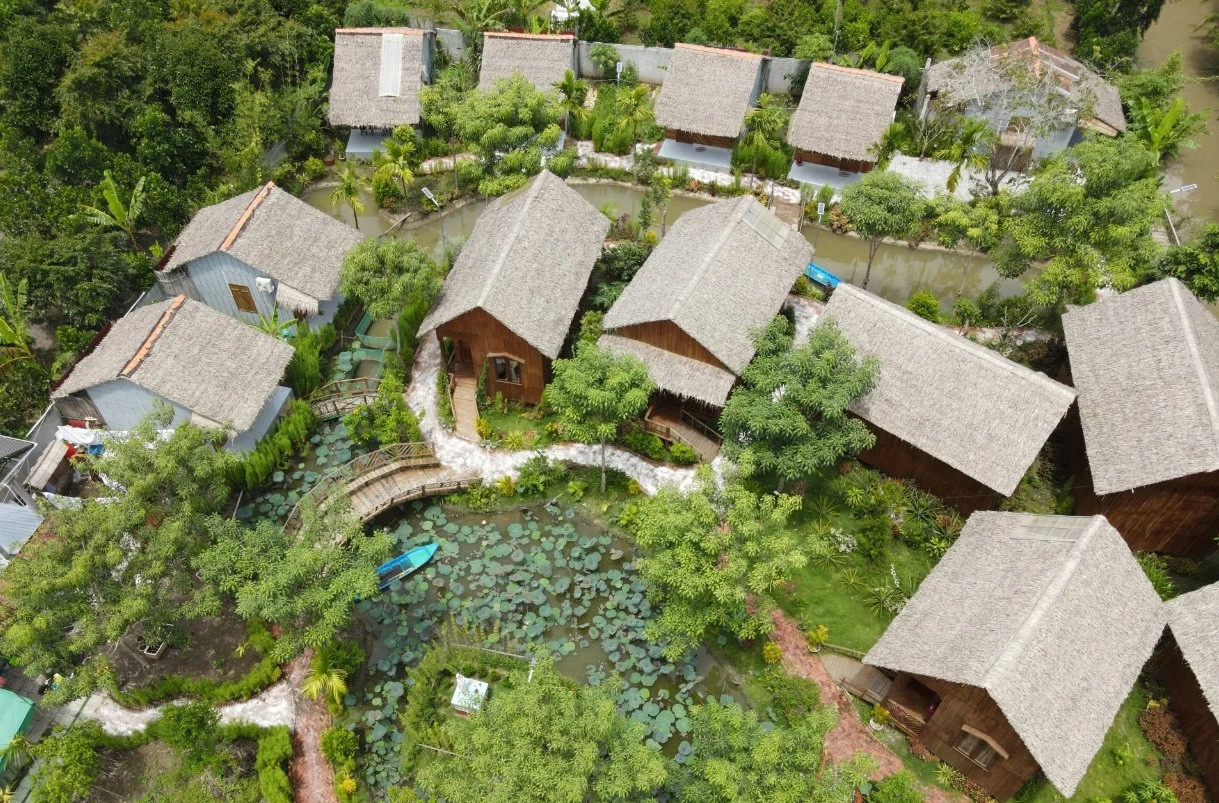
Refusing to chase after luxury resort styles, she chose to promote authentic local life, taking tourists on boat rides and guiding them to visit fruit-laden orchards.
Nguyen Nhu Huynh, 26, from Tan Hoa commune, Can Tho City, graduated with a degree in Business Administration from Can Tho University.
Prior to returning to her hometown to launch her business, Huynh worked an online part-time job for a company, managing human resources and personal development. Because it was only a part-time position, Huynh's income back then was not high, but it was sufficient to provide the young woman with a nice lifestyle in the city.
The turning point arrived when Huynh’s family constructed a homestay facility but lacked someone to stand up and manage and operate it. In 2021, she made a "bold" decision to start her business right on her home soil.
To secure her family's nod of approval, Huynh held a straightforward "negotiation" to erase the generation gap.
"There is a massive gap between traditional mindsets and modern thinking. I asked my family for permission to be the person with total decision-making power to operate according to new ideas, instead of following the old frameworks of the past," Huynh shared.
When getting her hands dirty with actual work, Huynh realized everything was not rosy at all. Lacking experience in the service sector and not knowing how to search for her very first guests, Huynh had to figure out everything by herself, from running social media advertisements to studying on the Internet.
Her family's homestay is located on the outskirts, far from the center, so it had fallen into a "limbo" state: it lacked the scale to become a high-end luxury resort, yet it differed from ordinary residential homestays. After much agonizing over the financial puzzle and local advantages, Huynh decided not to pursue luxury but chose to develop green tourism tied to orchard life and native culture.
Attracting international guests
Huynh preserved the green space of the orchard, limited concrete paving, and focused on tidying up the landscape. Tourists come here to experience the rustic Mekong Delta lifestyle with peddling boats, familiar street cries, and the gentle flows of the Xa No canal.
"In the beginning, I faced a mountain of difficulties, from finding guests to operations. Afterward, I learned while doing, listening to guests' feedback to adjust step by step," Huynh recounted. Since the homestay was invested in quite methodically, it also received media communication support from local authorities.
That very rustic and natural charm became a luxury "specialty" that attracts the customer segment Huynh targets - international tourists, who account for up to 90 percent of the guest volume at her homestay.
“International guests generally prefer experiencing native culture and life rather than luxury leisure. They want to witness the real life of the Mekong Delta, and that is our competitive edge,” Huynh shared.
To forge an impression on international tourists, Huynh does not do tourism alone but chooses to link up with the local community. She designs experiential tours via boats, bicycles, or motorbikes, guiding guests through small canal networks, visiting local households, traditional craft villages, rural markets, and fruit-laden orchards to harvest and taste fruits right on the spot.
The cuisine at the homestay is also meticulously cared for. The dishes are adjusted to suit the palate of the tourists while still retaining the signature traits of Mekong Delta cuisine, prepared by local residents themselves.
The generosity and friendliness of the surrounding neighbors resonate with a unique staff lineup, featuring energetic Gen Z youths alongside older local uncles and aunts.
“Not only the staff but even the neighbors around are very open to guests. Many tourists say they love the feeling of being welcomed like family members when coming to the Mekong Delta,” Huynh said.
Building livelihoods
After several years of operation, Huynh's green tourism model has proven successful. With 14 rooms, the homestay enjoys strong occupancy rates during peak season, which runs from November to March. On average, it fills around 8-10 rooms per day during this period.
Annual revenue before expenses is estimated at around VND1 billion.
Beyond generating income for her family, the business also creates livelihoods for nearby households by sharing visitor traffic and tourism opportunities. The homestay provides stable employment for seven local staff members.
Hoai Thanh
.svg)
