 Vietnamnet.vn

 Podcast



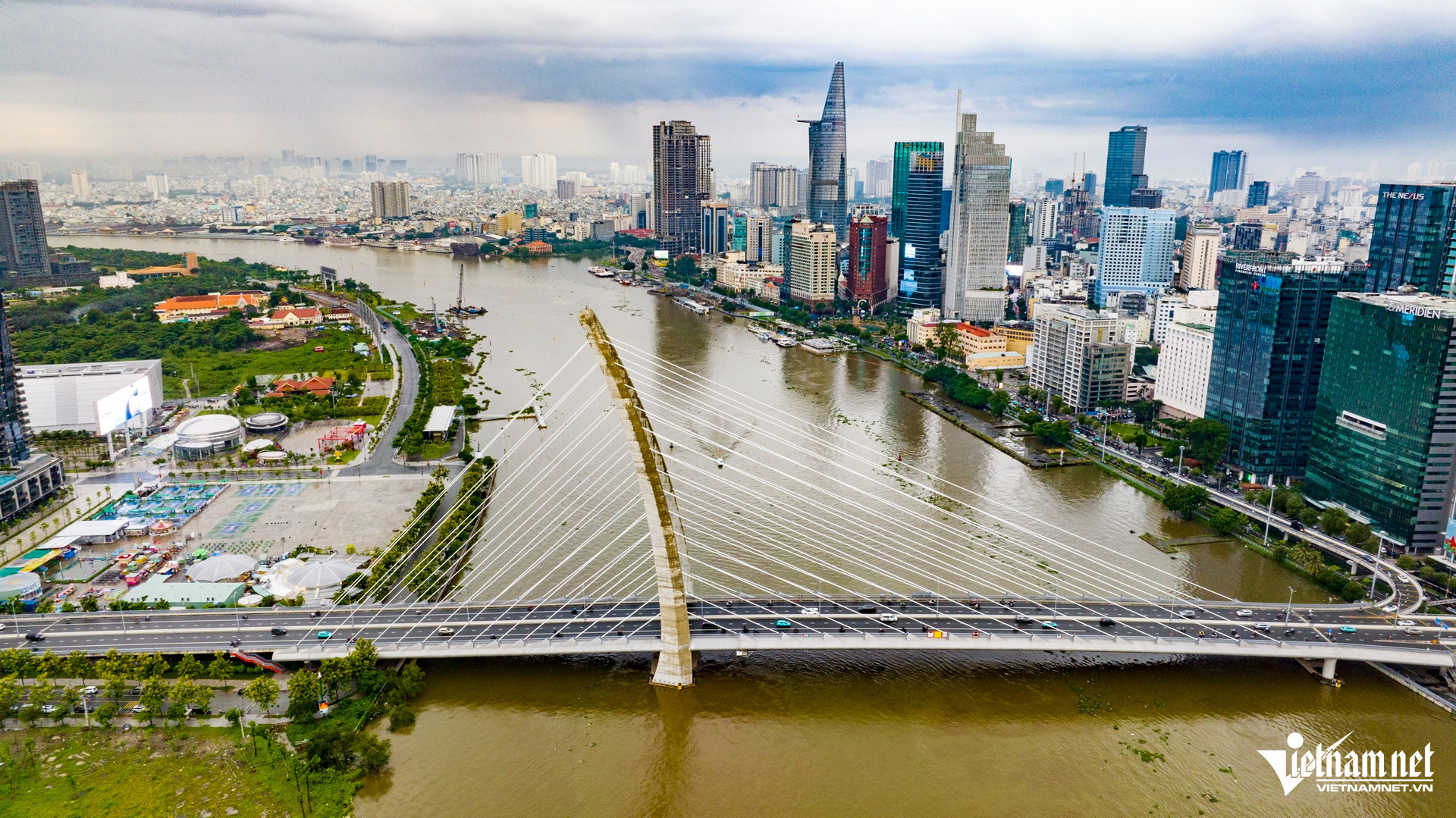
Anchored by the revised Resolution 260/2025/QH15, which amends and supplements several provisions of Resolution 98/2023/QH15 on piloting special mechanisms and policies for the city’s development, the municipal government and its citizens are confidently steering toward a breakthrough GRDP growth target of at least 10 percent in 2026.
In the early days of the Lunar New Year 2026, as a sense of urgency ripples across major construction sites and strategic projects in the city named after President Ho Chi Minh, the double-digit GRDP goal no longer feels like a dry statistical benchmark. It has become a demanding economic imperative. According to experts, for this giant economic engine to accelerate toward that target, nothing short of a revolution in public governance will suffice.
The city needs more than fuel
Looking at the current economic landscape of Ho Chi Minh City, Associate Professor Do Phu Tran Tinh, Director of the Institute for Policy Development under Vietnam National University Ho Chi Minh City, offers a pragmatic view of scale pressure. Once an economy reaches a certain size, he notes, each additional 1 percent of growth requires an enormous absolute increase in added value.
Ho Chi Minh City is now grappling with shrinking space for traditional expansion, while new drivers such as high technology and innovation continue to face obstacles.
Echoing this concern, Le Thanh Hai, Director of the Center for Economic Application Consulting at the Ho Chi Minh City Institute for Development Studies, warns of the so-called middle-income trap and persistently low labor productivity. “Current productivity levels are not strong enough to sustain 10 to 12 percent growth,” he says candidly. As advantages in low-cost labor fade, any delay in shifting toward a knowledge-based economy will inevitably stall growth momentum.
Strategic infrastructure remains uneven, and high logistics costs have become a barometer of the city’s competitiveness. Yet, experts argue that these visible challenges in infrastructure and human resources are only the surface. The real bottleneck lies deeper within the system’s operating core.
“To accelerate Ho Chi Minh City’s economic engine, the critical issue is not merely adding more fuel. It is about clearing the bottlenecks in the gearbox and operating system to generate new breakthrough energy,” Do Phu Tran Tinh observes.
When macro-level orientations are already clear and the business community stands ready, the final knot lies in execution capacity across both the public and private sectors. As Le Thanh Hai aptly puts it, if infrastructure and human capital represent the hardware, then implementation capacity is the operating system. To run the software required for double-digit growth, the operating system must be upgraded first.
Breakthroughs from sandbox mechanisms and endogenous resources
Institutional inertia often stems from fear of accountability and overlapping legal frameworks. To address this at its root, Do Phu Tran Tinh underscores the importance of protecting public officials. If those who act in accordance with proper procedures and public objectives are not safeguarded, the instinct for safety through inaction will prevail. Public investment decisions and pilot models will slow, and double-digit growth will remain little more than a slogan.
To turn the 2026 target into reality, experts propose an action-driven roadmap focused on unlocking resources currently frozen within the system. One bold solution is to activate the vast pool of public assets following administrative mergers. The city, Do Phu Tran Tinh suggests, should digitize these assets and design transparent exploitation models such as public-private partnerships, auctions or long-term leases, transforming dormant assets into development capital for infrastructure and the digital economy.
On the institutional front, establishing controlled pilot mechanisms, or sandboxes, is essential to prevent initiatives from becoming trapped in legal gray zones. Le Thanh Hai proposes the formation of special task forces endowed with exceptional authority to coordinate key projects, shifting the mindset from management to facilitation. At the same time, applying modern governance tools such as KPIs and OKRs, widely used in the private sector, to the administrative apparatus would help tie individual accountability directly to concrete growth outcomes.
Finally, to address the pressing talent shortage in strategic sectors such as artificial intelligence, data, semiconductors, cybersecurity and biotechnology, the city must move beyond piecemeal incentives. A more decisive approach is needed: building a comprehensive ecosystem for talent.
This includes competitive income, housing, world-class working and research environments, startup opportunities, robust computing infrastructure, open data and tailored mechanisms on taxation and visas. “Otherwise, the city will struggle to spark a wave of fast-growing technology enterprises. Talent comes when people see a thriving ecosystem, not merely an initial allowance,” Do Phu Tran Tinh emphasizes.
Achieving double-digit growth in 2026 is an ambitious destination, yet entirely attainable if Ho Chi Minh City is determined to upgrade its execution capacity. When the administrative apparatus truly becomes a partner rather than a gatekeeper, the city’s economic engine will naturally find the energy to surge past every barrier.
At its sixth session of the 10th People’s Council and subsequent conferences on socio-economic tasks, Ho Chi Minh City officially set a breakthrough scenario of over 10 percent GRDP growth for 2026. This confidence is grounded in the strong rebound of 2025, when growth is estimated at 8.03 percent, providing a solid runway for acceleration.
The city is now developing three flexible growth scenarios. The most ambitious, at 10 percent, rests on expectations of positive shifts in the global economy and, crucially, the early effectiveness of special mechanisms under Resolution 260, which amends and supplements Resolution 98.
At an early 2026 socio-economic review meeting, the city’s statistical authorities calculated that the total size of Ho Chi Minh City’s economy has reached approximately VND3 million billion, equivalent to roughly US$120 billion. To achieve the “colossal” target, the city must generate at least VND300,000 billion in additional value, or approximately US$12 billion, corresponding to 10 percent of its current scale. Meanwhile, total public investment capital allocated for 2026 stands at around VND150,000 billion, equivalent to roughly US$6 billion.
From this gap, city leaders stress that the state budget can only serve as seed capital. To reach double-digit growth, Ho Chi Minh City will need an extraordinary effort to mobilize non-budgetary resources, including social capital, corporate investment and foreign direct investment.
Quoc Ngoc
.svg)
