 Vietnamnet.vn

 Podcast



After initially studying information technology and realizing he had chosen the wrong direction, Ngo Khanh Hoa decided to retake the university entrance examination. What appeared to be a one-year delay became a source of motivation, helping him become both the entrance and graduation valedictorian of the Faculty of Physics at the University of Science.
Stopping in order to begin again
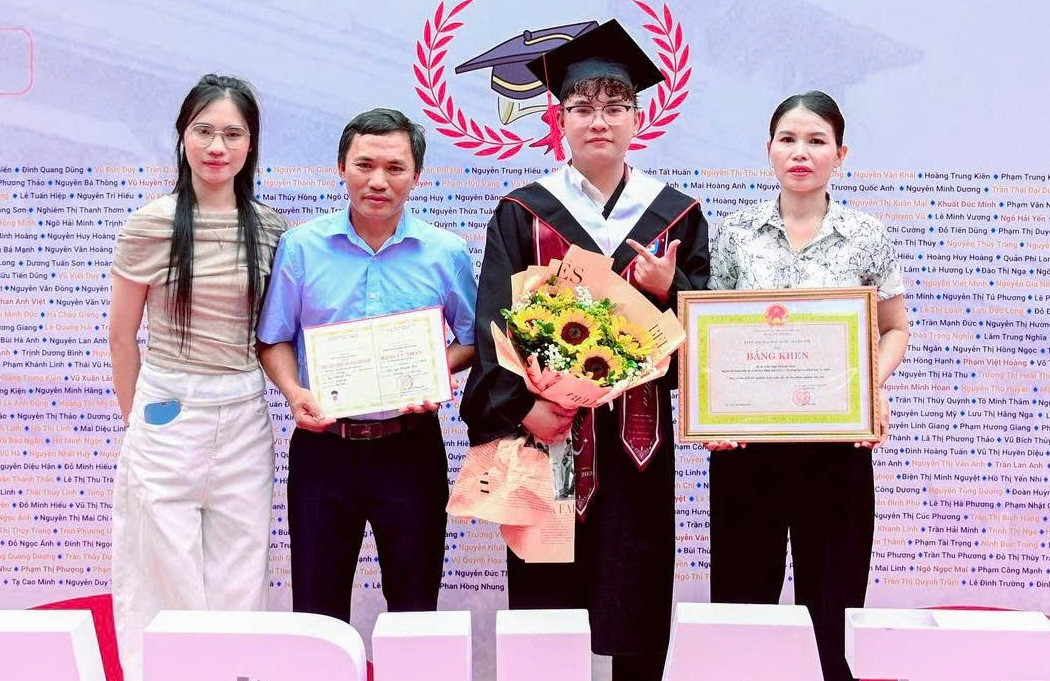
Ngo Khanh Hoa, born in 2003, has just graduated as valedictorian of the Faculty of Physics at the University of Science under Vietnam National University, Hanoi.
Four years earlier, he had also entered the faculty as its top-scoring student with 28.7 points. It was the second time the student from Bac Ninh Province had received a university admission letter.
In 2021, Hoa was admitted to an information technology program at another university in Hanoi. However, after one year of online study during the Covid-19 pandemic, he realized that the field did not truly suit his interests and began considering retaking the national examination.
After repeatedly struggling with concerns that he might disappoint his parents, Hoa decided to leave the university and focus on preparing for the examination.
He proactively contacted his former high school teachers in mathematics, physics and chemistry for guidance. Following their recommendations, he enrolled in online courses and developed his own study plan.
With only three months remaining before the examination, Hoa did not attempt to cram. Instead, he divided his preparation into three clearly defined stages: rebuilding fundamental knowledge, reviewing individual topics and problem types, and practicing full examinations and advanced application questions.
His determination and systematic preparation paid off. Hoa achieved an admission score of 28.7 and became the entrance valedictorian of the Faculty of Physics at the University of Science.
This time, he submitted only one university preference, choosing the Electronics and Informatics Engineering program.
"Electronics is like the 'body,' while programming is the 'soul' that controls the system. What I enjoy most is that I do not only write lines of code on a screen, but can directly see them operate electrical circuits that I designed myself," Hoa said.
Being one year behind his peers did not make Hoa feel inferior. Instead, he viewed the delay as motivation to begin university with greater focus and discipline.
From his first year, Hoa set a goal of performing well enough to earn scholarships while becoming financially independent and reducing the burden on his parents.
Over four years, he received more than VND250 million, approximately USD9,500, in scholarships and awards. He maintained a GPA of 3.76 out of 4.0 across all eight semesters and graduated with an excellent classification.
According to Hoa, these achievements did not come from innate intelligence, but from disciplined study habits.
Rather than memorizing selected material or learning by rote simply to pass examinations, he always tried to trace every circuit diagram and algorithm back to its fundamental principles in physics and mathematics.
Once he understood the underlying nature of a problem, Hoa said he could remember it for a long time and would not become confused when encountering unfamiliar question types.
He also maintained a habit of reviewing material immediately after every class.
Each day, Hoa spent 30-45 minutes going over his notes. Whenever he encountered something he did not understand, he immediately asked his lecturers or classmates.
As a result, by the time each examination arrived, he had already mastered most of the required material and could enter the exam room with a relaxed mindset.
Pursuing an academic career
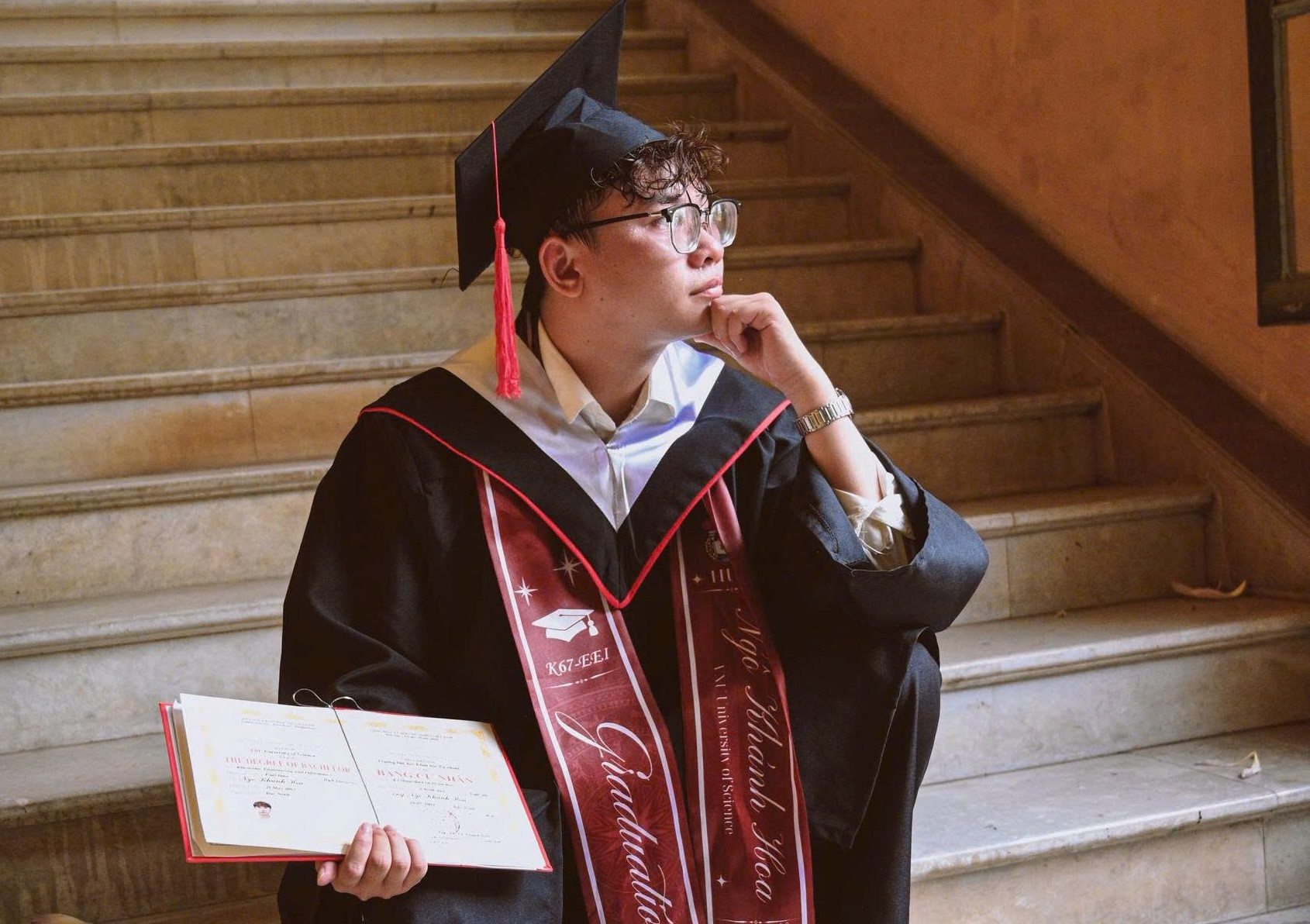
With guidance and inspiration from lecturers in the faculty, Hoa discovered a passion for scientific research toward the end of his second year.
Working in the laboratory not only allowed him to test the knowledge he had acquired in class but also helped him develop a research-oriented mindset.
"I came to understand that in science, there are no failed experiments, only new data," Hoa said.
Through this work, he became a co-author of an international paper published in a Q1-ranked journal.
His laboratory experience also changed his career plans.
Hoa had previously intended to graduate and work in an industrial park to secure a stable income. However, the deeper he became involved in research, the more determined he was to pursue an academic career.
"If I work for a company, I will operate technologies that already exist. Scientific research gives me the opportunity to create new technologies that can bring practical value to society," Hoa said.
After graduation, Hoa has chosen to remain in the laboratory to complete ongoing research projects while continuing to work as a private tutor to support himself financially.
His next goal is to pursue a PhD abroad in an interdisciplinary field combining electronics, information technology and biomedicine.
Hoa hopes that after gaining knowledge, research experience and an international academic network, he will return to Vietnam and contribute to the development of highly applicable biomedical devices that directly improve public health.
Thuy Nga
.svg)
