 Vietnamnet.vn

 Podcast



From a boy who loved mathematics to an International Mathematical Olympiad gold medalist and a PhD graduate from one of the world’s top 7 universities, Dr Can Tran Thanh Trung often speaks of Le Ba Khanh Trinh as the teacher who ignited his passion. That journey has also led him to a defining decision: to return home and contribute.
From IMO gold to a mathematics PhD at a top global university
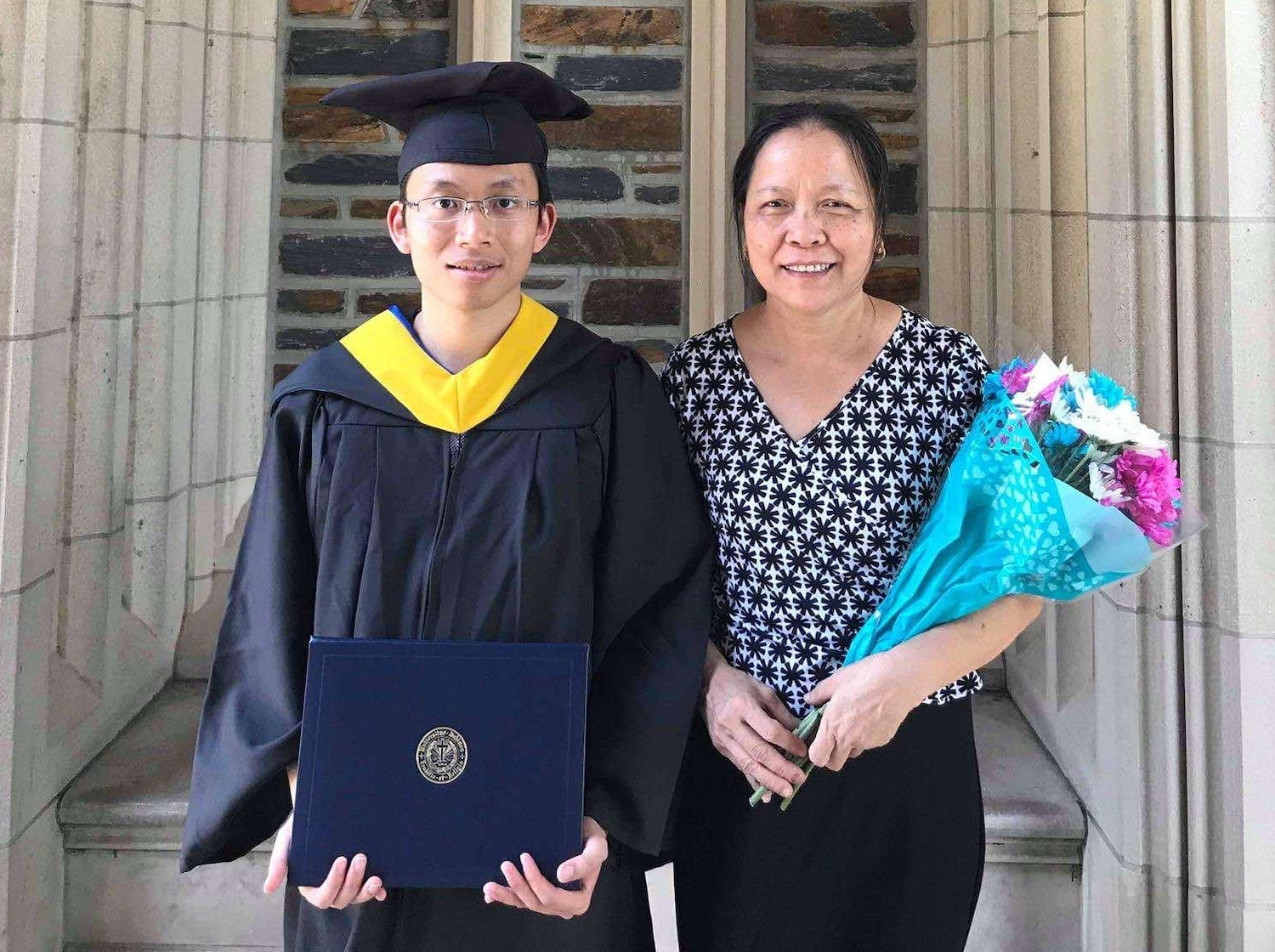
Born in 1995, Dr Can Tran Thanh Trung is an alumnus of the High School for the Gifted under Vietnam National University, Ho Chi Minh City, one of the country’s leading specialized schools. He grew up in a modest family - his father worked in national defense administration, while his mother, an electrical engineering technician, retired early to take care of the family.
His mathematical talent revealed itself early. In previous interviews, his mother recalled that even in kindergarten, he could mentally calculate problems given by teachers. “Because we did not recognize his gift early on, he was not systematically trained. In grade 8, he failed to make the math team at Nguyen Gia Thieu Secondary School in Ho Chi Minh City. He was very upset and begged me to ask his teacher to let him join because he loved math so much,” she shared.
The turning point came when he entered the High School for the Gifted. For Trung, learning mathematics is not about solving as many problems as possible, but understanding why a solution works. As a child, he often reused his older sister’s textbooks, and her handwritten notes in the margins became quiet lessons in reasoning.
Throughout his school years, he achieved numerous distinctions, including a fifth-grade math talent prize, a city-level prize in grade 9, a national second prize, a city third prize and a gold medal at the April 30 Olympic competition in grade 11. In grade 12, he was directly awarded the city’s first prize in mathematics.
In 2013, he won a gold medal at the International Mathematical Olympiad in Colombia. After graduating from high school, he received a full scholarship to Duke University, ranked among the top 10 universities in the US according to US News 2024, and graduated as valedictorian in mathematics in 2018.
He then pursued a PhD in mathematics at the California Institute of Technology (Caltech). According to THE 2024 rankings, Caltech stands seventh among the world’s best universities, while QS places it in the global top 10.
“The flame of Le Ba Khanh Trinh burns within me”
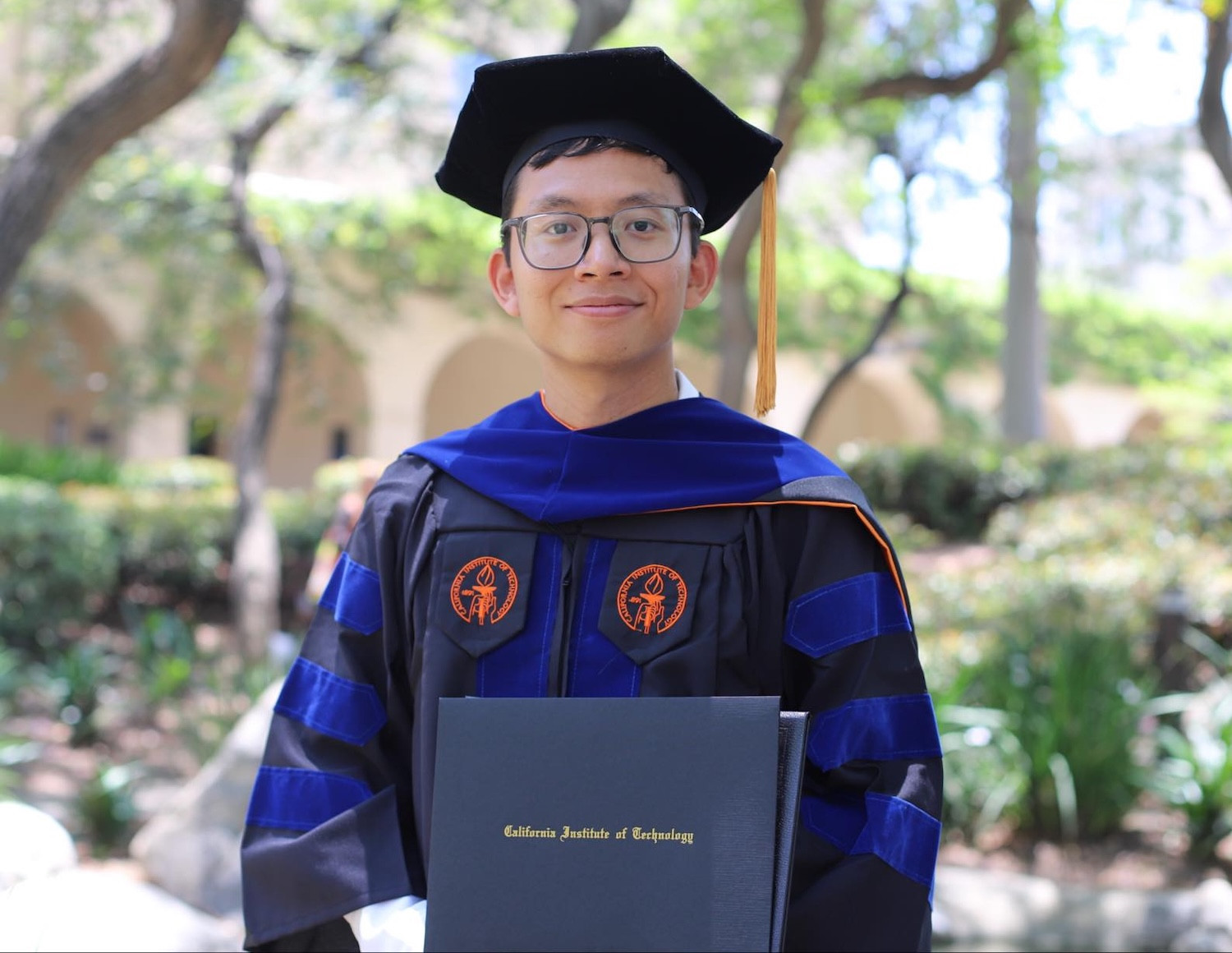
Dr Trung shared that 16 years ago, as a math major student, he was fortunate to study in an environment that fully supported his passion.
At the High School for the Gifted, he not only learned alongside talented peers but was also inspired by devoted teachers, especially Dr Le Ba Khanh Trinh, whose “legendary story” of a special solution at the 1979 International Mathematical Olympiad in London has long inspired generations.
“That story motivated me to nurture the aspiration to conquer similar heights, and eventually I had the opportunity to represent Vietnam at the 2013 IMO and win a gold medal,” Dr Trung said.
After nearly a decade of studying and conducting research in the US, what concerned him most was that the potential of Vietnamese students remains underutilized. In his view, young people in Vietnam are no less capable or passionate, but they lack early access to high-quality academic environments.
“Since 2015, Duke University has implemented a summer research program on big data for undergraduates and graduate students, attracting millions of US dollars in funding from businesses and local government. Such programs not only inspire but also equip research skills, shaping a new generation of experts in big data,” he noted.
In the context of the AI boom and hundreds of billions of US dollars invested in data centers worldwide, the demand for high-quality human resources is increasingly urgent. Yet the core issue, he emphasized, is not technology or capital alone, but early preparation of people.
“Nurturing talent is like planting a seed. With the right environment, proper guidance and enough time, the seed will grow strongly. Models like Duke’s show that systematic, early investment in people yields more sustainable value than any short-term funding,” he said.
Motivated by that belief and hoping to build a similar academic ecosystem in Vietnam, in 2016 he used his personal scholarship funds, along with support from students, graduate researchers and the University of Science, to establish the PiMA Summer Camp on mathematics and applications.
Over the past eight years, PiMA has introduced advanced content in machine learning, data science and bioinformatics to hundreds of high school students nationwide. Many alumni have gone on to pursue research at top universities worldwide or work at major technology corporations.
“Seeing them mature, find their direction and continue on the path of science makes me reflect more deeply on my own responsibility. Those initial results also led me to seriously consider returning long-term to contribute more to my homeland,” he shared.
In 2025, when faced with the choice of continuing his career in the US or returning to Vietnam, he learned about the VNU350 Program of Vietnam National University, Ho Chi Minh City - an initiative to attract and develop outstanding young scientists.
“This was both the starting point and the aspiration I wanted to realize,” he said. He applied and was selected as a lecturer at the Faculty of Information Technology, University of Science.
“Returning home, each day carries meaning for me. Beyond the new and challenging work, I have the chance to understand my homeland more deeply. After one year of teaching, I feel more confident and flexible. What brings me the greatest joy and pride is directly teaching and mentoring students - young people full of enthusiasm, eager to learn and ready to pursue their passion,” he said.
In addition, he participates in selecting and mentoring talented high school math students, inspiring those in regions with limited access to experts, and working alongside teachers he has long admired, including Dr Le Ba Khanh Trinh and Dr Tran Nam Dung.
“I cannot say that in grade 10 I already thought of ‘going far to return.’ But certainly, it was Dr Le Ba Khanh Trinh who lit in me the flame of passion for geometry and the spirit of dedication to the scientific path he chose,” Dr Trung said.
He believes that within each person lies a natural longing to return to one’s roots and witness the development of one’s homeland.
“I deeply admire the previous generation, those who quietly laid the first foundation stones for our nation’s science, such as Dr Le Ba Khanh Trinh, Professor Dang Dinh Ang, Professor Vo Van Toi and Dr Nguyen Thanh My. They show me a beautiful model of responsibility and perseverance in science,” he shared.
Le Huyen
.svg)
