 Vietnamnet.vn

 Podcast



From street vendor to scientist
Opening his talk with humor, Dr. Nguyen Thanh My joked: “Today, you - the professors and students - will be my victims, because I’ll be telling old stories. I hope you’ll forgive me.”
He shared that at his company, they regularly hold sessions discussing success, happiness, and fulfillment. Before reaching his own conclusions on those topics, he had asked many young people and employees for their insights and received some thought-provoking responses.
Reflecting on his past, Dr. My recalled a childhood of hardship, during which he juggled many jobs - selling ice cream, working on buses, hawking goods at flea markets, and even playing football for hire.
By the age of seven, amidst the ravages of war, he was already helping his mother support five siblings.
He said his motivation for studying was simple: to make his mother proud, to avoid conscription into the army of the old regime, and to build a better future. Passing his high school exams was the first great joy he ever gave his mother.
To pay for school, he continued doing odd jobs, including selling rice, fish, and shrimp, and working as a laborer and footballer-for-hire. These experiences, he said, deepened his understanding of life, community, and patriotism.
From Vietnam to Canada and then to groundbreaking innovation
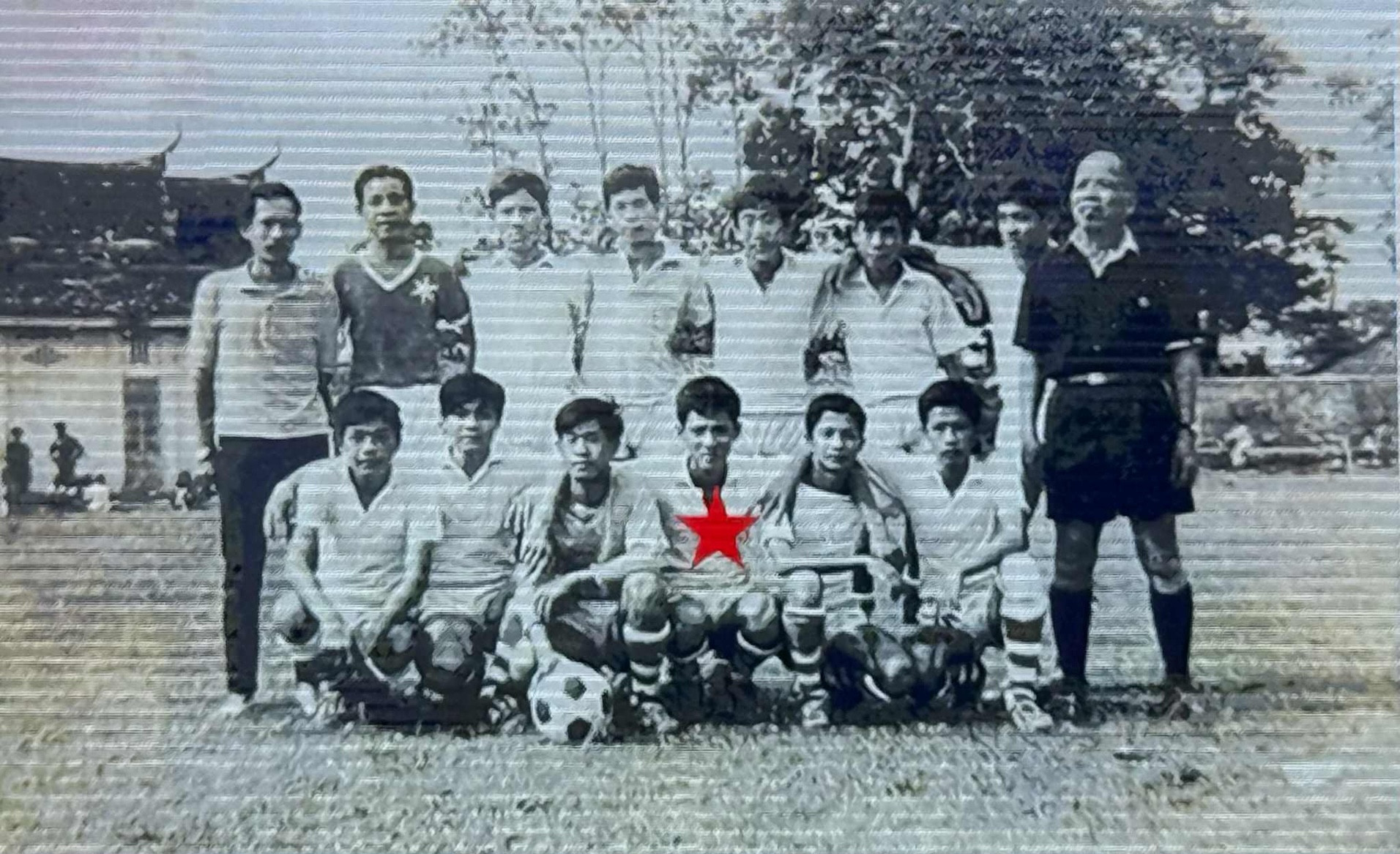
Dr. Nguyen Thanh My as a young footballer-for-hire. Photo: NVCC
After graduating in organic chemistry from Ho Chi Minh City University of Technology in 1978, he initially worked as a contract football player for a plastic factory.
“I studied chemistry but ended up farming and taking odd jobs. It was totally normal. I still found happiness,” he recalled.
A life-changing moment occurred on the morning of September 2, 1979, when he was swept out into the ocean on a sugarcane boat. After drifting for 12 days, he was rescued and taken to Montreal, Canada.
There, he survived by working various jobs: dishwasher, kitchen assistant, and waiter. One day, a Vietnamese girl asked him a life-altering question: “What’s your biggest dream?”
At that moment, while slicing beef in a restaurant kitchen, he responded: “My dream is to return home, build factories, and create jobs for people.” The kitchen fell silent. Some laughed, calling it unrealistic.
Academic excellence and entrepreneurial success

Dr. Nguyen Thanh My speaking at the 2025 opening ceremony of Vietnam National University HCMC. Photo: Thien Thong
To marry his wife, he had to earn a degree in Canada. In 1984, he applied to Concordia University, where he earned his bachelor's degree in just two years. Within six years, he completed his bachelor's, master's, and PhD programs.
In 1990, he earned a doctorate in energy and materials science from INRS Institute in Canada. He later worked at IBM Almaden Research Center in the U.S. and became a technical manager at Kodak Polychrome Graphics.
Dr. My is the author of approximately 700 patents, many of which are exclusive rights that have brought in tens of millions of dollars. Notably, his 2000 patented digital offset printing technology helped his company generate nearly USD 300 million in 20 years.
A return home to contribute
On the philosophy of learning, he said: “Education is the transformation of knowledge through levels: knowing - understanding - applying - analyzing - evaluating - creating. Today’s students often stop at knowing and understanding. We need to push further toward application and innovation. Start with something simple, like creating an app to help your mom sell vegetables.”
After years of success abroad, his wife once asked him, “Do you remember your old dream?” That question prompted his decision to return to Vietnam.
In 2004, he returned to Tra Vinh and founded Mylan Group - the province’s first high-tech company. Since then, he has founded or co-founded 13 high-tech enterprises, six of which are still operating locally.
He also established the Nguyen Thanh My Foundation, which has provided over USD 2.5 million in scholarships, infrastructure, and public health initiatives.
He teaches at Tra Vinh University and spent 10 years as director of the co-op program, producing practical applications in agriculture and aquaculture.
A personal formula for success

Dr. My shared his formula for success with students: Success = 15% health + 15% right mindset + 25% effort + 25% knowledge + 10% perseverance + 5% opportunity + 5% luck + 5% circumstance.
He added that a fulfilling life includes seven dimensions: health, career, finances, personal growth, time management, social relationships, and contribution to society.
He described life as having four stages:
Ages 18-20: laying the foundation
Ages 21-40: rising up
Ages 41-60: seeking balance
After 60: fulfillment
Each phase has its own priorities, but the key, he said, is to live according to one’s values. For him, fulfillment is marked by service and giving back. Now in his 60s, he said, “I feel fulfilled and have no regrets.”
He is a shining example of the spirit to “dare to dream, dare to act, dare to return, and dare to give back,” connecting global knowledge with a deep passion for Vietnam’s development.
Inspiration at the university’s opening ceremony
Guest speakers are a signature feature of the Vietnam National University’s annual opening ceremony. Each year, the school invites a distinguished leader, scientist, or entrepreneur to inspire its students.
This year’s ceremony was themed: “Aspiration for innovation to build a strong Vietnam.”
Professor Nguyen Thi Thanh Mai, Vice President of Vietnam National University HCMC, expressed hope that the university’s more than 100,000 high-quality personnel would share the same drive for innovation and a prosperous, forward-looking Vietnam.
 She left students with three key messages: Dare to think differently - Dare to fail - Dare to begin again. She encouraged students to dream big and continually learn from professors, peers, experts, and real life. She urged them to view failure as a vital lesson for growth, to rise again, and become better versions of themselves. To faculty, researchers, and administrators, she called for bold innovation in management, teaching, research, and community service. Now that regulations are more open, she urged teachers to lead students farther on their journeys. Le Huyen |
.svg)
