 Vietnamnet.vn

 Podcast



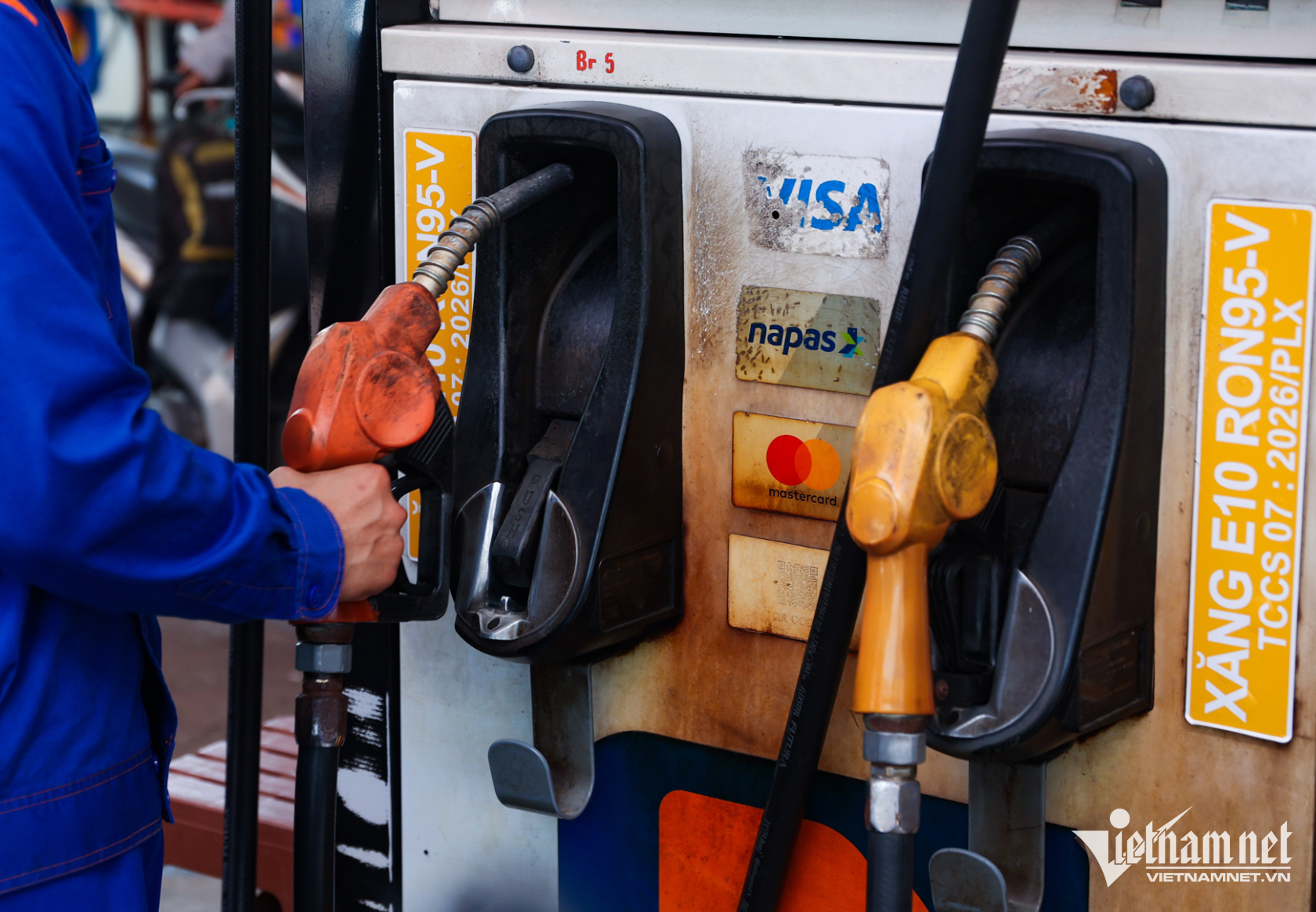
The question now is whether fuel tax reductions will be extended after June 30 or restored to previous levels.
After a period of sharp volatility driven by geopolitical tensions in the Middle East, fuel prices in Vietnam have declined. Current retail prices stand at VND20,126 per liter for E5 RON92 gasoline, VND20,753 per liter for E10 RON95-III gasoline, VND23,534 per liter for diesel, and VND16,680 per kilogram for mazut.
Compared with the peak recorded on March 24, E5 RON92 gasoline has fallen by VND9,988 per liter, while E10 RON95-III gasoline has dropped by VND10,667 per liter. Diesel prices have plunged by VND21,254 per liter from their peak of VND44,788 per liter recorded on April 3.
Compared with prices on February 26, before the outbreak of conflict in the Middle East, diesel remains VND4,255 per liter higher, while E5 gasoline is up VND603 per liter and E10 gasoline is VND933 per liter higher.
According to experts, the decline in domestic fuel prices has not only been driven by lower global oil prices but also by the fact that most fuel-related taxes were reduced to zero following the conflict in the Middle East.
Under Resolution 72, from March 9 to April 30, the Most Favored Nation (MFN) import tariff on unleaded gasoline and gasoline blending components was cut from 10 percent to 0 percent. MFN tariffs on diesel, fuel oil, jet fuel, and kerosene were also reduced from 7 percent to 0 percent.
In addition, import duties on certain petrochemical feedstocks such as xylene, condensate, and p-xylene were cut from 3 percent to 0 percent, while other cyclic hydrocarbons saw tariffs reduced from 2 percent to 0 percent.
On April 30, the Government issued Resolution 25 extending the validity of Resolution 72 through June 30, 2026.
The Prime Minister also issued Decision 482 under a national-interest emergency provision. From midnight on March 26 through April 15, environmental protection tax on gasoline (excluding ethanol), diesel, and aviation fuel was reduced to zero. These products were exempted from VAT declaration and payment requirements while still allowing input VAT credits. Luxury tax on gasoline was also cut from 8-10 percent to zero.
On April 12, the National Assembly officially passed a resolution introducing special provisions on environmental protection tax, value-added tax (VAT), luxury tax, and aviation fuel taxes.
Effective from April 16 through June 30, 2026, the resolution reduced fuel-related taxes to zero. Fuel products were exempted from VAT declaration and payment requirements while retaining eligibility for input VAT credits.
This means that after June 30, when these resolutions expire, several fuel taxes will revert to their previous levels.
Should tax cuts continue?
Before the temporary tax reductions, the retail price of each liter of fuel included several tax components: imported CIF prices (based on Platts Singapore prices), luxury tax (10 percent on RON95 gasoline and 8 percent on E5 RON92 gasoline, with diesel exempt), a 10 percent import tariff, 8 percent VAT, and environmental protection tax ranging from VND1,000 to VND2,000 per liter.
Nguyen Tien Thoa, chair of the Vietnam Valuation Association and former director general of the Price Management Department under the Ministry of Finance, said current forecasts do not provide sufficient grounds to conclude that the downward trend in global fuel prices will remain stable over the long term.
Meanwhile, Vietnam remains committed to maintaining macroeconomic stability, controlling inflation, and promoting the transition toward greener energy.
For that reason, he believes fuel tax reductions should be maintained for a longer period while authorities continue monitoring global market developments.
Once fuel prices remain stable for an extended period, the government can consider restoring the tax level. However, any restoration should follow a gradual roadmap rather than occur abruptly.
Thoa emphasized that taxes account for more than 30 percent of fuel prices. If all taxes are restored immediately after June 30, retail fuel prices could rise sharply.
This would not only increase businesses' input costs but also affect consumer spending and purchasing power at a time when the government is implementing measures to stimulate consumption and support economic growth.
“If taxes are reinstated immediately, achieving economic growth targets could become much more difficult,” Thoa said.
Nguyen Tu Anh, director of Macroeconomic Policy Research at Green-X Center at Vin University, said fuel taxes should be restored gradually rather than returning immediately to previous levels.
Tam An
.svg)
