 Vietnamnet.vn

 Podcast



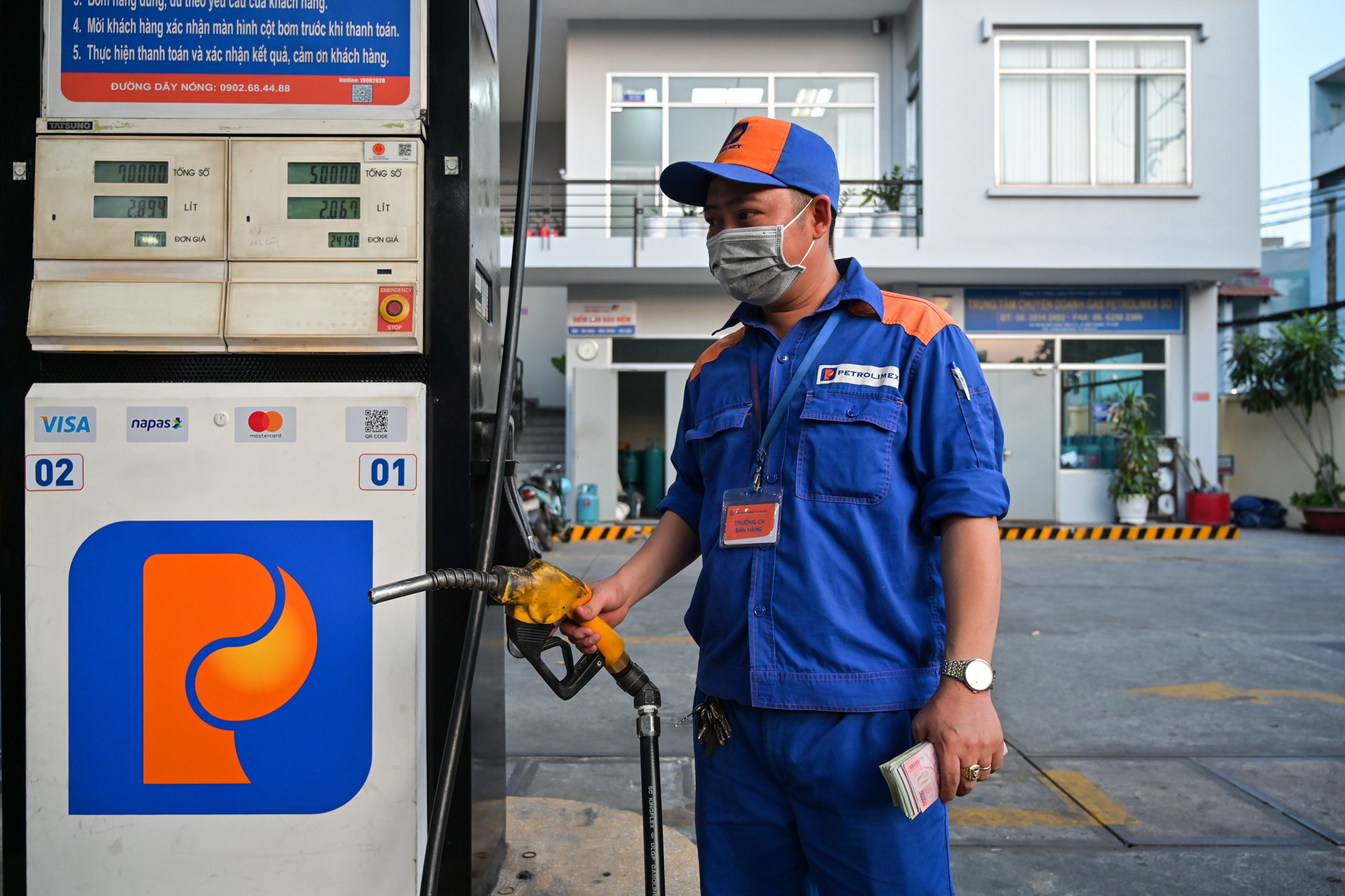
The price of RON95-III gasoline was adjusted down by VND3,880/liter compared to the current base price, with the retail price not exceeding VND25,240/liter. Similarly, E5 RON92 gasoline dropped by VND3,619/liter, with the selling price not exceeding VND22,951/liter. Diesel 0.05S was also adjusted down by VND4,247/liter, with the selling price at VND26,470/liter.
In a newly released communique, the Ministry of Industry and Trade (MOIT) explained why fuel prices dropped sharply under the March 11 review, in which kerosene decreased by nearly VND8,000/liter.
It stated that the world fuel market is influenced by military conflicts between the US, Israel, and Iran; the military conflict between Russia and Ukraine; information about a phone call between the US President and the Russian President regarding the easing of sanctions on Russian oil to cool down global oil prices; and the information that US and G7 countries are considering the release of strategic petroleum reserves.
These factors caused world fuel prices on March 10 to drop sharply compared to March 9.
In the world market, the price of RON92 gasoline used to blend E5 RON92 on March 10 was at $119.220/barrel, down $20.080/barrel (-14.41 percent); the price of RON95 gasoline was $127.420/barrel, down $20.080/barrel (-13.61 percent).
Kerosene was priced at $142.990/barrel, down $45.210/barrel (-24.02 percent); diesel 0.05S was at $160.400/barrel, down $24.030/barrel (-13.03 percent), and mazut oil 180CST 3.5S decreased by $199.670/ton (-22.63 percent), retreating to $682.710/ton.
Given the developments in world fuel prices, fluctuations in the VND/USD exchange rate, and current regulations, while implementing the government’s instructions, MOIT and the Ministry of Finance (MOF) have decided to continue applying a fuel price management plan that combines stabilization and price adjustment under the March 10 periodic review.
The expenditure from the Fuel Price Stabilization Fund was set at VND5,000/liter for diesel and VND4,000/liter or per kg for all types of gasoline, kerosene, and mazut oil. This is the second consecutive adjustment period in which the stabilization fund has been activated.
This approach aims to ensure balanced interests among market participants while allowing domestic fuel prices to reflect global price trends.
At the same time, the authorities continue maintaining a reasonable price gap between biofuel E5 RON92 and RON95 gasoline in order to encourage the use of biofuels.
After applying the stabilization fund, retail prices of commonly used fuel products on the market dropped sharply.
E5 RON92 gasoline is now priced at no more than VND22,951 per liter, down VND3,619 per liter (-13.62 percent) and VND2,289 per liter lower than RON95-III gasoline.
Diesel 0.05S is priced at no more than VND26,470 per liter, down VND4,247 per liter (-13.83 percent).
Mazut 180CST 3.5S is priced at no more than VND19,001 per kilogram, down VND5,706 per kilogram (-23.09 percent).
Notably, kerosene fell sharply by VND7,966 per liter compared with the previous maximum retail price, equivalent to a drop of 24.60 percent, to VND24,419 per liter.
MOIT emphasized that without using the Fuel Price Stabilization Fund, the base prices of fuel products on March 11 would have remained very high. In that case, E5 RON92 would have been priced at VND26,951 per liter; RON95-III at VND29,240 per liter; diesel 0.05S at VND31,470 per liter; kerosene at VND28,419 per liter; and mazut 180CST 3.5S at VND23,001 per kilogram.
Of note, this is the third special review period as the inter-ministerial MOIT and MOF decided to adjust prices flexibly according to Government Resolution 36; simultaneously, and also the first price cut after four consecutive increases.
The time for applying the new base price levels will last until the next review period by MOIT.
In the coming days, MOIT will coordinate with agencies to take inspection tours to retail points to ensure fuel supply for the market by fuel traders and will strictly handle violations.
At the same time, the two ministries will continue closely monitoring market developments to announce appropriate fuel prices in line with government directives and promptly propose solutions to stabilize prices.
Earlier, amid escalating military tensions in the Middle East, the government reduced preferential import tariffs on some fuel products to 0 percent from March 9 to April 30, 2026, in order to secure supply and help stabilize the domestic market.
MOIT required key fuel traders, producers and distributors to ensure supply, strictly implement import and stockpiling plans and guarantee adequate fuel supply, while strictly prohibiting hoarding in anticipation of price increases and ensuring that no disruption occurs in the fuel distribution system.
Tam An
.svg)
