 Vietnamnet.vn

 Podcast



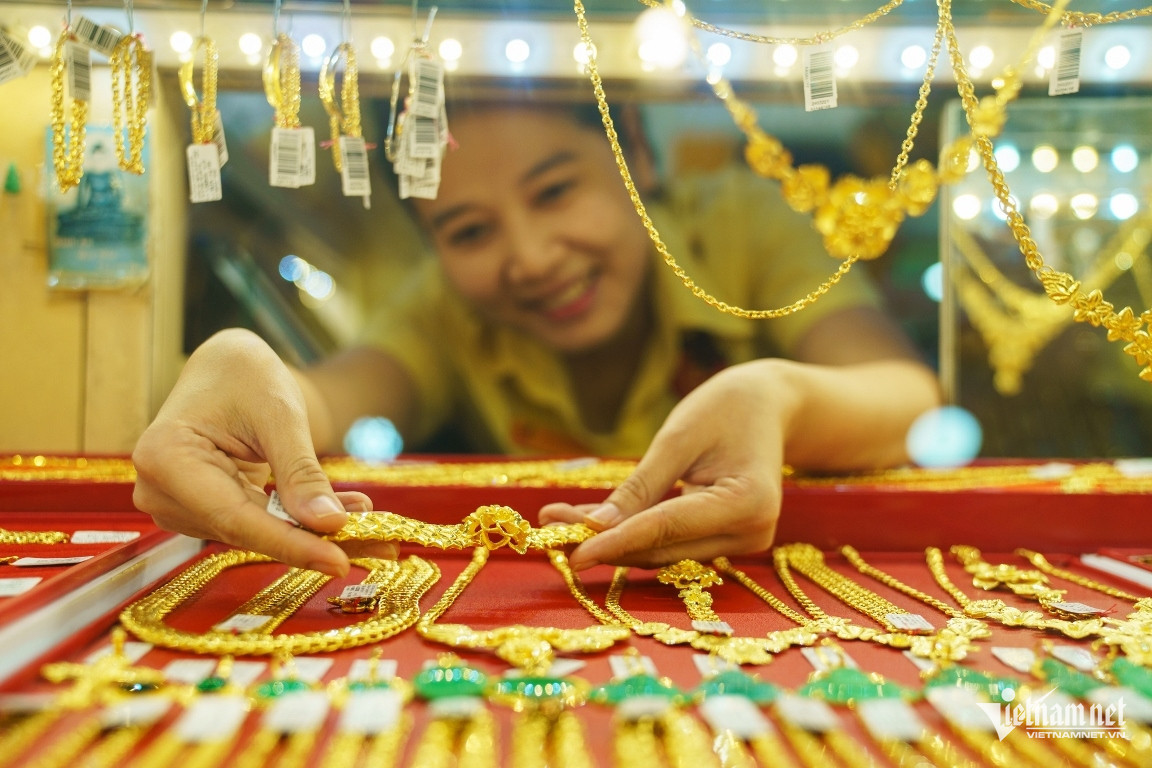
The Vietnam Gold Business Association has sent an official letter to the National Assembly Chair Tran Thanh Man proposing the removal of manufacturing, crafting and trading of jewelry gold, and the import-export of raw gold materials for jewelry production from the list of conditional business fields.
Accordingly, the conditional business category for the gold industry in appendix 4 of the revised investment law draft will only include “production and trading of gold bars, gold derivative products, and gold exchanges.”
The Vietnam Gold Trading Association noted that around the world, the manufacturing and trading of jewelry gold is considered a normal commercial sector, and no country categorizes it as a conditional business industry.
Finance and banking expert Nguyen Tri Hieu said that jewelry gold production and trading should be considered a common business commodity, similar to products serving people's needs for beauty and savings, rather than belonging to the group of conditional business goods.
Gold bars and raw gold can influence macroeconomic conditions, as they are not everyday consumption products. Excessive investment or speculation can affect foreign exchange reserves, inflation and national reserves. Therefore, gold bars must remain a conditional business and require licensing.
In contrast, gold does not have macroeconomic influence and can be removed from the conditional business list.
“In many countries, such as the US, companies producing and trading jewelry gold only need regular business licenses, without special permits like in the banking sector,” Hieu emphasized.
He added that removing jewelry gold from the conditional list would help create a more transparent market, developing according to supply-demand dynamics.
Careful calculation needed
Nguyen Quang Huy from Nguyen Trai University said that jewelry gold has long been considered a sector combining cultural value, craftsmanship and market factors. Unlike gold bars, this segment is more commercial and creative, with little direct relevance to monetary management goals.
From a neutral, comprehensive perspective, he said the proposal aims to support production and trade but requires careful calculation to maintain market stability and harmonize the interests of businesses, consumers and regulators.
Huy evaluated the proposal as reasonable on three aspects:
First, product characteristics: Jewelry gold undergoes crafting processes, altering its form and value, which no longer depends solely on raw gold. For this reason, many countries classify it as a normal commercial product without applying conditions similar to those for gold bars.
Second, growth potential: With loosened conditions, businesses can access raw materials more easily, invest in machinery, upgrade designs and improve craftsmanship standards. This creates a foundation for expanding exports, especially to markets that demand high precision and appreciate emerging brands.
Third, socio-economic benefits: The jewelry gold industry uses a large skilled workforce. Reducing administrative barriers will boost production, create more jobs and encourage the development of supporting industries. These benefits align with the goal of promoting creative industries and increasing domestic added value.
However, the expert warned that while opening the market is necessary, a balanced management mechanism is essential to ensure stable operation.
Removing business licensing requirements does not mean loosening product standards. To protect the reputation of Vietnamese goods and consumers’ rights, quality testing systems for gold content, jewelry standards and transparent labeling must still be maintained.
Although jewelry gold does not directly affect monetary policy, raw gold remains a high-value, sensitive commodity. A clear traceability system helps ensure transparency, reduce trade discrepancies and build trust among international importers.
Huy proposed that large-scale businesses should be integrated into a mechanism for reporting large transactions above a reasonable threshold to ensure market transparency and safety. This regulation would support risk management without creating administrative pressure on small businesses.
“Gold is a sensitive market, so policy changes should be implemented step by step to avoid shocks. A pilot phase followed by evaluation and expansion is the safest and most balanced option,” Huy said.
He added that to optimize the proposal, a simple and clear technical standard system could replace conditional business licensing to ensure transparency without creating barriers. At the same time, a digital traceability system should be developed through batch coding and linked data between enterprises, customs and state agencies, helping streamline management and control material flows effectively.
Nguyen Le
.svg)
