 Vietnamnet.vn

 Podcast



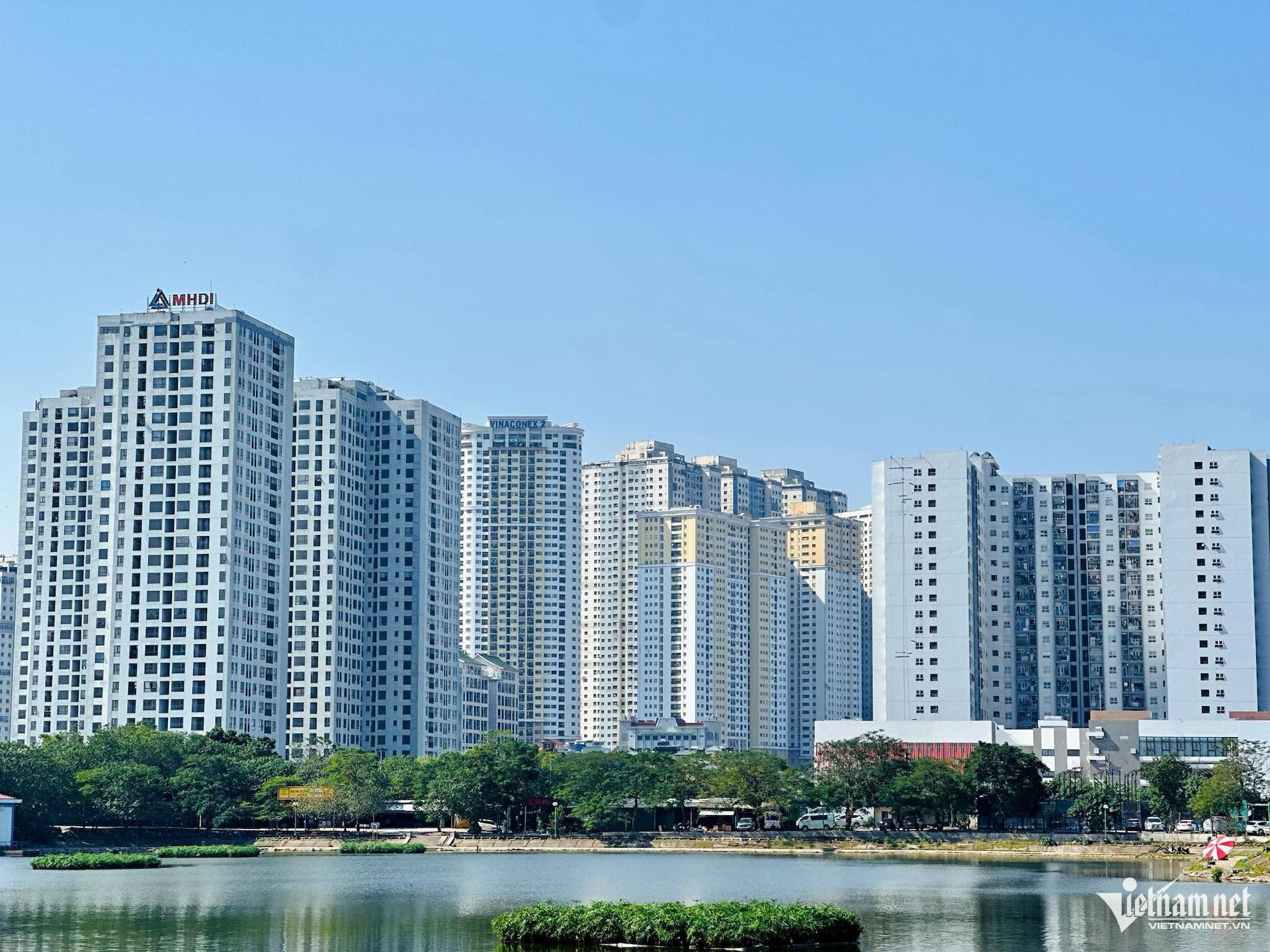
According to the housing and real estate market report for Q1 2026 released by the Ministry of Construction, in the first three months of the year, prices of newly launched apartments maintained a steady upward trend. The main causes were rising material and financial costs.
In Hanoi, the average selling price of new apartments reached around VND128 million per sqm, surpassing the average price in HCMC at VND112 million per sqm.
In the high-end segment, prices have drawn attention as many projects in the two major cities recorded listing prices of hundreds of millions of VND per sqm.
A survey in Hanoi found many projects with common listing prices ranging from VND140–250 million per sqm, such as Vinhomes Metropolis at VND192–258 million per sqm; D’. Le Roi Soleil at VND170–223 million per sqm; Vinhomes Skylake at VND140–178 million per sqm; and Hoang Thanh Tower at VND180–212 million per sqm.
In HCMC, prices are even higher, with luxury projects such as Grand Marina Saigon at VND440–557 million per sqm; The Marq at VND222–260 million per sqm; Vinhomes Golden River at VND223–360 million per sqm; and Metropole Thu Thiem at VND330–448 million per sqm.
In contrast to the upward trend of the primary market, the secondary apartment market has shown signs of slowing down. Selling prices generally remain high but there are signs of downward adjustments in some areas.
Field observations show that since late 2025, secondary apartment prices in Hanoi have started to cool after a period of rapid increases. In some suburban projects, there are signs of “stopping losses” by several hundred million VND to improve liquidity.
The Vietnam Association of Realtors (VARS) confirmed that the secondary apartment price index in Hanoi has slightly declined. While asking prices remain high due to input costs, actual transaction prices are more flexible, and transaction closing times have lengthened significantly.
According to VARS, this reflects that a segment of individual investors is adjusting profit expectations to improve cash flow, as liquidity is not yet strong and capital costs are no longer as low as before.
Transactions decline, market enters selective phase
Another notable point is that inventory of apartments and individual houses continues to increase. According to the Ministry of Construction, in Q1 2026, total real estate inventory at projects was 29,860 units/plots, including apartments, individual houses, and land plots.
Of this, apartment inventory was more than 10,496 units; and individual houses about 10,474 units, equivalent to around 101.0% compared to Q4 2025. Land plot inventory recorded about 8,890 plots, showing a decreasing trend to around 73.3 percent compared to the previous quarter.
Market liquidity also recorded a decline. Total successful real estate transactions in Q1 reached 139,855 transactions, or 92.4 percent compared to Q4 2025.
Of these, apartment and individual housing transactions declined more sharply, reaching more than 30,850 transactions, or 81.5 percent compared to the previous quarter and lower than the same period last year.
Land transactions reached nearly 109,000 transactions, orv96 percent compared to Q4 but still higher than the same period.
According to experts, current developments show the market is entering a selective adjustment phase. Research from the Vietnam Institute for Real Estate Market Research (VARS IRE) indicates that buyer behavior has clearly changed. Instead of following the crowd, buyers increasingly prioritize products with transparent legal status, good usability, and real housing demand.
Liquidity therefore no longer depends solely on price, but is closely tied to actual use value and real potential of the product.
In the coming time, the real estate market will still be affected by macroeconomic factors and financial pressures, especially capital costs.
However, opportunities are expected to become clearer for those with strong financial capacity, long-term strategies, and good adaptability.
As price levels are no longer the only decisive factor, the market is expected to gradually return to real value, where quality products that meet real housing demand and have transparent legal status will gain advantage.
Hong Khanh
.svg)
