Hanoi officials say the controversial dragon sculptures near Hoan Kiem Lake were carefully designed using Ly Dynasty artistic traditions. The temporary installation is part of Vietnam Culture Day celebrations from November 21 to 24.
Hanoi cultural authorities have defended a pair of dragon sculptures installed near Hoan Kiem Lake after their unusual appearance sparked debate on social media, emphasizing that the designs are rooted in historical research and cultural symbolism.
At a press conference on November 17, representatives of the Hanoi Department of Culture, Sports and Tourism and the event's creative team explained the artistic concept behind the installation, which forms part of the capital's Vietnam Culture Day celebrations.
Pham Xuan Tai, deputy director of the department, said much of the online discussion stemmed from the public not having sufficient information about the event, the design concept and the cultural significance of the dragon figures.
The celebrations will take place from November 21 to 24, with major activities centered on Ly Thai To Flower Garden and the Hoan Kiem Lake area.
The opening ceremony, scheduled for the morning of November 21, will feature a large-scale performance stage in front of the King Ly Thai To Monument, accompanied by heritage parades and artistic performances.
Dragon sculptures inspired by Ly Dynasty heritage
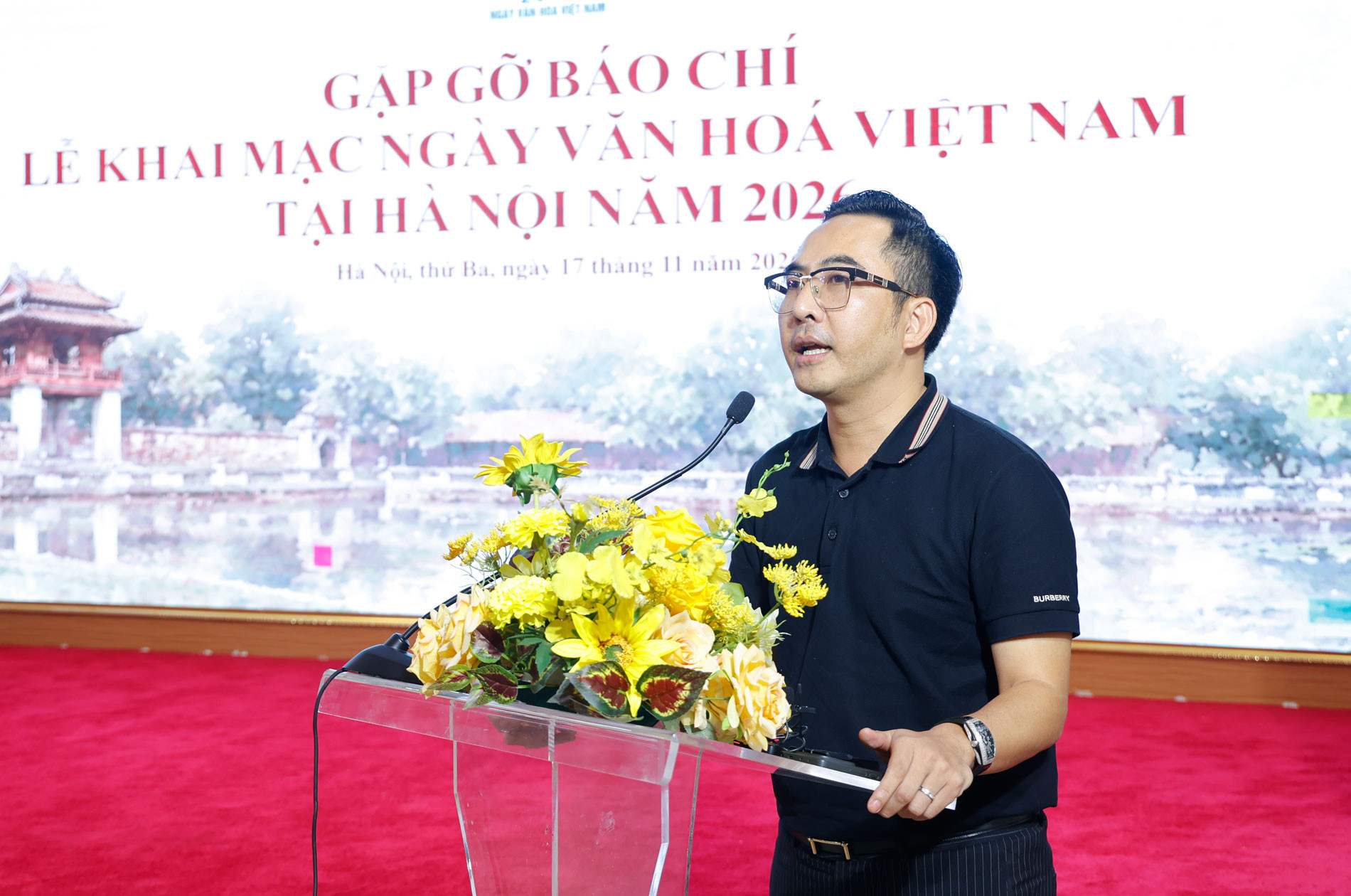
Pham Xuan Tai, deputy director of the Hanoi Department of Culture, Sports and Tourism, speaks at the November 17 press conference.
Responding to questions from VietNamNet about online criticism of the sculptures, general director Hoang Cong Cuong said the dragon figures were inspired by artistic traditions dating back to the Ly Dynasty.
The design, he explained, was intended to create a dialogue between Vietnam's thousand-year heritage and contemporary artistic creativity.
The dragon imagery is closely associated with King Ly Thai To's decision to relocate the capital in 1010 and the name Thang Long, meaning "Ascending Dragon."
According to Cuong, the dragon symbolizes the nation's aspirations for development, independence and progress.
The sculptures' flowing, curved bodies represent the continuity of Vietnamese culture across generations, connecting the past with the present.
Both dragon heads face the central section of the installation, conveying the idea of convergence, where cultural traditions from different regions of Vietnam come together in Thang Long-Hanoi.
The circular structure at the center is intended to symbolize a gateway connecting different periods of history, allowing cultural memory and contemporary creativity to intersect.
Positioned in front of the King Ly Thai To Monument, the sculptures also express gratitude to earlier generations who laid the foundations for Hanoi's thousand-year history.
The dragons' upward-reaching forms and outward-extending bodies are designed to evoke a capital that preserves its cultural roots while remaining open to new ideas and influences.
Cuong said the installation conveys a broader message that culture connects communities, sustains national identity and inspires aspirations for the future.
He rejected comparisons circulating online that likened the sculptures to octopuses or crocodiles.
"There is no basis for saying the two dragons resemble octopuses or crocodiles, as some comments have suggested," Cuong said.
He stressed that the designs have clear historical and cultural foundations that specialists can analyze and compare with traditional artistic representations.
The general director also clarified that the sculptures are temporary stage installations created specifically for the cultural event.
They will be dismantled immediately after the program concludes and are not intended to become permanent landmarks at Hoan Kiem Lake.
Tai echoed this explanation, saying public debate had intensified partly because audiences had not yet received comprehensive information about the artistic concept.
He encouraged media organizations to provide accurate details about the installation's cultural meaning and temporary nature.
More than 2,300 artisans to perform on 200-meter stage
A 3D rendering of the Ly Dynasty-inspired dragon sculptures near Hoan Kiem Lake.
Beyond the dragon sculptures, the opening ceremony will feature an ambitious outdoor performance involving approximately 2,300 artisans from traditional craft villages, cultural centers and heritage communities across Hanoi.
According to Cuong, many participants are amateur performers whose experience largely comes from traditional festivals in their local communities.
Under the direction of a professional creative team, they will participate in a large-scale production showcasing the diversity of Hanoi's cultural traditions.
Organizers have mobilized participants from 148 communes and wards across the city for continuous rehearsals.
Coordinating such a large number of performers from different localities has presented considerable logistical challenges, particularly in synchronizing movements and integrating individual performances into a unified production.
The main performance space will extend for more than 200 meters along part of Hoan Kiem Lake's shoreline, creating an unusually expansive outdoor stage.
Additional performances will take place at designated locations around the lake, allowing residents and visitors to interact directly with participating artists.
The event will involve more than 3,000 performers and support personnel, requiring extensive preparations for sound systems, technical connections and crowd movement.
Historic relocation of Vietnam's capital to be recreated
The program will bring several important episodes in Thang Long-Hanoi's history to life through large-scale reenactments.
One of the main performances, Chieu doi do (Edict on the Transfer of the Capital), will recreate the historic events of 1010, when King Ly Cong Uan moved the capital from Hoa Lu in present-day Ninh Binh to Thang Long.
The reenactment will feature a royal dragon boat carrying the king, alongside portrayals of the queen and civil and military officials.
Another performance, Vinh quy bai to, will depict the traditional ceremony honoring a successful scholar returning to his hometown.
The production will feature a performer portraying a top imperial examination graduate riding a real horse on stage.
The scene will introduce audiences to the scholarly traditions of Ha Bai, while other performances will showcase Hanoi's traditional costumes.
Organizers expect the combination of historical reenactments, traditional attire and community performances to provide audiences with an immersive experience of the capital's cultural heritage.
Cultural celebrations extend across Hanoi
Tai said Vietnam Culture Day activities would extend far beyond the central performance area.
A total of 126 communes and wards across Hanoi have registered to organize their own events, many of which will be connected to traditional local festivals and heritage activities.
The department highlighted several initiatives demonstrating how communities are developing new ways to promote cultural heritage.
In Phu Xuyen, visitors will be able to join experiential tours connecting historical sites with traditional craft villages.
Tu Lam Commune will organize a one-day cultural experience program, while Co Nhue will host an event commemorating 600 years of the spirit of Thang Long-Dong Do.
Hoang Cong Cuong, general director of the Vietnam Culture Day opening ceremony, explains the artistic concept behind the dragon installation.
Other activities include a program exploring the legend of Phu Dong's golden bamboo in Soc Son, a festival honoring traditional crafts in Chuyen My and a flower and ornamental plant festival in Tich Giang.
Digital technology will also play an increasingly prominent role in promoting cultural attractions.
Bach Mai Ward is introducing a website offering 360-degree virtual tours of historical sites, while Thanh Xuan Ward is developing a digital map.
Meanwhile, digital cultural house models are being introduced in residential communities to improve access to cultural information and activities.
These initiatives are intended to connect traditional heritage preservation with modern technologies and new forms of public engagement.
Hanoi seeks to expand cultural tourism and heritage preservation
With more than 1,700 elements of intangible cultural heritage and over 6,400 historical and cultural sites, Hanoi possesses one of Vietnam's most extensive cultural heritage resources.
Representatives of the Department of Culture, Sports and Tourism emphasized that the opening ceremony should be viewed as the beginning of broader efforts to make the capital's heritage more accessible to the public.
Following Vietnam Culture Day, the city plans to strengthen heritage preservation at the community level while expanding cultural industries.
A key priority will be connecting historical sites, traditional craft villages and cultural attractions with tourism routes to create more diverse visitor experiences.
Hanoi also intends to promote the use of virtual reality and other digital technologies to introduce its heritage to audiences across Vietnam and internationally.
Officials said these efforts would help preserve the capital's distinctive cultural identity while encouraging new approaches to cultural development.
The temporary dragon installation, they stressed, is part of that wider ambition to present traditional Vietnamese heritage through contemporary artistic expression.
 Vietnamnet.vn

 Podcast