 Vietnamnet.vn

 Podcast



As the city accelerates institutional reforms to implement Resolution 57 and the revised Law on the Capital, CMC Technology Group has signed a “triple-helix” cooperation agreement with the Hanoi People’s Committee and Hanoi University of Science and Technology (HUST). The partnership aims to catalyze breakthroughs in science, technology, innovation, and digital transformation during the 2026–2030 period.

Hanoi “commissions” real-world challenges, measured by outcomes
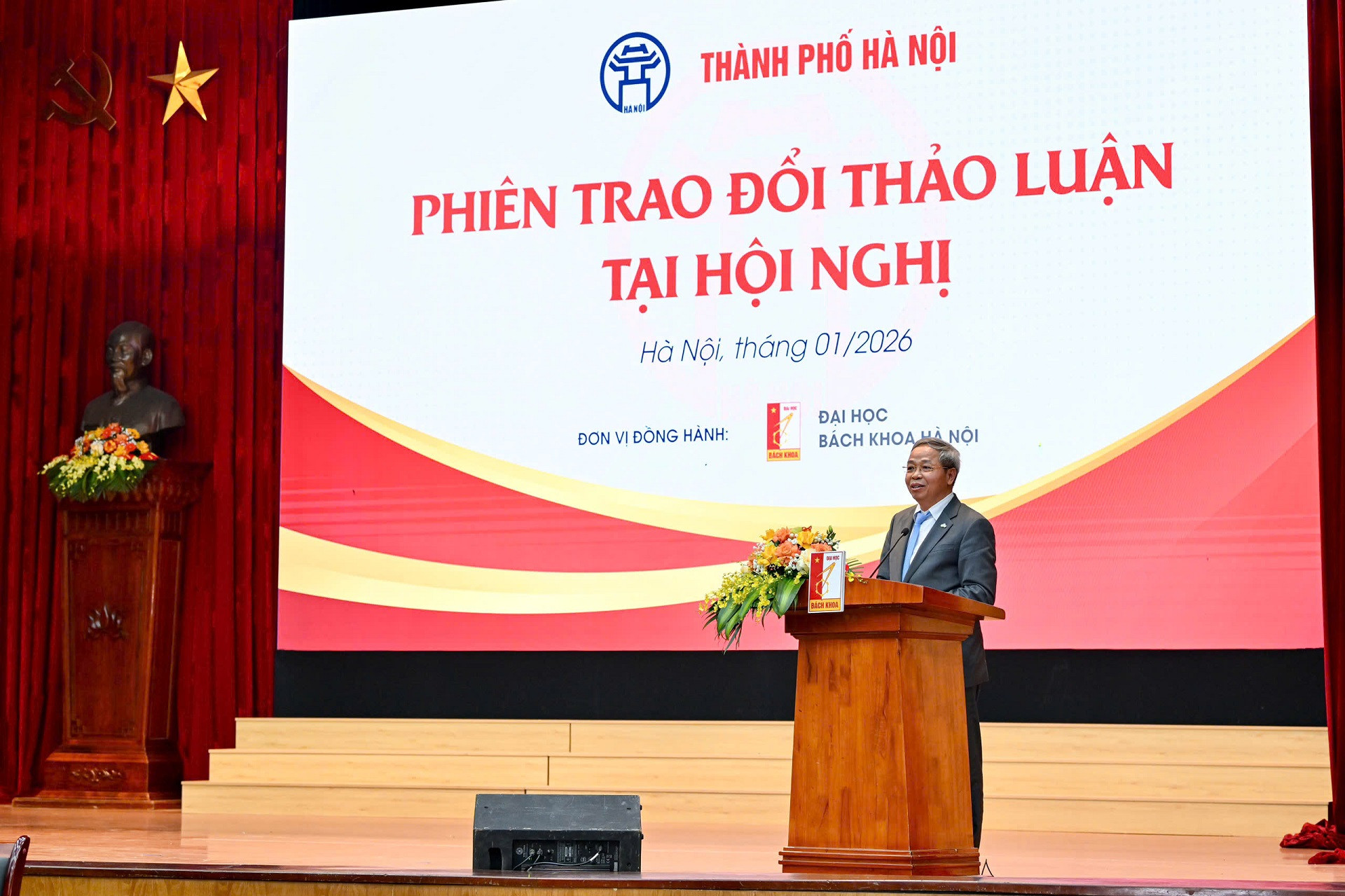
At a meeting with experts, scientists, universities, and enterprises held at HUST on the afternoon of January 10, city leaders outlined a shift toward an innovation-led growth model. Vice Chairman of the Hanoi People’s Committee, Truong Viet Dung, announced: “Hanoi plans to allocate around 4% of GRDP in 2026 to science, technology, and innovation.” He emphasized that while the newly signed agreements mark an important milestone, they are “only the beginning.”
According to the city’s action plan, science and technology programs will follow a closed-loop four-step model: identifying problems by locality or sector, standardizing outputs and KPIs, publicizing problem statements, and inviting enterprises and scientific organizations to propose solutions. Priority will be given to a results-based payment mechanism.
Earlier, Hanoi consulted on a “package of six resolutions” passed by the Hanoi People’s Council to put the revised Capital Law into effect. These include a controlled pilot mechanism (sandbox), a technology exchange platform, and a proposal to establish a city-level innovation center.
The “triple-helix” agreement: connecting government, university, and enterprise
The tripartite agreement was signed by representatives of the Hanoi People’s Committee, HUST, and CMC Technology Group - Vice Chairman Truong Viet Dung, Assoc. Prof. Dr. Huynh Quyet Thang (President of HUST), and Nguyen Trung Chinh (Chairman of the Board/Executive Chairman of CMC Group). It was one of six agreements signed during the conference.
The partnership aims to implement breakthrough initiatives in science, technology, and innovation, with a strong focus on developing high-quality human resources, transferring research into practice, and commercializing outputs to meet Hanoi’s strategic development goals.
From HUST’s perspective, the university remains committed to the “triple-helix ecosystem” as a core framework for innovation. At the event, Prof. Le Anh Tuan, Secretary of the University Party Committee, affirmed HUST’s pursuit of the “One HUST” development philosophy, aspiring to become a leading model for Government-University-Enterprise cooperation.

Cooperation focus: AI talent, a Center of Excellence, a “Design Factory,” and urban challenges
Under the agreement, several priority programs are planned:
First, developing human capital for Hanoi. HUST will take the lead in training specialized engineers and offering master’s and doctoral programs in strategic technology fields. It will also provide capacity-building for officials working in science, technology, innovation, and digital transformation - starting with data science and artificial intelligence.
Second, establishing an AI Center of Excellence. The center is envisioned as a hub for domestic and international talent, connected to both national and regional innovation ecosystems. It will support startup incubation, pilot new models, and commercialize AI-driven products.
Third, launching a “Design Factory” - a multidisciplinary center for design, innovation, and manufacturing. This space will bring together students, lecturers, researchers, and businesses to co-create and test new solutions, while integrating knowledge from science, technology, arts, and economics to cultivate a startup culture rooted in innovation.
Fourth, implementing research and technology-transfer programs based on the city’s practical needs. These include: an AI-based digital platform for enterprise carbon emission planning, a digital twin of Hanoi’s river-lake system for monitoring and flood forecasting, aerial environmental monitoring devices, a multi-model meteorological forecasting system powered by AI and digital twins, and a data infrastructure hub to support blockchain applications.
The agreement also pledges to support AI-driven startups and pilot projects across sectors such as transportation, education, public administration, process automation, and biomedicine - accelerating the translation of lab-based research into market-ready products.
CMC Chairman: Enterprises as the “conductor” of innovation
Speaking at the event, CMC Chairman Nguyen Trung Chinh emphasized that a truly effective “triple-helix” model requires tight collaboration, with enterprises playing a pivotal role in transforming research into viable products, services, and competitive advantages.
He argued that businesses are not only key to identifying market-driven “problem statements,” but must also serve as the “conductor” that aligns and mobilizes research, training, and deployment resources - anchoring the innovation ecosystem in real-world demands.
Chinh outlined six key responsibilities that the enterprise pillar must undertake in this partnership:
First, enterprises must lead in market development and growth, being closest to shifting consumer and societal needs.
Second, they serve as both investors and organizers of production - bridging the gap between research and its application in society.
Third, enterprises must act as coordinators, linking research agendas with practical business applications and aligning efforts across institutions.
Fourth, they are the builders of foundational technology platforms and development ecosystems. CMC is collaborating with HUST and the city government to develop a market-driven innovation center that can turn research into real-world impact.
Fifth, enterprises are the gateway to global markets. CMC has brought Vietnamese technologies to 30 countries and operates in 10 international markets, contributing to the global expansion of Make in Vietnam solutions.
Sixth, they are willing to share investment risks with the State. CMC has committed to long-term investments in core technologies that demand perseverance and substantial capital.
Reflecting on his own journey, Chinh noted that Hanoi has been his home for over 60 years and HUST his academic foundation. “We are committed to substantive collaboration - focusing on building high-quality talent and accelerating innovation in the spirit of Resolution 57,” he said.
Expectations: creating a “runway” for Make in Vietnam technology from Hanoi
City leaders emphasized that while the six agreements signed on January 10 represent a solid start, they must be followed by concrete actions - turning commitments into detailed problem statements, measurable pilot programs, and scalable, high-impact models.
With this agreement, Hanoi, HUST, and CMC plan to establish a joint coordination mechanism with clearly defined goals, KPIs, and deliverables. The initiative aims to launch new institutions such as the AI Center of Excellence and the Design Factory, both critical to attracting top talent, driving technology transfer and commercialization, and accelerating the growth of Hanoi’s innovation ecosystem.
PV
.svg)
