 Vietnamnet.vn

 Podcast



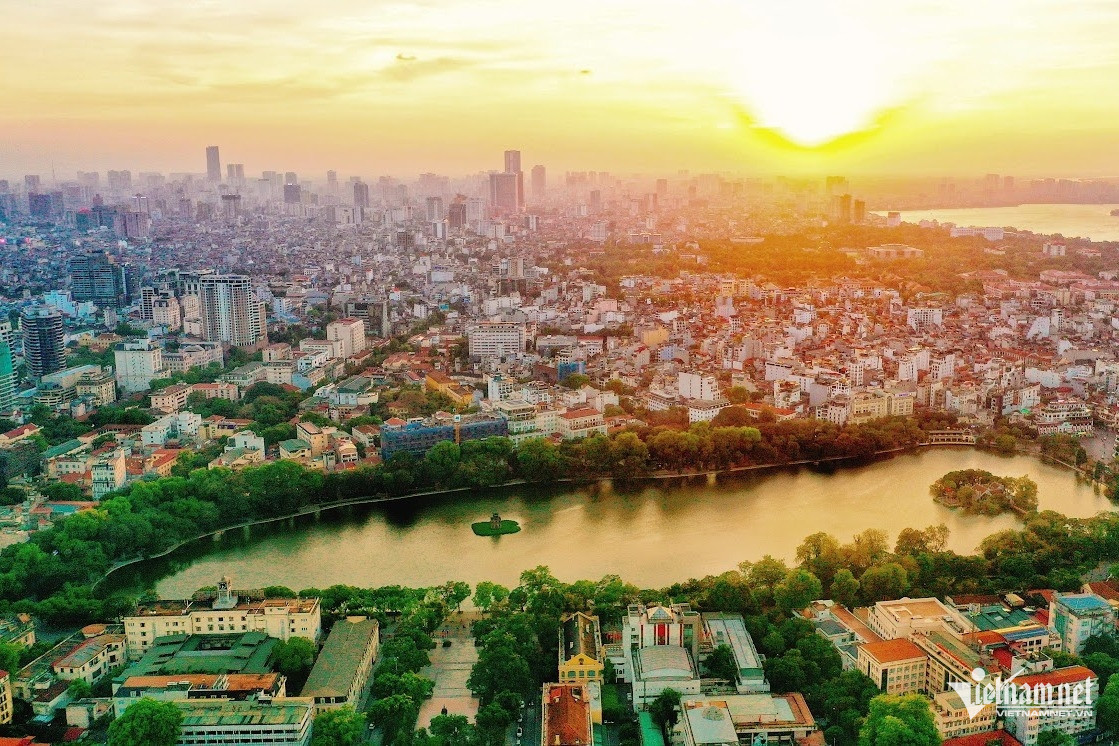
The Hanoi People's Committee has just reported on the main contents of the Capital Master Plan with a 100-year vision, to be submitted to the City People's Council for consideration at the 31st session.
According to the City People's Committee, the Capital Planning for the 2021-2030 period, with vision to 2050, and the Capital General Planning to 2045, with vision to 2065, are no longer suitable and need review and adjustment to be consistent with the national master plan, the adjusted Red River Delta regional planning, and related sectoral plans.
Regarding the orientation of spatial development and urban infrastructure, Hanoi proposes a strategic spatial and infrastructure structure. At the same time, it identifies cultural and historical heritage spaces and landscapes along the Da, Red, and Duong rivers.
The city also proposes breakthrough tasks and solutions to address existing issues and bottlenecks such as flooding, traffic congestion, and environmental pollution.
Specifically, to resolve issues of civilization, urban order, and urban development, Hanoi proposes restructuring the Capital's development model toward a multi-polar and multi-center urban direction, associated with a multi-layered and multi-level urban structure. This aims to rationally distribute population, production spaces, services, and infrastructure, reducing pressure on the core urban area.
Hanoi clearly stated that the goal of urban restructuring is to create a revolution in architecture and urban landscape, a revolution in housing, and a revolution in heritage and preservation shifting from a “preserve and renovate” mindset to a “rebuild value” approach.
Simultaneously, it aims to create a new planning structure, release land resources, and create new values; fundamentally solve infrastructure bottlenecks, heading toward a green, smart, and sustainable urban development.
Urban restructuring
The scope of urban restructuring is expected to be from Ring Road 3 inward, with priority given to the Ring Road 1 and Ring Road 2 areas. Areas identified for restructuring associated with preservation and restoration include: the Ba Dinh political-administrative center; the Hoan Kiem Lake area and its vicinity; the Old Quarter; the West Lake area and its vicinity; and the areas on both sides of the Red River associated with the landscape axis.
Regarding population restructuring, Hanoi proposes implementation of population dispersal to reduce pressure on the inner city. Residents subject to clearance and relocation will partially be arranged for on-site resettlement; the remainder will be arranged in new urban areas at growth poles such as Dong Anh, Gia Lam, and Hoa Lac.
These areas are designed for synchronized infrastructure investment, offering full amenities such as schools, hospitals, and parks, which ensures better living conditions than the old residences.
According to calculations by the Hanoi People's Committee, the total resources to implement the overall adjustment of the two plans in the 2026-2045 period are approximately VND64.84 quadrillion.
In the 2026-2035 period, Hanoi would need VND14.5 million trillion worth of capital, of which the city's public investment budget is nearly VND1.97 quadrillion to develop infrastructure and solve urgent social issues. Approximately VND8.8 quadrillion will be from private enterprises and residents and injected into new urban infrastructure, industrial parks, science and technology, healthcare, education, culture, and urban restructuring. The state sector will invest about VND4.4 quadrillion, state-owned enterprises in the area VND2.4 quadrillion.
During this period, Hanoi expects to relocate about 200,000 people in the Red River area, 200,000 people in the West Lake area and its vicinity, and 42,000 people along several routes within Ring Road 3.
In 2036-2045, the capital demand increases to about VND50.34 quadrillion, of which the city's public investment budget is over VND5 quadrillion. The state sector will invest over VND14 quadrillion; state-owned enterprises in the area VND9 quadrillion. The remainder is primarily from the private sector and residents.
Hanoi expects to relocate 26,730 people in the Old Quarter, 23,000 people in the Old Citadel area, and approximately 370,000 people in the remaining areas within Ring Road 3.
Thus, throughout the entire 2026-2045 period, Hanoi proposes relocating over 860,000 residents to serve the goal of urban restructuring.
Vu Diep
.svg)
