 Vietnamnet.vn

 Podcast



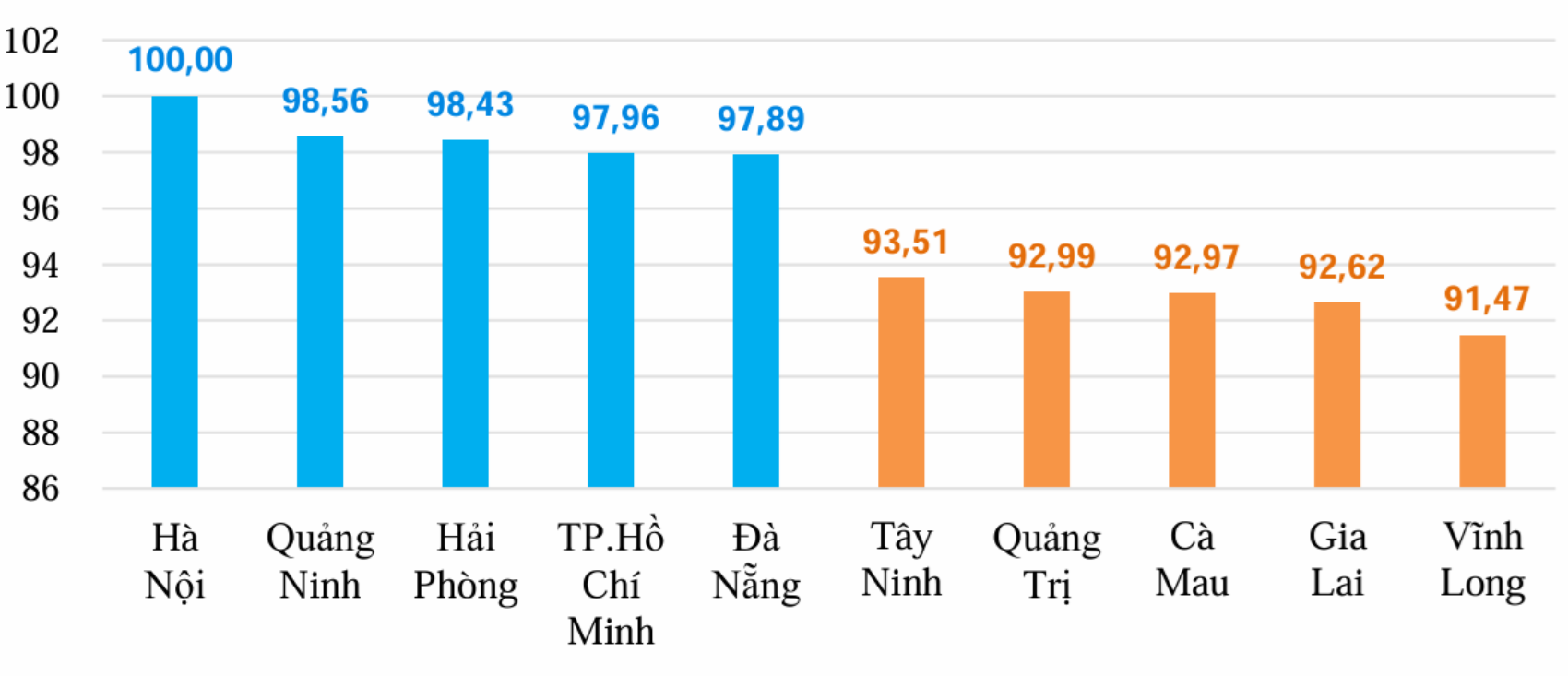
Hanoi continues to rank as the most expensive locality in Vietnam in 2025, according to the spatial cost of living index (SCOLI) released by the General Statistics Office under the Ministry of Finance.
The data was announced at a press conference on socio-economic statistics for the first quarter of 2026, held on April 4.
Among the country’s 34 centrally governed provinces and cities, Hanoi maintained its position at the top of the cost-of-living rankings.
Quang Ninh followed in second place, with a SCOLI equivalent to 98.56 percent of Hanoi. The province benefits from a diversified economic structure spanning industry, services, and tourism, highlighted by its status as a major tourism hub centered around Ha Long Bay. Strong commercial and service activities, along with a steady inflow of domestic and international visitors, have driven up demand and price levels.
However, thanks to stable supply chains and relatively reasonable living and transportation costs, overall prices in Quang Ninh remain slightly lower than in Hanoi.
Ranked third was Hai Phong, with a SCOLI equal to 98.43 percent of Hanoi. As a key economic center in northern Vietnam, the city benefits from its port and logistics advantages, which help reduce transportation costs and stabilize goods supply. Its robust industrial, commercial, and service sectors continue to support consumer demand and price levels, though still below those of the capital.
Ho Chi Minh City placed fourth, with a SCOLI of 97.96 percent. Despite being a major economic hub with a large population and high consumption demand, its extensive distribution networks, abundant supply, and intense market competition help keep prices lower than in Hanoi.
In fifth position was Da Nang, with a SCOLI of 97.89 percent. As a major economic and tourism center in central Vietnam, the city benefits from well-developed infrastructure and services. Nevertheless, overall price levels remain below those of Hanoi due to stable supply and comparatively moderate living costs.
At the other end of the spectrum, Vinh Long recorded the lowest cost of living nationwide, with a SCOLI of 91.47 percent of Hanoi. Prices in the province are lower thanks to its strengths in agriculture and aquaculture, abundant food supply, and relatively modest consumer demand.
Following Vinh Long were Ca Mau (92.97 percent), Quang Tri (92.99 percent), Tay Ninh (93.51 percent), Ha Tinh (93.75 percent), An Giang (93.93 percent), Cao Bang (94.54 percent), and Dong Thap (94.95 percent).
According to the General Statistics Office, provinces with lower price levels typically benefit from lower living costs and cheaper essential goods such as food, housing, transportation, education, and entertainment services.
The 2025 SCOLI data also indicates that price differences between regions are not significant. Higher costs are concentrated in major economic centers with rapid urbanization and strong consumer demand, while provinces with advantages in essential goods supply maintain lower price levels.
The expansion of distribution networks, logistics systems, and e-commerce has improved market transparency, increased competition, and narrowed regional price gaps. This reflects effective price management efforts, ensuring balanced supply and demand for essential goods and contributing to overall price stability nationwide.
Nguyen Le
.svg)
