 Vietnamnet.vn

 Podcast



The Hanoi People’s Committee, together with the Steering Committee and Working Group for building the “socialist commune and ward” model for the 2026-2030 period and beyond, held a meeting on Tuesday to review the draft proposal for piloting the model.
The draft proposal was developed by the Hanoi Institute for Socio-Economic Development Studies in coordination with agencies, units, experts and scientists.
The model aims to reorganize development spaces, restructure socio-economic activities, innovate governance methods, and ensure harmony between economic growth, social progress, equality, cultural development and people’s empowerment. Notably, improvements in quality of life, citizen satisfaction and happiness are identified as the most important overall indicators.
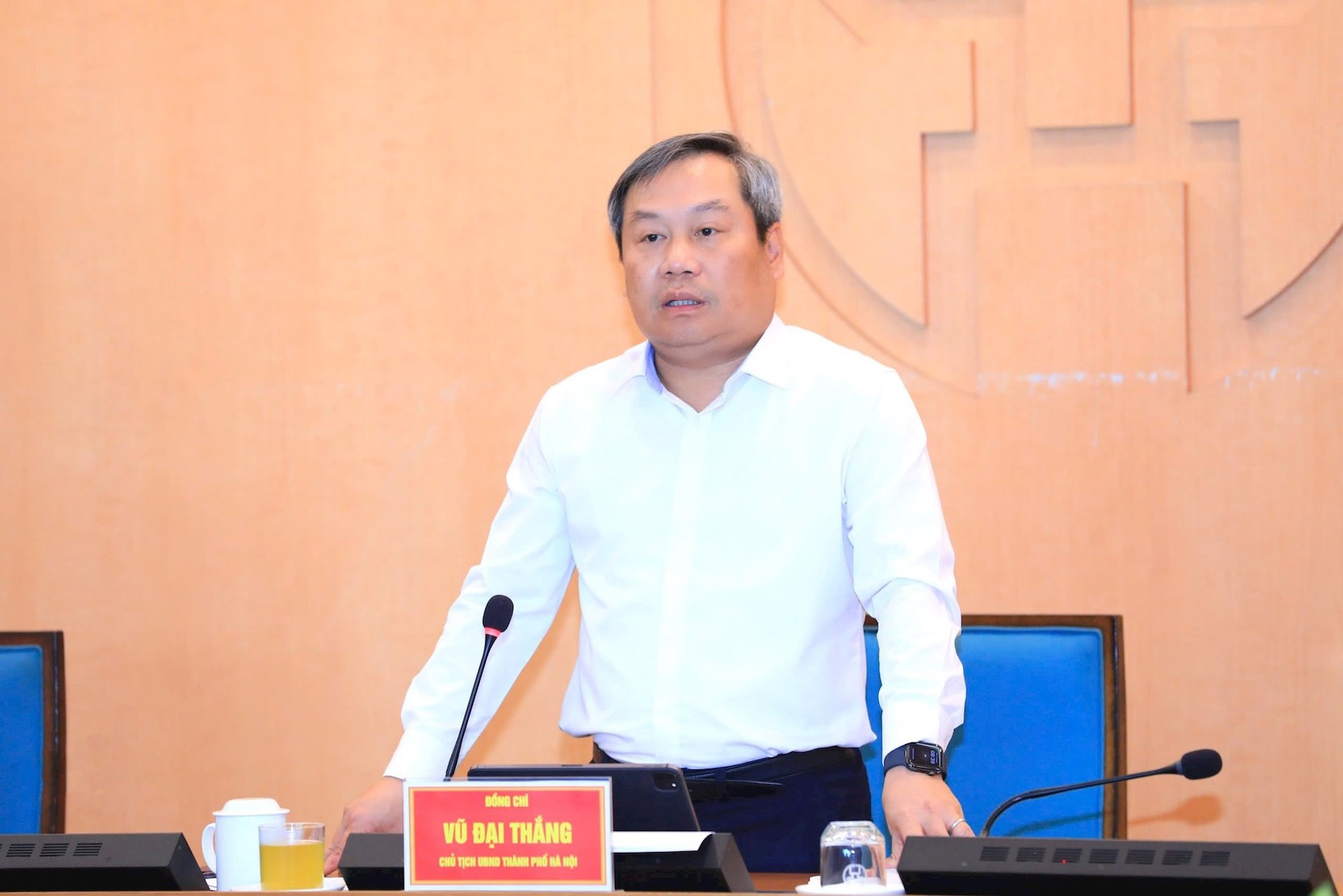
Chairman of the Hanoi People’s Committee Vu Dai Thang said studying the “socialist commune and ward” model is a new approach aimed at meeting the capital’s development demands in the new context. Photo: TH
The draft outlines eight key areas, including building grassroots political systems; developing infrastructure and smart living spaces; economic development; social welfare; cultural and human development; environmental protection; national defense and security; and promoting science, technology and digital transformation.
The evaluation framework is designed around 54 measurable criteria covering areas such as the economy, employment, income, infrastructure, healthcare, education, environment, digital transformation and public participation. The proposal also adds two composite indicators: the happiness index and overall citizen satisfaction.
Regarding implementation, the proposal suggests selecting pilot locations based on criteria including representativeness, the ability to reorganize development spaces, infrastructure conditions, political system capacity, readiness for innovation and scalability.
According to the drafting agency, the decisive factors are not only existing conditions but also political commitment, implementation capacity and the ability to generate practical, replicable results.
The proposal also recommends special mechanisms and policies to mobilize and effectively use resources, including state budget funding and socialized capital, while clearly defining coordination mechanisms among different levels and sectors. The preliminary implementation list includes 19 specific projects focused on infrastructure, digital transformation, economic development, social welfare and environmental issues.
To ensure feasibility, the city administration is expected to assign departments, sectors and pilot localities to develop detailed implementation plans along with estimated budgets as a basis for allocating appropriate resources.
The proposal aims to build a pilot model to test and summarize Hanoi’s development practices under a socialist-oriented framework, thereby improving mechanisms and policies for broader implementation across the city. The municipal administration is currently reviewing issues including pilot site selection, completion of the criteria framework, special policy mechanisms and the implementation roadmap.
Particular attention to people’s livelihoods
Chairman Vu Dai Thang said studying and developing the “socialist commune and ward” model represents a new direction to meet the capital’s development requirements in the new context. Hanoi has many favorable conditions for piloting the initiative as institutional mechanisms and policies continue to improve alongside major strategic orientations and long-term planning already approved.
According to the chairman, opinions expressed at the meeting generally agreed with the contents of the draft proposal. The model is designed to concretize the characteristics of socialism under practical grassroots conditions, aiming to establish new socio-economic relations aligned with the country’s development goals through 2045.
The Hanoi chairman stressed that this is an important issue requiring careful orientation, while also calling for consultations with central agencies and Party bodies before finalization and approval.
Regarding the criteria framework, he urged further review to ensure it is theoretically grounded, practically applicable, measurable and aligned with overall development orientations.
On implementation, Thang emphasized the need to closely connect the model with local development realities, especially by prioritizing residents’ livelihoods.
“The model must not simply be a place of residence but a space for socio-economic development where people can live, work and generate income locally while remaining connected with other areas,” the Hanoi chairman said.
Thanh Hue
.svg)
