 Vietnamnet.vn

 Podcast



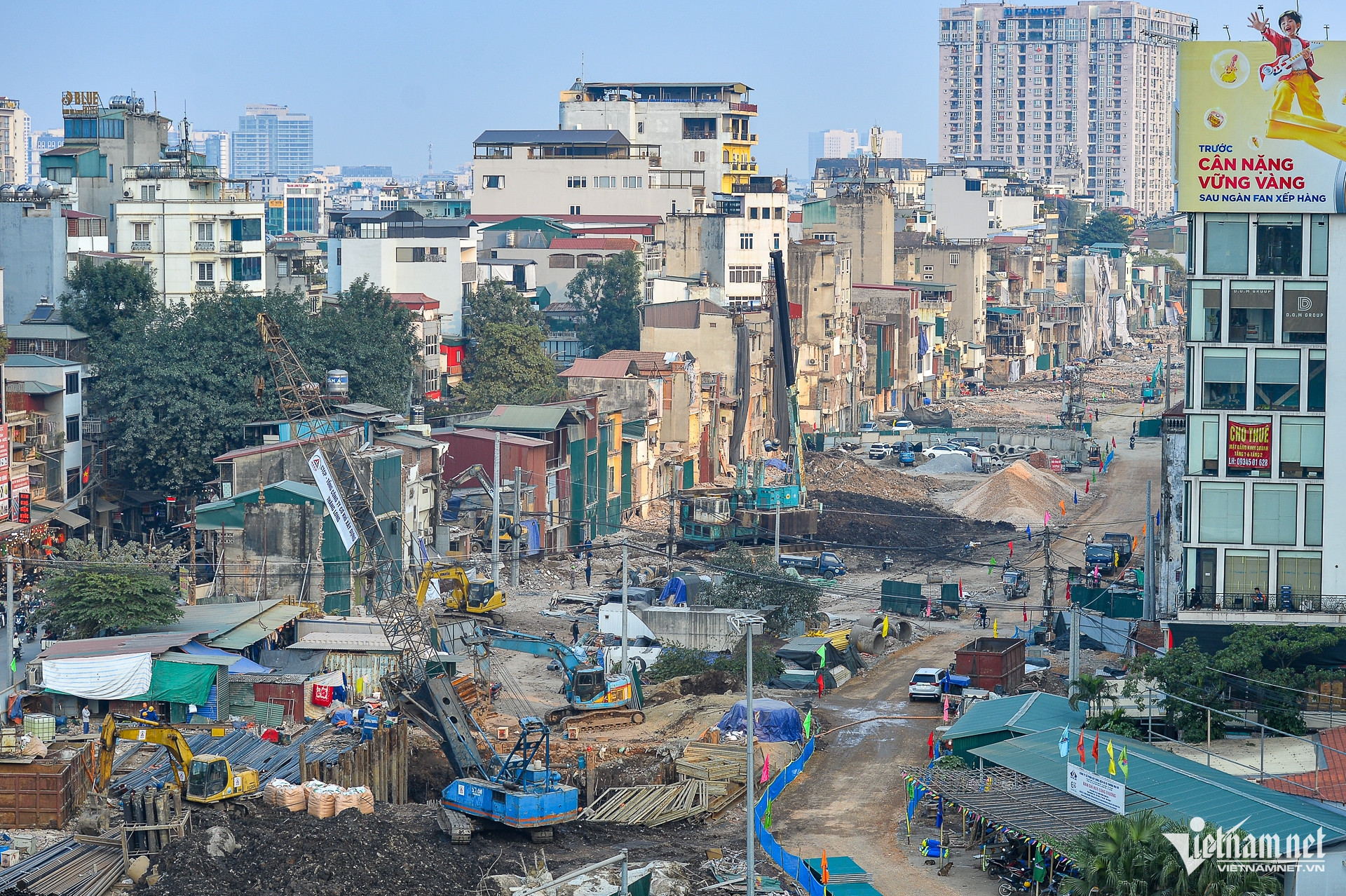
After the Lunar New Year holiday, traffic began to flow seamlessly on the section of Ring Road 1 from Hoang Cau to Voi Phuc – a route mentioned for decades as an "unsolvable bottleneck" of Hanoi. In old sections, congestion remains, but on the new part of the route, machinery and people work almost without rest, as if racing against time to clear a traffic artery that had been constricted for many years.
Figures show a very clear change. The total area cleared is over 153,000 sqm, involving nearly 2,000 households and organizations. In just over five months before Tet, O Cho Dua, Giang Vo, and Lang wards completed compensation, support, and resettlement for 1,295 households, whereas in the seven previous years, the figure was just 686 households. Procedures did not change overnight, but the approach certainly did.
The city’s official opening of the Hoang Cau–Voi Phuc section of Ring Road 1 therefore not only settled a decades-long infrastructure bottleneck, but also sent a more important signal: Hanoi has moved decisively into action.
Former Minister of Planning and Investment Vo Hong Phuc said he was deeply impressed by how Hanoi handled this project. The Ring Road 1 section from Hoang Cau to Voi Phuc had been discussed since the 1990s, across multiple leadership terms. Individual segments were opened, but the project could never be completed due to difficulties in land clearance, procedures, and compensation.
What is regrettable, he noted, is that had it been done earlier, clearance costs would have been much lower. Much of the land along the route was then agricultural rather than residential, with relatively low compensation values. Prolonged hesitation meant missed opportunities and steadily rising costs. Only when new leadership stepped in, decisively did tasks once considered “impossible” begin to be resolved. The lesson is clear: defining goals is not enough; what matters is acting early and acting decisively.
This shift is tied to a new governing spirit. Hanoi Party Secretary Nguyen Duy Ngoc has emphasized a consistent principle: dare to think, dare to act, dare to take responsibility, and see things through to the end - using work effectiveness and the quality of service to citizens and businesses as the measurement.
That spirit goes beyond slogans. It has been translated into the “six clear” approach: clear people, clear tasks, clear timelines, clear responsibility, clear authority, and clear results, and into a focused effort to resolve five long-standing urban bottlenecks: traffic congestion, urban order, environmental pollution, flooding, and food safety.
Five mega urban areas
For many years, Hanoi has developed at a very high speed: apartment buildings have sprouted up densely, traffic has become more crowded every year, and the pace of life is much more hurried than before. But while the city has grown rapidly in terms of height and density, roads have not been expanded in time, the drainage system has not kept pace with "concretization," and schools and hospitals in many areas remain constantly overloaded.
Hanoi’s current momentum cannot immediately solve all the challenges of a city of nearly nine million residents, but it shows something crucial: the city has begun tackling its most difficult bottlenecks head-on.
From the opening of Ring Road 1, a new wave of infrastructure development began to appear, leading to a change in how Hanoi reorganizes its development space. The Hanoi Mayor has signed 10 decisions to develop emergency construction works, with a total investment of more than VND5,500 billion, requiring completion within 2026. The message is very clear: long-standing urgent matters are no longer allowed to be handled at a sluggish pace.
Since the end of 2025, after announcing a population dispersal plan with about 860,000 people to be relocated out of the inner-city area within the next 20 years, Hanoi has truly entered an infrastructure development acceleration phase.
On December 19, 2025, the city started construction on seven key infrastructure and urban projects, with a total preliminary investment of nearly VND1.9 quadrillion. These are not just individual works but pieces of a new development structure.
Prominent among them are the Olympic Sports City and the Red River Landscape Avenue – two symbolic projects for the expansion of the Capital's development space. Along with the traffic axes and ring roads, Metro Line 5 (Van Cao – Hoa Lac), nearly 40km long, is identified as the backbone of the Transit-Oriented Development (TOD) model, connecting the central area with the western part of the city.
Tu Giang
.svg)
