 Vietnamnet.vn

 Podcast



Hanoi’s public venture capital fund to launch December 20

Truong Viet Dung, Vice Chairman of Hanoi People's Committee, delivers the opening remarks on December 13. Photo: Vu Hieu
At the National Policy Forum on International Investment Cooperation for Innovation and Startups held on December 13, Truong Viet Dung, Vice Chairman of Hanoi People's Committee, announced that the city will officially launch its venture capital fund on December 20.
With an initial budget of 600 billion VND (approximately 24 million USD), Hanoi plans to allocate up to 2,000 billion VND (around 80 million USD) to venture capital investments in the coming period.
“This is a major shift in perception and thinking. We are embracing venture capital and risk, and the government is joining hands with private investors,” said Truong Viet Dung.
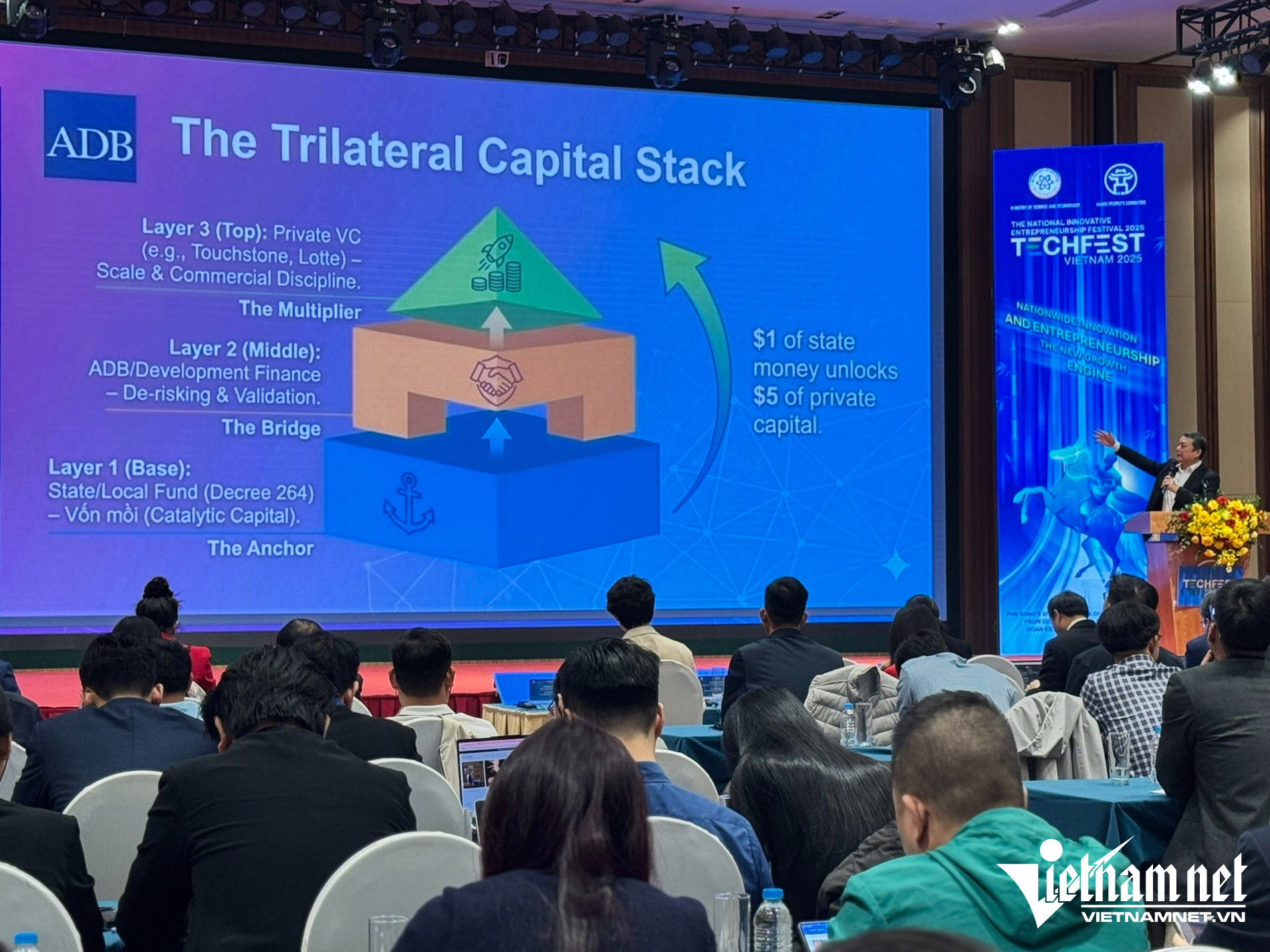
He reiterated a fundamental principle of public venture funds: the state does not replace the market but plays a facilitating role, sharing initial risks. Public-private co-investment is key, with a preference for private-sector leadership. State funding is intended as catalytic capital to attract broader social resources.
He added that higher-risk portfolios will be accepted, with a focus on innovation, core technologies, and green tech.
To achieve the city’s 11% growth target next year, Truong emphasized: “There is no alternative - besides revitalizing traditional growth drivers like public investment, exports, and consumption, we must rely on science, technology, innovation, and digital transformation.”
Drawing lessons from international markets such as the U.S., he asserted that innovation only thrives when society allows for experimentation and offers civilized, controlled risk-absorption mechanisms.
In this context, risk is managed and distributed through market institutions, with venture capital funds playing a central role - helping many countries give rise to globally competitive tech companies.
In the near future, Hanoi will work closely with national ministries to implement new mechanisms, while continuing to improve the investment environment, innovation infrastructure, and execution capacity at the local level.
The city’s leadership invited domestic and international businesses, funds, and startups to come to Hanoi, “where the government is always ready to foster innovation and partner long-term to turn creative ideas into real societal value.”
Every city should have its own startup 'gazelles'
At the event, representatives from investment funds, banks, and international organizations offered insights on public-private collaboration in venture funding for innovative startups, aiming to address challenges related to the twin transition and smart urban development.
They also offered policy recommendations to help shape national and local investment strategies for Vietnam’s venture capital market.
Speakers praised Vietnam’s strong push to build an innovative startup ecosystem through institutional reforms and its commitment to venture capital.
However, experts also called for robust filtering mechanisms to ensure quality investments and proposed priority frameworks to help foreign investors access the domestic market, channeling global capital into Vietnam.
David Lewis of Energy Capital Vietnam (ECV) expressed his optimism about Vietnam’s prospects: “Within just 20 years, Vietnam will no longer be asking ‘how to attract capital,’ but instead, ‘how to govern capital more effectively.’”
Samuel Ang, a senior expert at the Asian Development Bank (ADB), proposed a strategy focused on “gazelles” - a term he uses for high-growth startups that account for only 1% of all companies but generate 40% of new jobs.
Gazelles, according to Ang, must meet three criteria: they should be young (under five years old), operate in hard tech sectors, and solve large-scale infrastructure problems that can be replicated.
Banks like ADB can act as risk mitigators, validating these startups to attract further venture capital.
He recommended that each locality create a curated list of its own gazelle companies, focusing on sectors such as AI, semiconductors, and green infrastructure. State venture funds could adopt a fund-of-funds model, while startups should aim to solve local problems - such as traffic and waste management in Hanoi’s case.
Green and climate tech were also key investment priorities for Juhern Kim, Vietnam Country Representative at the Global Green Growth Institute (GGGI), especially given Vietnam’s commitment to net-zero emissions by 2050.
He suggested joint fund models, fund-of-funds, and blended finance mechanisms to catalyze and co-finance innovation.
Du Lam
.svg)
