 Vietnamnet.vn

 Podcast



Speaking with VietNamNet, Nguyen Phi Thuong, Director of Hanoi’s Department of Construction, said the city is currently executing multiple large-scale infrastructure projects. These include the Capital Region’s Ring Road 4, seven major bridges spanning the Red River, two metro lines, and a new road connecting to Gia Binh Airport.
Particularly notable are two newly launched mega-projects, both groundbreaking as of December 19: the Olympic Sports Urban Area, with a total investment of around $38.2 billion, and the Red River Scenic Boulevard, estimated at $35.3 billion.
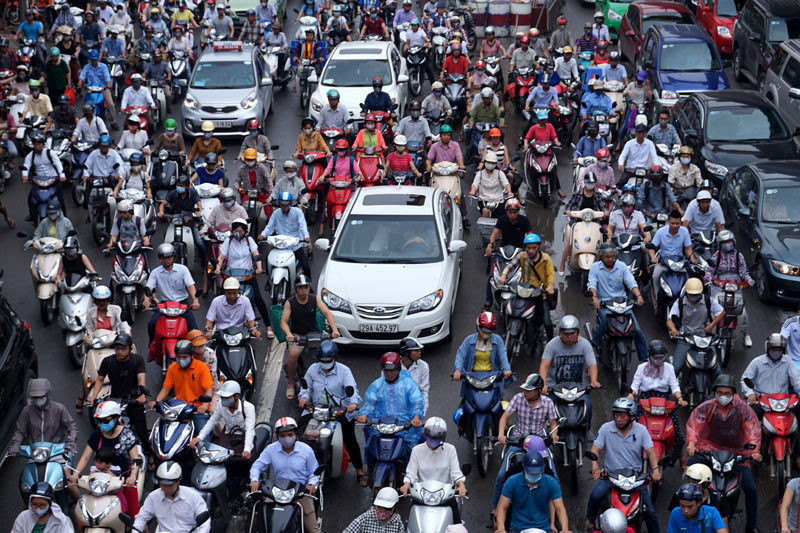
Alongside infrastructure investment, Hanoi is urgently tackling four major bottlenecks in the construction sector: traffic congestion, environmental pollution, urban flooding, and the reorganization of urban planning.
According to the city's construction chief, congestion is a “long-term battle,” but immediate interventions are essential to prevent worsening conditions.
In the long term, Hanoi aims to boost high-capacity public transportation while restricting private vehicle use and restructuring overall traffic organization.
For immediate action, this week the city will coordinate with the Traffic Police Department (Ministry of Public Security) and the Vietnam Road Administration (Ministry of Construction) to begin restricting vehicle flow on Ring Road 3.
Additionally, truck access during peak hours will be banned on certain roads - including National Highway 32 and the Lang–Hoa Lac route (inbound direction only). The outbound lanes will operate as normal. The rollout is set for January 1, 2026.
City officials also plan to restrict certain delivery trucks entering the city center during peak hours. These include vehicles falsely marked as postal or express delivery services, which have caused disorder within inner-city streets.
Because this move involves amendments to road traffic regulations, Hanoi will issue official directives this week, with implementation also slated for January 1.
At the same time, Hanoi is fast-tracking an emergency project to resolve congestion at the Phap Van – Cau Gie interchange, one of the capital’s most complex traffic junctions. This project will also be completed and operational by January 1, 2026.
On the environmental front, the city is executing pollution treatment projects along four inner-city rivers, with work already underway on the To Lich River. Hanoi has also passed a new resolution replacing Resolution 47/2024/NQ-HDND to implement low-emission zones, part of a broader effort to improve air quality.
To address flooding, the city is developing a long-term drainage and anti-flooding master plan. In the short term, following the 18th Party Congress of Hanoi, emergency projects were launched to build new regulating lakes, pumping stations, and control systems - all with a goal to complete before next year’s rainy season.
Urban reorganization is being implemented with a focus on modernization and smart urban solutions, aiming to shape Hanoi into a more civilized and livable capital.
Vu Diep
.svg)
