 Vietnamnet.vn

 Podcast



As part of Hanoi’s strategic development plan for 2026–2035, the city is set to establish five new large-scale urban areas covering approximately 49,700 hectares, with a total projected investment of over $160 billion.
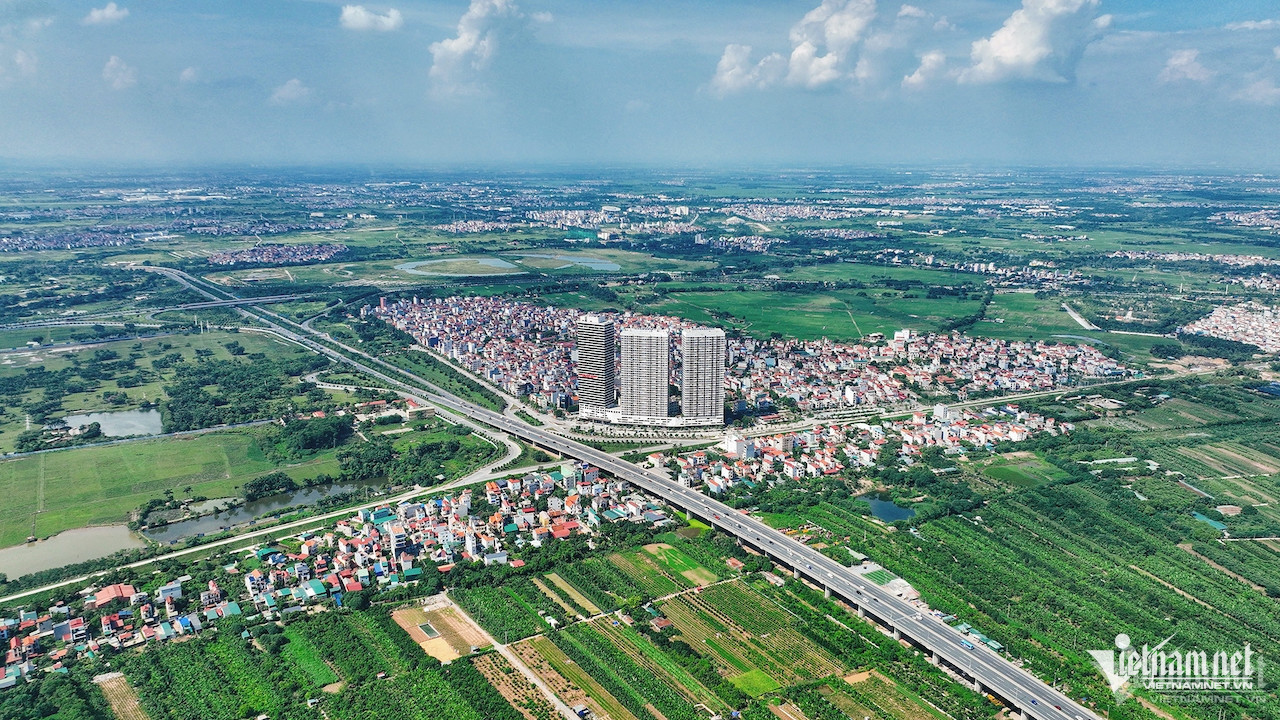
The announcement was made on January 27 during the 31st session of the Hanoi People’s Council, where the city approved a resolution outlining key components of its 100-year capital master plan.
According to the proposal, the five new urban zones will serve as strategic pillars for the capital’s future growth and urban restructuring.
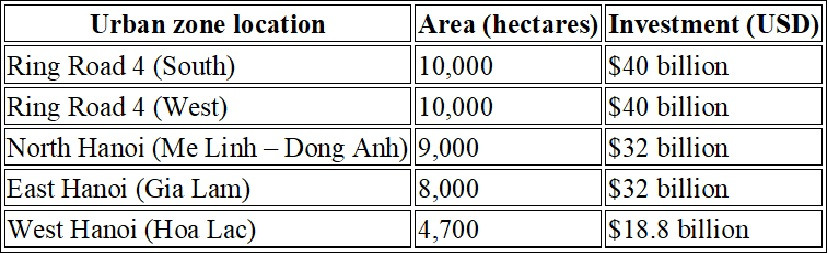
The first zone will be developed on both sides of the southern section of Ring Road 4. Spanning 10,000 hectares, it will require an estimated $40 billion in investment. About 55% of the land will be dedicated to housing, while the remaining space will include green areas, social infrastructure, public facilities, and technical infrastructure. Housing distribution will be 80% low-rise (3–5 floors) and 20% high-rise (21–30 floors).
The second urban zone will rise along the western section of Ring Road 4, also measuring 10,000 hectares with a similar $40 billion investment. This area will feature a greater share of high-rise housing - approximately 40% - with the remainder being low-rise homes.
Urban expansion across all cardinal directions
The third development will be located to the north of Hanoi, in the Me Linh – Dong Anh area. With a projected area of 9,000 hectares and an investment of around $32 billion, it will follow a housing distribution pattern similar to the western Ring Road 4 zone.
To the east, Gia Lam will host the fourth urban zone, occupying 8,000 hectares and attracting an estimated $32 billion in investment. Like the northern and western areas, this development will include 40% high-rise and 60% low-rise housing.
Finally, the fifth and smallest project will take shape in Hoa Lac, west of the city, covering 4,700 hectares. It is projected to cost $18.8 billion and will also maintain a 40-60 ratio between high-rise and low-rise housing.
These new developments are part of a broader plan to restructure Hanoi’s urban core, ease congestion, and decentralize population density.
In a related move, Hanoi is also proposing to relocate over 860,000 residents from within Ring Road 3 by 2045 as part of its long-term demographic strategy.
Summary of five strategic urban zones in Hanoi (2026–2035):
Hong Khanh
.svg)
