 Vietnamnet.vn

 Podcast



In celebration of the 43rd anniversary of Vietnamese Teachers’ Day (November 20), the People’s Committee of Ho Chi Minh City held a meeting over the weekend with educators and more than 70 leaders from universities, academies, and institutes in the city.
Attending the meeting were Tran Luu Quang, Secretary of the Party Central Committee and Secretary of the Ho Chi Minh City Party Committee; Associate Professor Dr. Vu Hai Quan, member of the Party Central Committee and Standing Deputy Minister of Science and Technology; Nguyen Van Duoc, member of the Party Central Committee, Deputy Secretary of the Party Committee, and Chairman of the Ho Chi Minh City People’s Committee; and Tran Thi Dieu Thuy, member of the Party Committee and Vice Chairwoman of the People's Committee, along with leaders from various departments and agencies.
Scholars propose practical solutions

The meeting was not only an opportunity to honor educators but also served as a platform for city leaders to listen to university representatives and address existing challenges.
Associate Professor Dr. Hoang Cong Gia Khanh, Rector of the University of Economics and Law (UEL), part of the Vietnam National University, Ho Chi Minh City, opened the discussion by sharing his experience collaborating with the city in managing and developing public assets.
He supported the city’s policy of reallocating surplus public assets after administrative restructuring to educational and healthcare institutions, calling it “a timely and correct decision.” However, he emphasized the need for clear principles, criteria, and conditions to implement this effectively.
He noted that UEL had completed the Project on Management, Exploitation, and Use of Public Assets assigned by the Ho Chi Minh City People’s Committee and is ready to further refine the transfer criteria.
From the perspective of urban development, Associate Professor Dr. Nguyen Huu Huy Nhut, Acting Rector of Hoa Sen University, proposed that Ho Chi Minh City should consider the maritime economy as a new driver of growth. He described it as a “green and intellectual development frontier,” advancing toward a model of circular and sustainable economic development.
Hoa Sen University suggested three strategic pillars: modernizing ports, logistics, and maritime services; developing coastal cities and marine tourism; and establishing a center for research and innovation in the maritime economy.
On the topic of green transition, Dr. Le Mai Lan, Vice Chairwoman of Vingroup and Chairwoman of the Board at VinUniversity, revealed that Ho Chi Minh City emits 35–40 million tons of CO₂ annually. Industry and energy account for 40%, transportation 25%, and infrastructure and residential activities nearly 30%. Without prompt action, the city could lose up to 3% of its GRDP annually by 2050.
VinUni proposed three strategic solutions: establish the Ho Chi Minh City Green Transition Steering Committee and Green Transformation Fund; launch the Comprehensive Electrification and Circular Program 2025–2030; and issue a Green Data and Metrics Strategy.
From the international research community, Professor Dr. Nguyen Thu Anh, Director of the University of Sydney Vietnam Institute, recommended that the city prioritize precision medicine and biotechnology by leveraging artificial intelligence, big data, and smart devices. She also suggested forming a center for research and production in biotechnology, while promoting functional food innovations based on Vietnamese ingredients and cuisine. The institute requested support with tax exemptions and international aid to serve community-focused research.
To progress, one must dare to be different


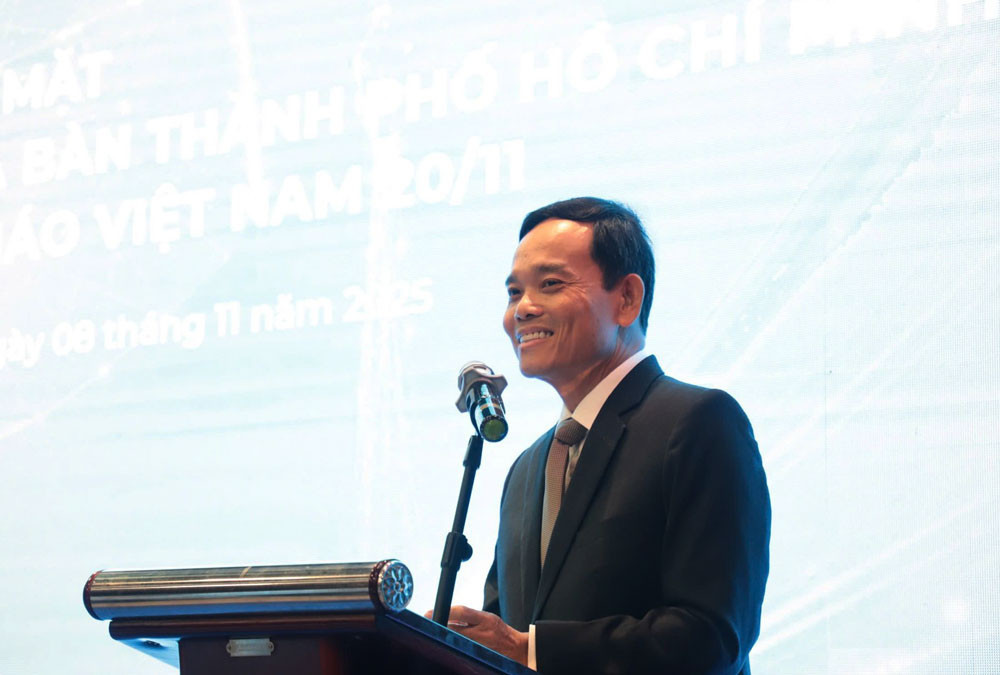
Professor Dr. Huynh Van Son, Rector of Ho Chi Minh City University of Education, emphasized the importance of culture, education, and mental health in urban development.
He urged the city to digitize scientific data and encourage direct commissioning of research from scientists, instead of relying on cumbersome administrative procedures. His university has initiated programs in cultural education, social welfare, and traditional heritage preservation in Con Dao.
In response to the proposals, Secretary Tran Luu Quang stated that the city has already adopted a policy of reallocating surplus land and buildings for the development of education and healthcare, noting specific proposals from institutions like the Ho Chi Minh City University of Medicine and Pharmacy, Vietnam-Germany University, the University of Economics Ho Chi Minh City, and the Vietnam National University.
He also acknowledged the academic community’s ideas for socio-economic development, especially regarding green transition efforts in Can Gio and Con Dao.
The city is considering forming a Steering Committee for the Development of Ho Chi Minh City, with green transformation potentially being a dedicated subcommittee. Additional plans include advancing waste-to-energy technologies and recycling initiatives.
Regarding Con Dao’s development, the Secretary shared that the city aims to transform it into a green zone by transitioning to electric vehicles and encouraged universities to bring students to Con Dao at least once to learn about its history and core values.
Secretary Tran Luu Quang affirmed that Ho Chi Minh City is committed to creating the best conditions for universities to grow and to maximize the potential of the university-research-government model.
In his concluding remarks, Secretary Quang sent a strong message to the academic community, asserting that the city will implement change - particularly in its methods and approach to complex challenges - because “we cannot expect different results by doing things the old way.” He urged for greater courage and innovation.
He stressed that the current regulatory framework has evolved significantly and that, if used flexibly, it could help Ho Chi Minh City break through limitations.
The city’s top Party official expressed his desire to hear more from experts and scientists and tasked the Ho Chi Minh City Institute for Development Studies (HIDS) with receiving, classifying, and advising on these contributions.
The meeting concluded as a renewed commitment between city officials and the scientific community to “co-create a knowledgeable, innovative, and sustainably developed Ho Chi Minh City.”
Quoc Ngoc
.svg)
