 Vietnamnet.vn

 Podcast



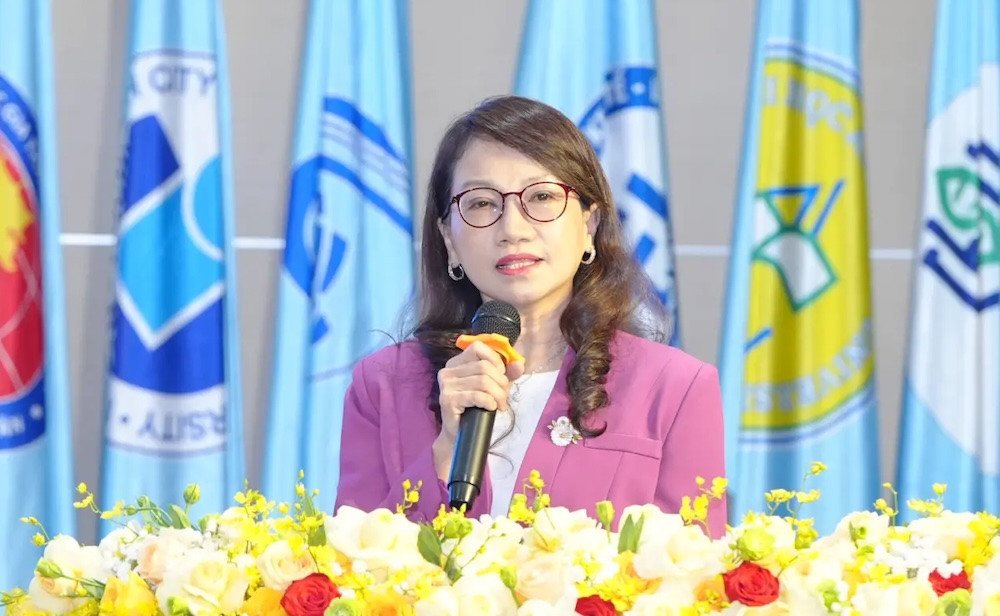
At the recent annual conference, the VNU-HCMC Board of Directors announced draft strategic targets for the 2026–2030 period, aiming to create a breakthrough in both human resources and scientific research.
Over the next five years, VNU-HCMC plans to add 1,500 PhDs, around 50 percent of whom are expected to hold the academic titles of professor or associate professor. On average, the university system aims to increase its PhD staff by about 300 people per year.
In terms of research, the entire VNU-HCMC system targets publishing 41,200 international scientific papers and owning 100 international patents. In addition, the university plans to build one to two hospitals serving training, research, and medical examination and treatment. Average employee income is expected to rise by 10–12 percent, while the on-time graduation rate is targeted at 70 percent.
Multiple programs
Currently, VNU-HCMC is implementing a range of solutions to increase the number of PhDs, most notably the VNU350 program, which aims to attract, retain, and develop outstanding young scientists and leading experts.
The program targets around 350 individuals with PhD-level qualifications or higher during the 2024–2030 period.
Under this program, in the first two years, young scientists will be granted one category C research project with funding of VND200 million. In the third year, they will receive one category B project with funding of up to VND1 billion. In the fourth year, they will be supported with laboratory investment for scientific research worth up to VND10 billion. In the fifth year, they will receive support and guidance on procedures for consideration for the national associate professor title.
For leading scientists, in the first two years they will be granted one category B research project with funding of up to VND1 billion. In subsequent years, they will be supported with laboratory investment for scientific research worth up to VND30 billion, as well as assistance in establishing strong research groups and registering to lead research projects at various levels.
Scientists working at VNU-HCMC are entitled to income and other benefits under the specific policies of their affiliated units, including salaries, bonuses, allowances, additional income, allowances for teaching beyond standard workloads, seniority allowances, research support, and rewards.
VNU-HCMC is also piloting PhD training under international standards, allowing doctoral candidates to defend their dissertations in as little as two years. Candidates may also be exempt from the independent external review process if they are the first author of at least three conference papers or scientific articles.
According to the pilot regulations issued by VNU-HCM, there are two training modes:
Full-time intensive research: Candidates must complete their overview essays, specialized topics, and the dissertation within 12 months of enrollment. Candidates must be the lead author of at least three reports or articles published in journals indexed in the Web of Science or Scopus (or equivalent), with at least one publication in the Q2 group or higher.
Combined research and coursework: Candidates must fulfill the requirements set by the Ministry of Education and Training while meeting additional scientific publication requirements stipulated by the university.
The university will recognize scientific publications equivalent to those in the list prescribed by the State Council for Professorship, consistent with industry practices and international contexts, ensuring equivalent quality and compliance with current regulations.
Academic integrity and accountability
Candidates with outstanding academic and research achievements may defend their dissertations ahead of schedule, with a minimum program completion time of two years. The new regulations also waive the independent review process for lead authors of at least three publications (Web of Science/Scopus) including at least one Q2 article.
VNU-HCM requires its member universities to be responsible for verifying the relevance of scientific publications to the dissertation content based on proposals from specialized councils. Simultaneously, it emphasizes academic integrity and accountability. If necessary, schools have the right to request candidates to clarify issues related to academic integrity, and such explanations will be made public on the school's website.
As of October 2024, VNU-HCMC had 6,406 staff members, including 991 management personnel and 5,415 professional staff. However, the university had only 34 professors, 328 associate professors, and 1,255 PhDs.
Compared to 2023, the total number of staff in 2024 increased by 202 people, but the number of PhD holders rose by only 74. VNU-HCMC has set a goal that by 2030, 75 percent of its teaching staff will hold PhD degrees or higher.
Le Huyen
.svg)
