 Vietnamnet.vn

 Podcast


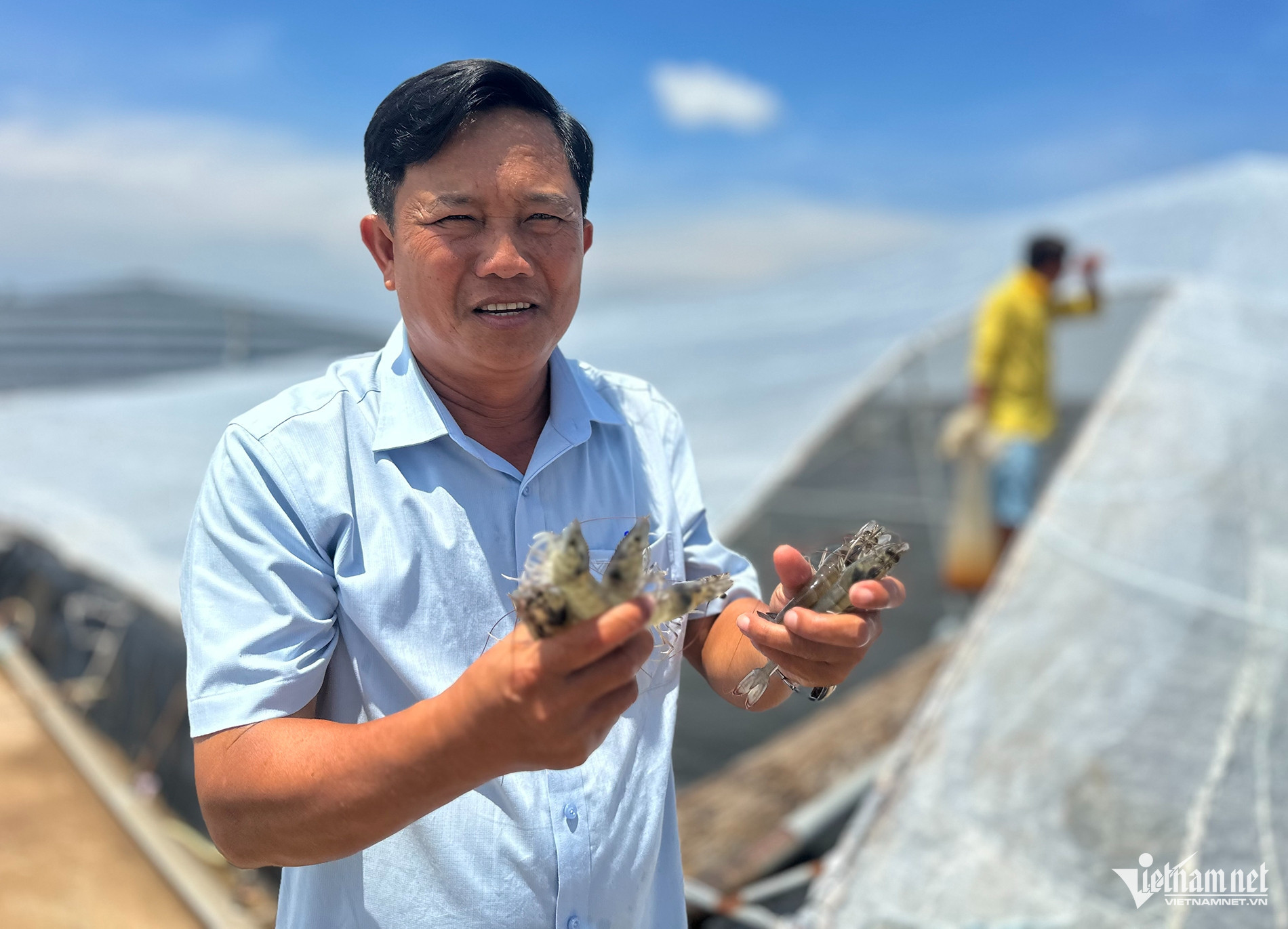
He currently manages six farming areas covering 45 hectares, generating roughly VND40 billion in profit annually.
Instead of concentrating production during the favorable main season like many local farmers, Bay, 55, a high-tech shrimp farmer in Thanh Phong Commune, in Vinh Long Province, allocates most of his land area to off-season production.
Bay said shrimp prices have declined in recent years, but production costs and operational risks remain elevated.
Investing in technology to farm during off-peak supply periods allows him to avoid direct competition with the majority of farmers. "Raising one shrimp during the off-season equals raising two during the main season," he said.
Abandoning traditional methods
Bay began raising shrimp about 25 years ago. At the time, only a few households in Thanh Phong Commune were engaged in shrimp farming. Seeing the advantages of the coastal area, he decided to make a bold investment.
After years of using traditional farming methods, a turning point came in 2017 when he decided to invest all his capital in a closed-loop, high-tech shrimp farming model.
Previously, on each hectare of land, farmers would typically have about two shrimp ponds, each with a water surface area of 4,000 sqm, with the remaining area used for settling ponds and water treatment.
Under the high-tech model, Bay allocates only about 1,500 sqm of water surface for a commercial grow-out pond, while the rest is divided among nursery ponds, settling ponds and water treatment ponds.
This setup allows him to control water quality, stock shrimp at high densities and continuously replenish the ponds with clean water. As a result, the shrimp grow faster, are less prone to disease and achieve much higher yields than under conventional farming methods.
Using net houses to reduce shock to shrimp
One solution that Bay pays particular attention to is building net houses over the shrimp ponds. The structures limit sudden temperature changes, one of the factors that can cause shrimp to develop diseases.
For example, when the ambient temperature is around 30 degrees Celsius, a heavy rain can cause the pond water temperature to fall to 25-26 degrees Celsius. Such a sudden change can shock the shrimp, reduce their appetite and increase the risk of disease.
In ponds covered by net houses, however, water temperatures change more gradually. When it rains, the temperature falls by only about 1-2 degrees Celsius before gradually rising again when sunny weather returns.
The net houses are also effective during periods of extreme heat or cold. Bay said that on hot days, temperatures inside the farming areas are generally lower than outside. During cold weather, the structures also help limit temperature fluctuations, creating a more stable environment for the shrimp.
This is also why Bay chooses to farm shrimp during the off-season. In his view, under unfavorable weather conditions, conventional farming methods can result in high losses. When ponds are covered, however, water temperatures fluctuate less, allowing the shrimp to grow more steadily.
The cost of installing a net house over a 1,000-sqm pond is about VND50 million, including support posts, tension cables and related components.
In addition to investing in net houses, Bay has developed a closed-loop farming process to control the environment and prevent disease from the outset.
Water is first pumped into a settling pond and then transferred to a treatment pond before being supplied to commercial grow-out ponds. Shrimp fry are sourced from suppliers that meet quality requirements and are then raised in nursery tanks for about 20-30 days. Once they reach a relatively uniform size, the shrimp are transferred to grow-out ponds.
During the farming process, waste is regularly collected and treated to minimize water pollution.
At the farming site, Bay regularly checks each pond, monitors the shrimp’s feeding behavior and pays particular attention to the water color. Drawing on decades of experience in the industry, he says he can assess the shrimp’s health to some extent simply by observing the color of the water.
The model's efficiency is demonstrated through yield and profitability figures. In 2019, Bay harvested about 300 tons of shrimp, generating nearly VND20 billion in profit. In 2020, production grew to roughly 350 tons, bringing in around VND25 billion.
Bay currently operates six high-tech farming zones totaling 45 hectares. He said the model yields approximately VND40 billion in annual net profit.
Hoai Thanh

