 Vietnamnet.vn

 Podcast



On December 30, 2025, the Ho Chi Minh City Party Committee’s Inspection Commission held its annual conference to review disciplinary and oversight work in 2025 and outline priorities for 2026.
The event shed light on critical post-merger challenges, a rising emphasis on data-driven governance, and a call for political accountability in Vietnam’s largest city.
2025: The year of restructuring and no-excuses discipline
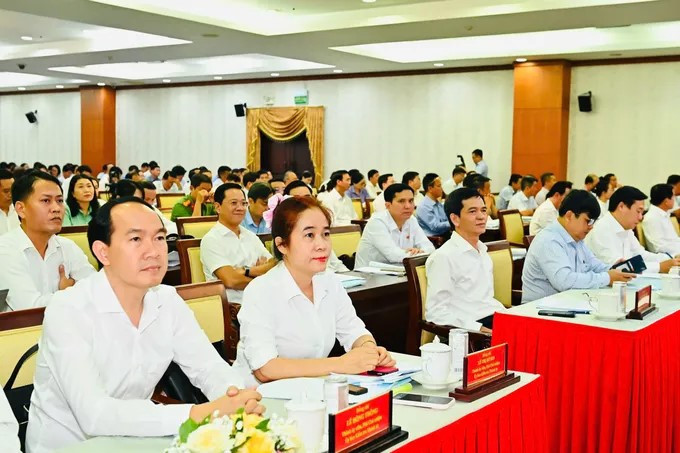
The commission’s report emphasized that, in addition to its routine responsibilities, 2025 was a year of intense focus on implementing Central Party directives to merge the Party committees of Ho Chi Minh City, Ba Ria–Vung Tau, and Binh Duong provinces.
The consolidation of 801 staff positions across local-level inspection units and 16 positions at the city-level commission ensured uninterrupted operations after the Party Congress at all levels.
Throughout the year, local and citywide Party Standing Committees conducted inspections of 809 Party organizations and over 3,500 Party members, alongside thematic supervision of 672 Party bodies and more than 3,000 individuals.
Disciplinary data revealed zero tolerance in enforcement:
Party committees disciplined 26 Party organizations and 257 members
The inspection system disciplined 7 Party organizations and 21 members
21 Party members were suspended from Party activities
In one notable effort, the commission reviewed the assets of 83 senior-level officials and audited over 1,000 Party organizations, uncovering and correcting numerous shortcomings before they escalated into serious violations.
Data-powered inspection: A shift in governance thinking
A highlight of 2025 was the transition toward data-based supervision and inspection.
In line with Resolution 57 of the Politburo, the HCMC Inspection Commission has started digitizing documents and building an integrated information system - reducing subjective judgment and enhancing accuracy.
However, some challenges remain:
Several inspection teams lagged behind schedule
Local-level oversight lacked proactive and effective follow-through
Asset and income monitoring was hindered post-merger, due to two-tier governance complexity
Grassroots inspectors in communes and wards remain inexperienced and unsure in executing duties
Over 100 sensitive, unresolved cases demand urgent closure
Speaking at the event, Nguyen Hong Linh, Deputy Head of the Central Party Inspection Commission, underlined the urgent need to close unfinished cases following previous audits and inspections.
Based on the merger of three major localities, HCMC is now subject to 18 official conclusions from the Central Commission, involving more than 300 issues.
While over 200 have been resolved, 101 highly complex issues remain, posing a significant political challenge.
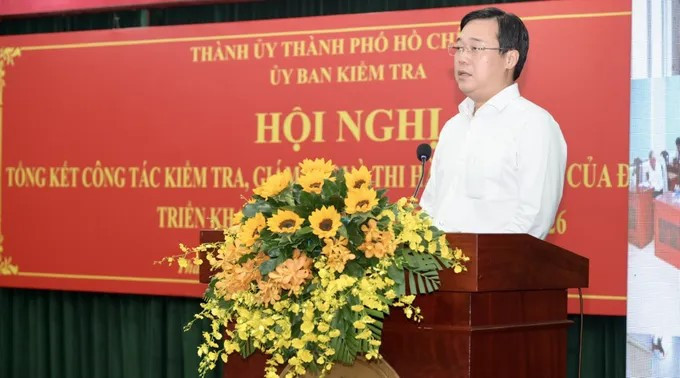
“These are sensitive and difficult cases. Resolving them will not be easy,” Mr. Linh stressed, urging the HCMC Party Standing Committee to take decisive and focused action.
He called on Department 7 (a branch of the Central Commission) to monitor progress monthly, with a goal to fully resolve all outstanding issues in 2026.
Moreover, Mr. Linh proposed a fundamental shift in methodology: “Thematic supervision must be prioritized over reactive inspections. Early detection and correction of small errors can prevent major violations.”
HCMC leadership urged to break old patterns in a new term
Le Quoc Phong, Permanent Deputy Secretary of the HCMC Party Committee, affirmed that 2026 marks a politically pivotal year, both for the city and the nation, as it kicks off a new term.
In this new context, he said, Party oversight in HCMC must evolve - shedding outdated mindsets and embracing a more proactive, preventive approach.
“To achieve real breakthroughs, we must move from reactive inspections to continuous and thematic supervision,” he declared, noting this as a core strategy to protect capable officials and avoid unnecessary personnel losses.
Mr. Phong also emphasized that a top priority for the city’s leadership in the new term is to resolve lingering issues from the 2025 merger process.
With a vast workload ahead, he concluded that human capacity - the people behind the system - is the true engine of transformation.
Quoc Ngoc
.svg)
