 Vietnamnet.vn

 Podcast



A new draft amendment to Resolution 98/2023/QH15 on special mechanisms for Ho Chi Minh City is under review by the Ministry of Justice. If approved by the National Assembly, it could mark a new step in expanding the institutional space for Vietnam’s economic powerhouse.
But according to Dr. Nguyen Dinh Cung, former Director of the Central Institute for Economic Management, the issue is not just what to amend, but how far the city is allowed to do things differently.
“The conditions are ripe for Ho Chi Minh City to have a new resolution based on breakthrough and systemic thinking,” he said, “not merely technical tweaks.”
A new city needs a new institutional framework
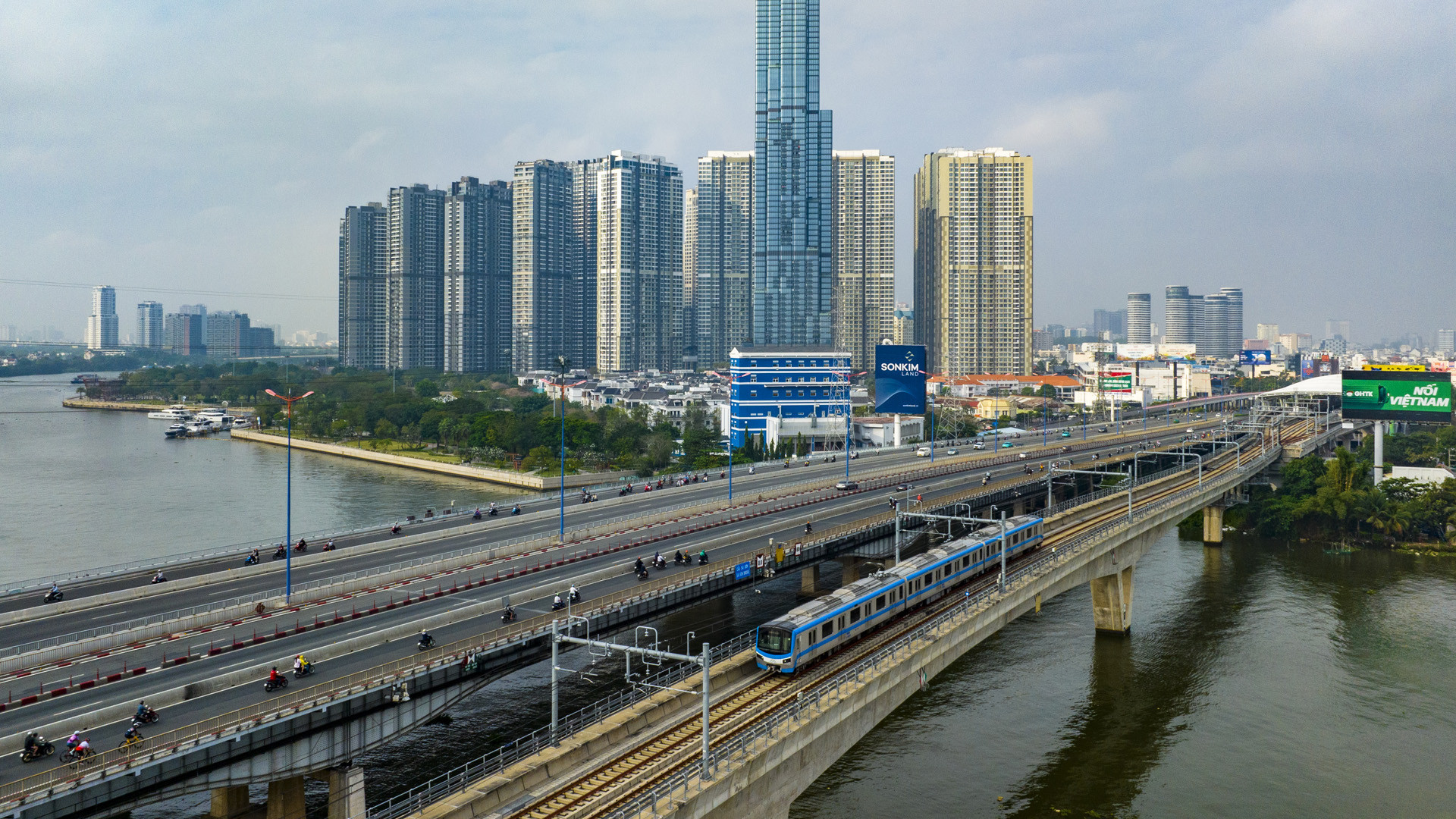
Previously, Ho Chi Minh City had about 10 million residents. Now, with a registered population of 14 million, and up to 20 million people present daily including visitors, tourists, and short-term labor, Dr. Cung believes the city clearly needs a stronger, more flexible institutional framework.
The amendment of Resolution 98 is therefore not just necessary, but inevitable.
Sharing this view, Dr. Truong Minh Huy Vu, Director of the Ho Chi Minh City Institute for Development Studies, noted that the new draft expands decentralization and delegation in most core areas - from urban planning and land management to infrastructure investment and attracting strategic investors.
“With the city’s current size and economic scale, it’s impossible to operate under a 10-year-old system,” he said.
The draft focuses on four key reforms: resolving conflicts between land and investment laws; enabling the city to proactively reclaim and allocate land for project acceleration; expanding sectors for strategic investors such as advanced healthcare, logistics, seaports, renewable energy, and heritage conservation; and most notably, establishing a free trade zone (FTZ) tied to the Cai Mep - Ha Port area.
In short, Ho Chi Minh City has outgrown its old institutional “jacket.” The question now is whether the country dares to tailor a new one - well-fitted, modern, and flexible enough to breathe.
From TOD to FTZ: Signs of institutional unshackling
From an economic governance perspective, Dr. Nguyen Dinh Cung identified two critical features in the draft: transit-oriented development (TOD) and the FTZ.
Currently, under Resolution 98, the city can only use public funds for compensation and resettlement around metro stations, major intersections, and the Ring Road 3. The new draft significantly broadens this scope.
TOD will no longer be confined to transport infrastructure but will extend to areas along metro lines, major junctions, and selected redevelopment zones.
“This is a breakthrough,” said Dr. Cung. “It shifts the focus from transport to comprehensive urban development, allowing the city to leverage land as a tool for spatial renewal and flexible investment attraction.”
However, he warned against equating “untying” with “loosening.” The past model of trading land for infrastructure (build-transfer or BT) left problematic legacies.
“There are at least three risks with land-for-infrastructure schemes: land prices are never accurately appraised, investors may manipulate valuations, and public officials always face legal risks,” he said.
Instead, he recommends moving toward a transparent land value capture mechanism rather than exchanging land to pay public debt.
If TOD expands urban space, FTZ unlocks a new economic frontier.
FTZ must be truly special, not halfway
The draft proposes a free trade zone with superior mechanisms: goods entering and exiting the FTZ will be treated as special exports/imports, exempt from import-export and VAT taxes unless brought into the domestic market.
Foreign currencies can flow freely in and out of the zone. Financial, banking, fintech, and cross-border payment activities may be piloted under a sandbox mechanism.
Importantly, the FTZ’s management board will report directly to the central government, with authority equivalent to a ministry - representing the deepest decentralization ever proposed.
“If we’re building an FTZ, it must be truly special - not a free trade zone in name only but still bound by the old legal system,” Dr. Cung stressed.
He added that Vietnam currently lacks any models akin to Dubai’s JAFZA or Singapore’s FTZs - ecosystems where trade, logistics, finance, and technology converge.
If Ho Chi Minh City can pull this off, it would not just be an economic project but a national-scale institutional experiment.
“Ho Chi Minh City needs a real institutional sandbox”
For Dr. Cung, this is the most important - and yet overlooked - aspect.
He calls it a real institutional sandbox: a legal space where the city is empowered to experiment, fail, correct, and learn.
“Today’s special mechanisms still follow the model of ‘asking to do something different but doing it the old way,’” he said. “Even with approval, implementation is delayed awaiting central guidance. That kills innovation, no matter how many special mechanisms you write.”
A true sandbox must be written into law with a clear framework: define which areas can be piloted, set goals for each phase, give the city full discretion to choose tools and organizational models, and establish an independent central oversight mechanism.
“The city must have the right to adapt flexibly - even stop if needed,” he said. “Only then can Ho Chi Minh City truly become the nation’s institutional lab.”
From ‘amendment’ to ‘institutional reinvention’
If Resolution 98 is viewed as an institutional contract between the central government and Ho Chi Minh City, then the upcoming amendment must go beyond extending terms - it must redefine the relationship.
The city does not just need “more rights.” It needs autonomous legal space where experimentation is allowed within managed risk.
“We can’t expect a locomotive to speed ahead if we keep tying it down with old ropes,” said Dr. Cung. “An amendment helps the city breathe, but a resolution that rethinks institutional logic lets it fly.”
Ultimately, revising Resolution 98 is not about adding a few more powers. It’s about testing Vietnam’s institutional autonomy at the scale of its largest metropolis.
Unleashing Ho Chi Minh City is not just a local reform - it’s a test of national governance. Can Vietnam be confident enough to let its flagship city accelerate, stumble, self-correct, learn, and inspire others?
If the answer is yes, this won’t just be a special mechanism. It will be a transformational leap for Vietnam’s entire economic architecture.
Tu Giang - Lan Anh
.svg)
