 Vietnamnet.vn

 Podcast



Speaking to VietNamNet on the sidelines of the 2026 Ho Chi Minh City Conference on Promoting Imports, Exports and Supply Chains, organized by the municipal Department of Industry and Trade on September 21, Vo Thi Phuong Lan, Standing Vice Chairwoman of the Ho Chi Minh City Logistics and Seaport Association (HLA) and Chairwoman of ASL Logistics, said logistics costs in the city and Vietnam as a whole remain much higher than in many other countries in the region.
She estimated the costs at 16-17% of GRDP.
According to the HLA executive, a longstanding bottleneck for the logistics industry in Ho Chi Minh City and Vietnam’s southern key economic region is fragmented transport infrastructure and limited connectivity.
Roads linking airports and major seaport clusters with industrial parks and manufacturing facilities are frequently congested, increasing both transportation time and costs.
Bui Ba Nghiem, a senior specialist at the Agency of Foreign Trade under the Ministry of Industry and Trade, said Ho Chi Minh City currently accounts for around 17.6% of Vietnam’s exports, 18.4% of imports and 18% of the country’s total import-export turnover.
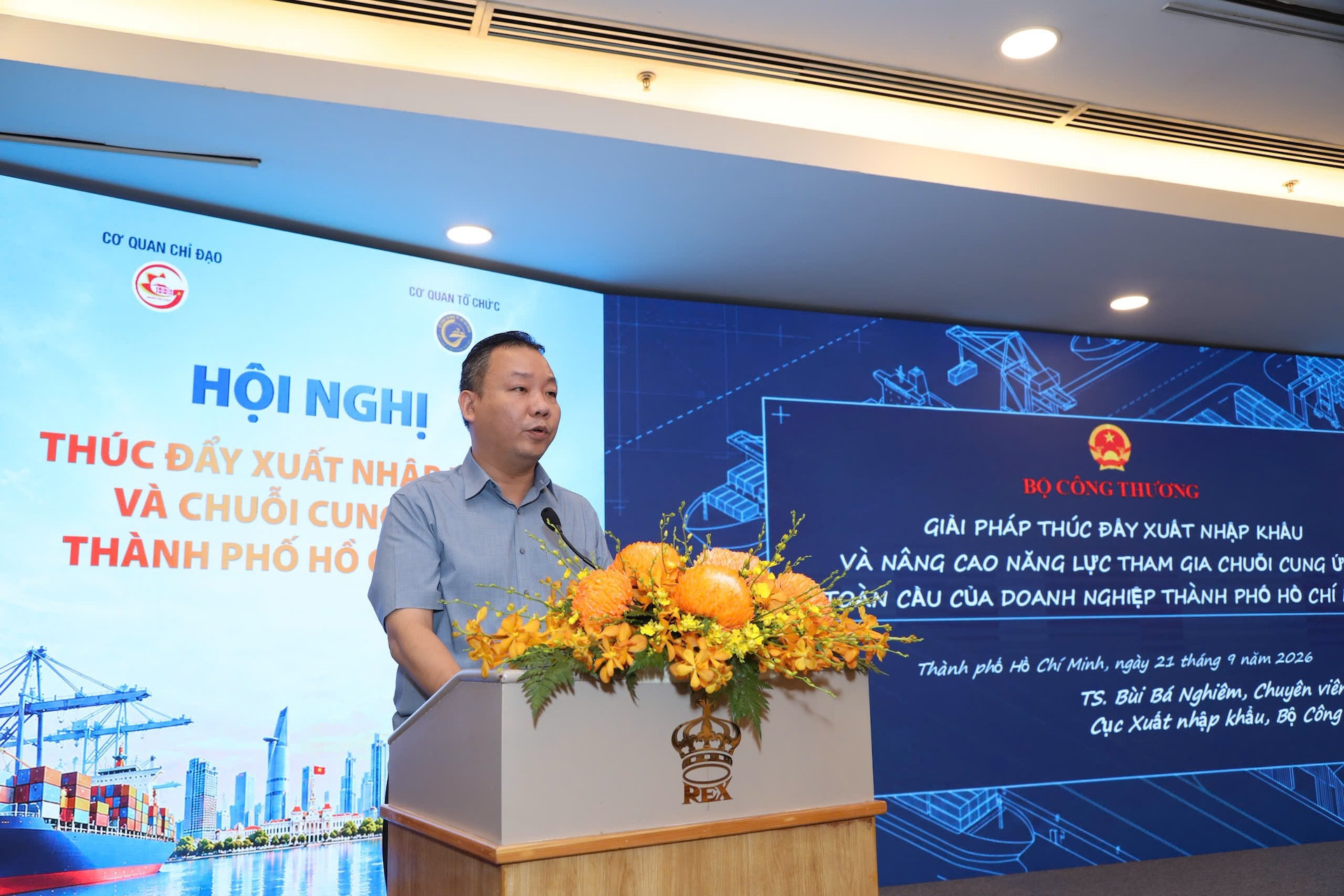
However, the city’s foreign trade faces four major bottlenecks. Its export scale does not adequately reflect the value generated by domestic companies; market opportunities are not always converted into contracts because of difficulties with certificates of origin (C/O); fragmented logistics infrastructure leads to additional storage costs and delivery delays; and mechanisms for inter-agency coordination and data sharing have yet to meet operational needs.
The pressure is mounting as international trade becomes increasingly volatile.
Nghiem proposed seven groups of measures for Ho Chi Minh City to maintain its markets, raise supply-chain standards and optimize the movement of goods.
They include expanding markets for individual product groups while strengthening the ability to respond to tariff fluctuations; upgrading domestic suppliers to meet buyers’ requirements; diversifying import sources and using inputs more efficiently; organizing logistics around production corridors and international gateways; providing support for financing and compliance capabilities; building a digital platform to coordinate imports, exports and logistics; and facilitating trade through a seamless processing mechanism.
According to the Ministry of Industry and Trade representative, businesses need to strengthen their capabilities in order management, inventory, multimodal transportation and international distribution, while developing closer links with overseas agents that can take responsibility throughout the entire shipping journey.
Companies also need to gradually gain control over core and strategic technologies while assessing their dependence on critical materials such as fabrics, engineering plastics and electronic components.
Based on those assessments, businesses should develop alternative sourcing plans, determine appropriate safety-stock levels and ensure that finished products comply with rules of origin.
Ho Chi Minh City pushes to lower logistics costs
Le Van Danh, Deputy Director of the Ho Chi Minh City Department of Industry and Trade, said the city is implementing a range of measures to improve transport infrastructure connectivity, with the goal of reducing logistics costs to 11-14% of GRDP during the 2025-2030 period.
At the heart of the strategy is the development of a multimodal transport network encompassing roads, railways, inland waterways, aviation and seaports.
Between now and 2030, alongside accelerating ring roads and expressways connecting Ho Chi Minh City with Moc Bai, Can Tho and Long Thanh, the city will prioritize the development of railway and inland waterway infrastructure.
A railway linking industrial parks in the Binh Duong area with the Cai Mep-Thi Vai port cluster has been identified as a strategic project that could shorten transportation times and lower costs for imports and exports.
The city also plans to pilot an interconnected open-port mechanism to attract more transit cargo.
According to Vo Thi Phuong Lan, exemptions and reductions in seaport infrastructure fees have helped import-export businesses lower their operating costs. Digital transformation and the automation of business processes are also bringing tangible changes.
The shift from paper delivery orders to electronic delivery orders, or e-D/Os, allows businesses and logistics agents to submit documents, pay freight charges and receive delivery orders online without having to queue at shipping lines’ offices.
At customs agencies, most goods classified under the green channel are now cleared automatically without paper documentation. Consolidating customs clearance at key centers has also reduced the need for businesses to complete procedures at multiple customs branches, while improving data transparency and speeding up clearance.
Lan said digital platforms now allow import-export companies to calculate costs across an entire supply chain with just a few steps in around two minutes, compared with at least two days previously.
“When major projects such as Ring Road 3 and Ring Road 4 are completed, combined with waterways and railway lines linking southern Vietnam’s industrial production areas with the Cai Mep deep-water port cluster, logistics costs will fall significantly,” Lan said.
The HLA executive expects increasingly integrated infrastructure and rapid digital transformation to help Ho Chi Minh City bring logistics costs below 15% in 2027-2028, creating better conditions for export growth and a more effective contribution to the economy.
Thu Ha
.svg)
