 Vietnamnet.vn

 Podcast



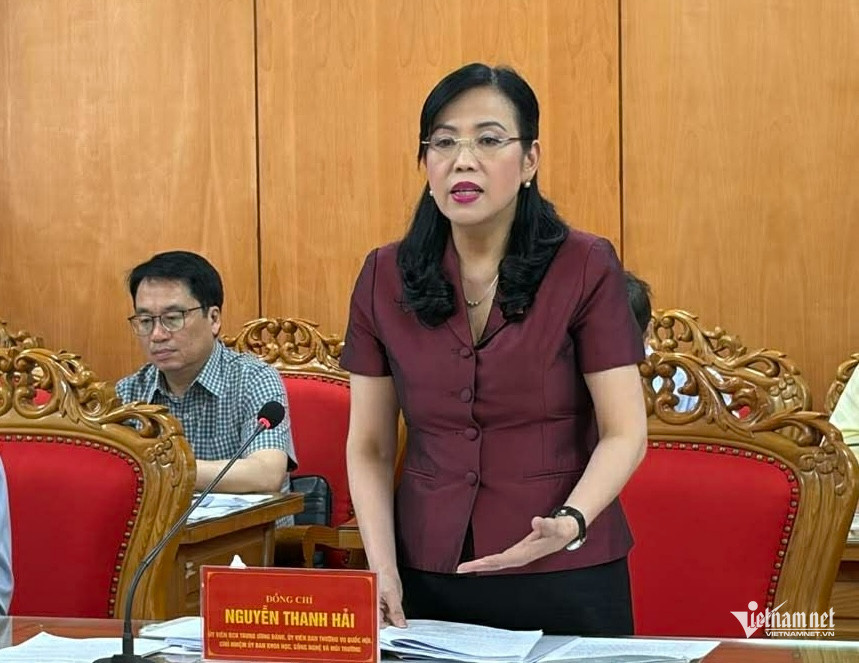
The issue was raised when a working group from the NA’s Committee on Science, Technology, and Environment, led by Committee Chair Nguyen Thanh Hai, conducted a field survey on "The implementation of policies and laws on food safety and hygiene control (FSH) of the “food supply chain" in Lang Son province.
The working group was divided into four teams to survey four border gates: Huu Nghi, Tan Thanh, Chi Ma, and Coc Nam, as well as several primary schools, kindergartens, traditional markets, and supermarkets in Lang Son province.
Hai said the survey was carried out under the NA’s direction at its 56th session regarding oversight and the implementation of the task of presiding over the verification of the Draft Law on Food Safety (amended).
The draft law will be submitted to the National Assembly for consideration and approval at the upcoming second session of the 16th NA.
Hai pointed out that the food safety situation is still complex nationwide. Most recently, 300 tons of dirty food infected with African Swine Fever were still circulated and processed into meals, particularly for children at schools.
The four teams of the delegation inspected and surveyed nearly 20 locations and found a lot of bottlenecks in current management, such as the overlap and fragmentation between management agencies.
The agriculture sector manages cultivation, husbandry, supply sources, and circulation; while the industry and trade sector manages processing and usage; while issues related to poisoning and health are handled by the Ministry of Health.
Furthermore, Hai argued that the current "pre-inspection" work has many inadequacies. Regarding food safety certificates, there are many procedures before issuance, but the inspection of the origin of food at schools and collective kitchens remains very limited.
“I visited two schools and found that neither tested input samples or performed spot checks. Information mainly comes from parents and citizens, so when a problem occurs, it is very difficult to trace the food origin. Almost no one inspects anymore after the food safety certificate is issued,” Hai stated.
Another issue is that the penalties for violations are not deterrent enough; surprise inspections and audits are very rare.
Nguyen Phuong Tuan, head of working group number 2, pointed out that the survey at Tan Thanh border gate showed that no one knows the actual quality of the goods inside the trucks which went through ‘green lane’ at customs agency.
Nguyen Thi Mai Phuong, head of group 3, also noted inadequacies at the Chi Ma border gate. Violating goods at the border gate must be transported to Hai Phong for destruction. This situation leads to expensive transport costs, which the state must pay.
Meanwhile, according to Ta Van Ha, head of group 4, the survey of school kitchens showed that buyers and users do not know the origin of the food and only depend on “faith” in the traders. This is a loophole allowing counterfeit and poor-quality goods to potentially penetrate schools, even though schools basically follow regulations and keep samples.
He also mentioned that the current coordination mechanism decentralizes power to four related sectors including the departments of: Health, Industry and Trade, Agriculture and Environment, along with Customs. “However, when asking who is responsible, it is still unclear,” Ha affirmed.
Should there be dedicated food safety agency?
Nguyen Ngoc Son, an NA deputy, pointed out a paradox: while exported goods are strictly controlled, domestic food is loosely managed, with weak oversight from “farm to table.”
He suggested classifying production facilities by risk level, with stricter control for high-risk operations.
Meanwhile, Hai raised the question of whether a single agency should take charge, or whether provinces should establish a dedicated body similar to HCMC Food Safety Department.
A representative of Lang Son’s Health Department proposed assigning food safety management to the Agriculture and Environment sector, noting that out of 112 product groups, the health sector is responsible for only six.
The official also said current fines of VND1–4 million are too low to deter violations, leading some businesses to simply accept penalties as a cost.
Bui Quoc Khanh, Director of Lang Son’s Department of Industry and Trade, cited staffing shortages. His department has only 40 staff covering multiple areas, making it difficult to assign sufficient personnel to food safety alone.
“In my view, a dedicated, specialized force is needed to ensure food safety, rather than splitting responsibilities among three departments as at present. A model similar to HCMC should be considered,” Khanh said.
Thu Hang
.svg)
