 Vietnamnet.vn

 Podcast



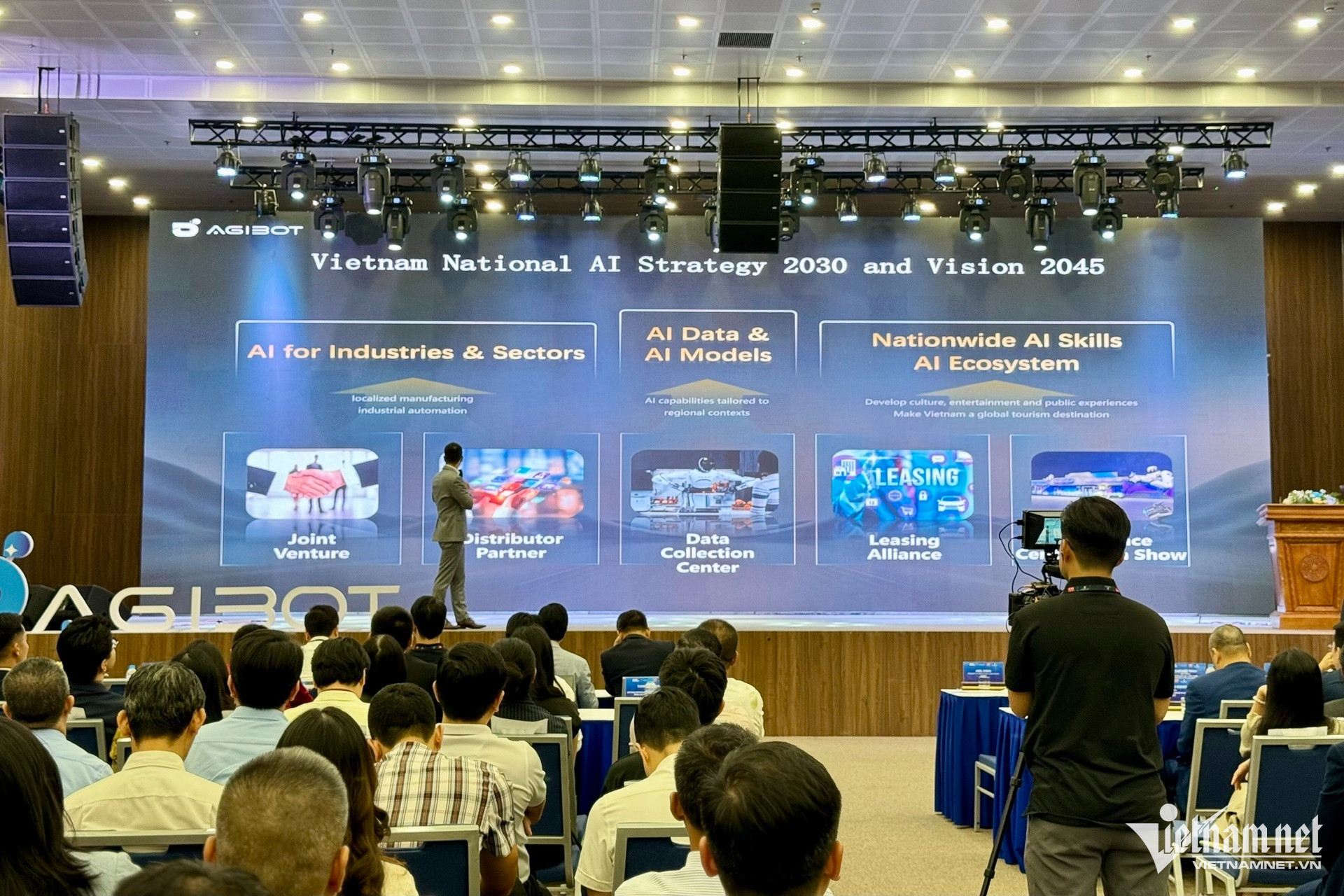
The year 2026 is being seen as a turning point for the global robotics industry as three critical factors converge.
Hardware platforms have achieved greater stability thanks to advances in materials, batteries and robotic joints.
At the same time, large language models are enabling robots to better understand their surroundings, while a "data flywheel" generated by tens of thousands of robots deployed in real-world environments is continuously improving their capabilities.
Commenting on the transition, Abel Dang, president for Asia-Pacific and the Middle East at robotics company AGIBOT, said: "In the era of the new industrial revolution, we are inevitably moving from digital AI to physical AI. The year 2026 is a turning point because, for the first time, large language models, reliable robot bodies and the data flywheel are converging."
According to data from the International Federation of Robotics, robot adoption in Asia is growing at a rate of 71%, led by China with more than 54% of the global market.
Although Vietnam is starting from a relatively modest position, it has significant advantages in its manufacturing base, young workforce and geographic location connecting regional markets.
The integration of autonomous mobile robots and smart production lines is expected to help address productivity challenges and labor shortages in industries including manufacturing, logistics and healthcare.
Regulatory framework could pave the way for businesses
To keep pace with the trend, Vietnam has begun preparing a comprehensive regulatory framework.
Decision No. 21/2026/QD-TTg officially included robotics and automation among the country's 10 strategic technology groups.
The Law on Artificial Intelligence and the national AI strategy through 2045 also set out a shift in regulatory thinking from pre-approval toward post-inspection, allowing sandbox mechanisms and direct financial support through incentive packages.
Notably, Vietnam aims to allocate 0.6% of state budget expenditure specifically to AI while preparing 500 MW of power capacity for data center infrastructure.
Do Tien Thinh, deputy director of the National Innovation Center (NIC) under the Ministry of Finance, outlined three groups of recommendations for developing Vietnam's embodied AI market.
First, he said Vietnam needs a dedicated program for embodied AI rather than incorporating it entirely into the broader AI strategy because the technology has characteristics that distinguish it from other AI fields.
Second, if Vietnam wants to participate more deeply in the AI market, it must develop its own talent pool alongside attracting foreign-invested enterprises.
Vietnam already has an advantage in this area, with major companies including SAP, Qualcomm, Samsung and Nvidia having established or committed to establishing research and development centers in the country.
Finally, Thinh recommended introducing a sandbox mechanism specifically for embodied AI and prioritizing part of the 0.6% state budget allocation for the technology. He also suggested that the government could become the first customer for such technologies.
AI, particularly embodied AI and robotics, is one of the core technological pillars in the NIC's strategic direction.
According to Hoang Trung Hieu, deputy director of the NIC, the center plans to serve as a bridge connecting the government, universities and businesses to help shape policy and develop technology.
It will also focus on developing highly skilled human resources, promoting experimentation and commercialization, and utilizing modern infrastructure at Hoa Lac Hi-Tech Park.
The conference also featured strategic cooperation agreements between the University of Engineering and Technology under Vietnam National University, Hanoi, the School of Automotive and Mechanical Engineering under Hanoi University of Industry, and the Vietnam Association for Vocational Education and Training with international education partners.
Du Lam
.svg)
