 Vietnamnet.vn

 Podcast



Imported pork undercuts domestic prices
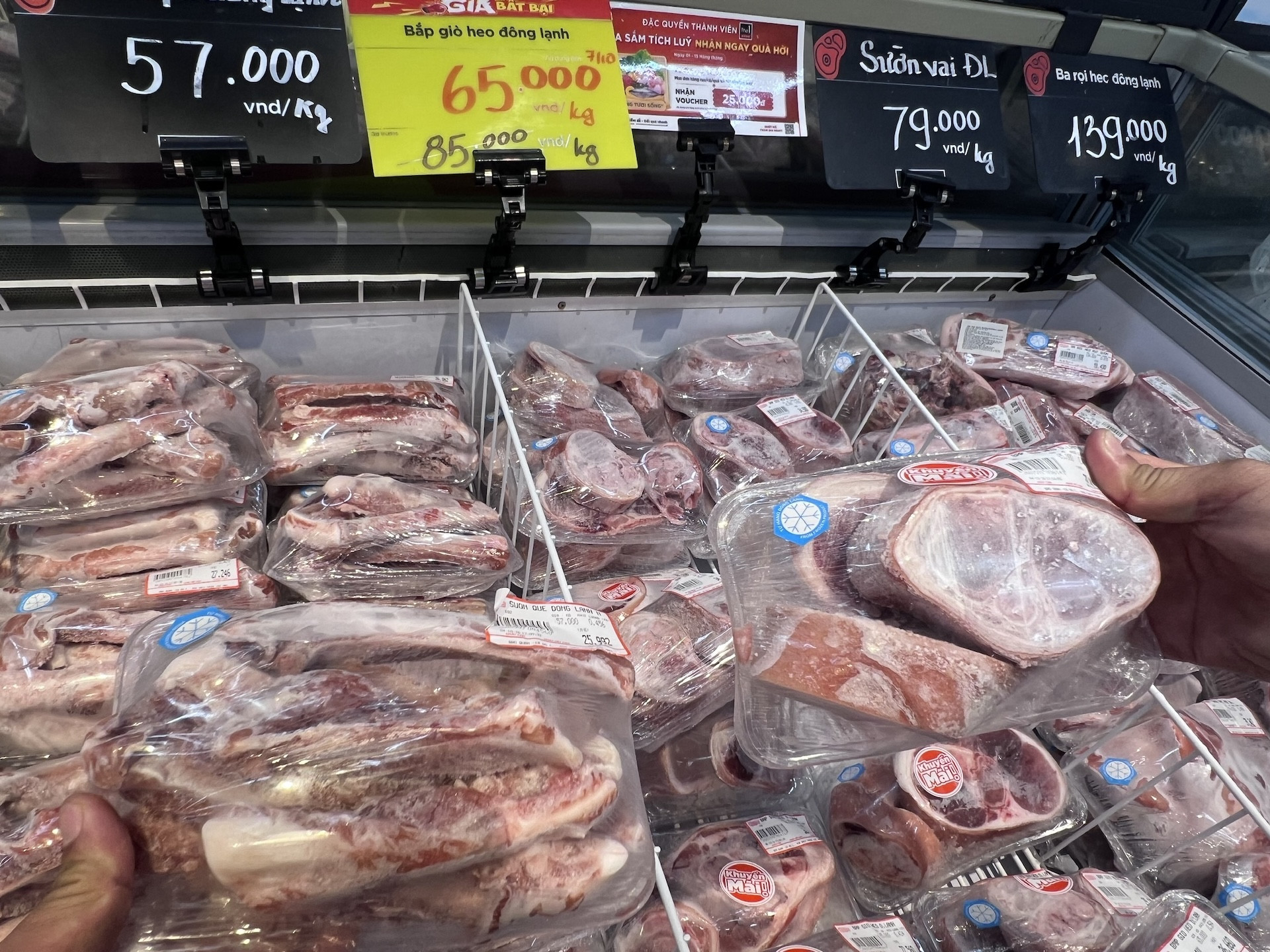
While shopping at a major supermarket in Ho Chi Minh City, Kim Anh, a resident of Tan Son Nhat Ward, noticed that the pork on display came not only from domestic suppliers but also from Brazil and Russia.
What caught her attention was the substantial price difference between imported and locally produced meat.
For example, pork leg from a major Vietnamese brand was priced at approximately $3.82 per kilogram, while the same cut imported from Germany cost just $1.89 per kilogram.
The gap was equally striking for boneless pork belly.
At traditional markets, premium cuts typically sell for around $6.18-6.95 per kilogram. Domestic brands at supermarkets charge between $7.64 and $9.65 per kilogram, depending on the brand and product.
By comparison, frozen pork belly imported from Russia or Brazil costs approximately $4.59-5.02 per kilogram.
"Even before considering quality, a quick calculation shows that buying imported meat can help households ease their spending burden," Kim Anh says.
Like Kim Anh, many consumers have noticed that imported meat is becoming increasingly available not only in supermarkets and retail outlets but also in shops and wholesale markets.
Its competitive pricing is particularly attractive to buyers purchasing in large quantities.
Customs data show that Vietnam spent $1.95 billion on meat imports in 2025.
In the first eight months of 2026 alone, however, imports had already reached $1.91 billion, covering 658,700 tonnes of meat and meat products. This represented increases of 5.6% in volume and 26.3% in value compared with the same period in 2025.
Imports of fresh, chilled and frozen pork totaled 124,100 tonnes, worth nearly $213 million.
While import volume rose 18.8% year on year, the total value declined 23.8%.
The average import price of fresh, chilled and frozen pork stood at $1,712 per tonne during the first eight months of 2026, down 36% from the corresponding period a year earlier.
That translates into an average import price of approximately $1.74 per kilogram, less than half the price of pork sold at traditional markets in Ho Chi Minh City, where retail prices average $3.86 per kilogram or more.
Where does imported pork find its buyers?
Speaking to VietNamNet about the competitive pressure between domestic and imported pork supplies, Phan Van Dung, deputy general director of Vietnamese food processor Vissan, says lower prices do not necessarily mean frozen imports can replace freshly slaughtered pork in Vietnamese households.
According to Dung, about 75% of Vietnamese people consume pork daily, and many continue to prefer what is locally known as warm meat, or pork sold fresh shortly after slaughter.
Shoppers often prefer to choose a cut of meat and have it sliced on the spot, or buy pre-packaged fresh or chilled pork from supermarket shelves.
Among regular pork consumers, only 5-10% choose frozen meat for their everyday meals.
This deeply rooted preference helps explain why significantly cheaper frozen pork has not generated a corresponding surge in retail sales.
"Imported pork does not compete directly with freshly slaughtered pork across every market segment. Apart from retail sales to the 5-10% of consumers who use frozen pork in daily meals, most imported meat is currently used as an ingredient in food processing," Dung explains.
From an industry perspective, Nguyen Kim Doan, vice chairman of the Dong Nai Livestock Association, shares a similar assessment.
He says imported pork is mainly supplied to industrial kitchens serving factory workers and businesses, as well as food manufacturers that use meat as a processing ingredient.
These buyers must carefully manage costs while ensuring that products meet quality requirements. Imported meat is also subject to strict controls upon entering Vietnam, he notes.
Doan adds that rising meat imports are not primarily the result of a domestic supply shortage.
Instead, they largely reflect Vietnam's bilateral trade relationships and international trade arrangements.
Free trade agreements currently in effect, together with scheduled tariff reductions, have made it easier for meat products from countries with advantages in production scale and costs to enter the Vietnamese market at competitive prices.
Major meat-exporting countries, including Brazil, Spain and India, continue to view Vietnam as a promising export destination.
Looking at the broader picture, however, Doan expresses concern that imported pork is placing increasing pressure on domestic livestock farmers.
In Dong Nai, a major livestock production center in southern Vietnam, many farmers have left their pig barns empty and have not restocked their herds.
They face rising production costs, persistent disease risks and declining live pig prices.
Live pigs in southern Vietnam currently sell for approximately $2.05-2.12 per kilogram, while some imported pork products are priced at just $1.54-1.66 per kilogram.
Against this backdrop, the Dong Nai Livestock Association has called on the government to introduce measures to strengthen the competitiveness of domestic livestock production.
For Vietnamese businesses, Vissan's Dung believes authorities should tighten quality and food safety controls on imported meat from the point of entry, applying standards similar to those already used for poultry products.
He argues that stronger technical requirements and quality standards would not only create a more level playing field for domestic livestock producers but also give consumers greater confidence in the safety of imported meat.
Thu Ha
.svg)
