 Vietnamnet.vn

 Podcast



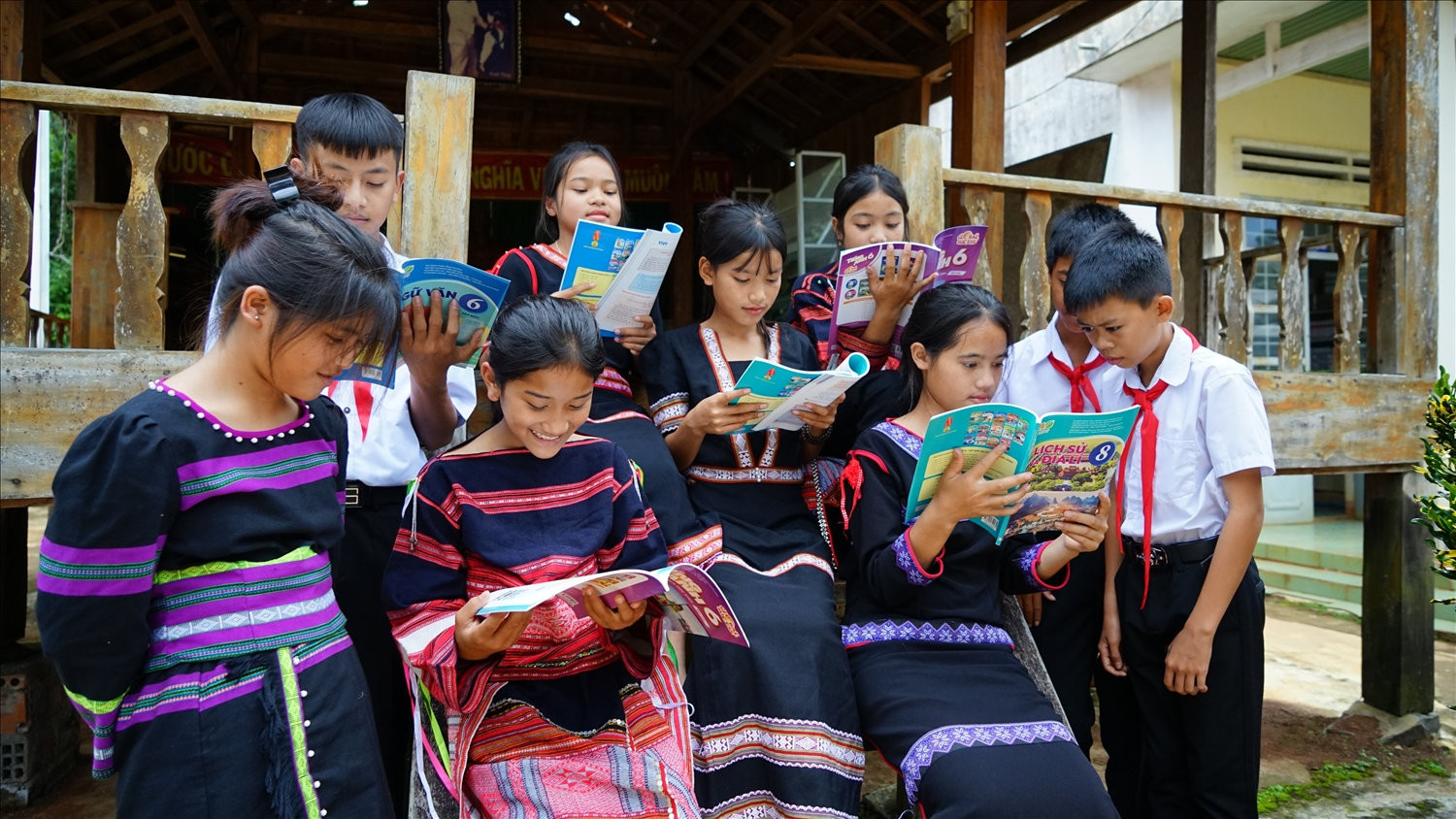
Recent data show that school attendance among ethnic minority children has improved significantly. Photo by Ngoc Thu.
Education policy needs a new transformation
For many years, education for ethnic minority and mountainous areas has remained one of the Vietnamese Party and State's highest priorities.
From the network of ethnic minority boarding and semi-boarding schools, support policies for students in disadvantaged areas and very small ethnic minority communities, to tuition exemptions, accommodation assistance, textbooks, vocational training and the development of ethnic minority officials, a wide range of policies has significantly expanded educational opportunities for children living in the country's most disadvantaged regions.
Measured by the achievements of universal education, this has been a remarkable journey. Many villages that once lacked classrooms, teachers and basic learning conditions now have children attending school regularly in safer, better-built facilities with improved access to the national curriculum.
These achievements have laid an essential foundation for narrowing the development gap between mountainous and lowland areas, and between ethnic minority communities and the rest of the country.
However, the 2026–2030 period, with a vision to 2035, presents a new challenge. Education policy for ethnic minority communities can no longer stop at ensuring that schools exist, classrooms are available and children attend school.
Today's central challenge is improving learning quality, enabling students to progress to higher levels of education, strengthening vocational skills, developing digital literacy, increasing employability and building the capacity of ethnic minority youth to shape their own future.
In other words, policy must shift decisively from simply supporting school attendance to investing in people.
When the challenge is no longer access to school
Recent statistics show that school attendance among ethnic minority children, especially at primary level, has improved significantly. This reflects years of investment in school infrastructure, student support programmes and the dedication of local authorities, teachers and communities.
Yet as access has improved, another gap has become increasingly apparent: the gap in learning quality.
For many ethnic minority students, Vietnamese is not their first language. When they enter Grade 1, they are expected to learn literacy, mathematics and other subjects through a language they have not yet fully mastered.
Without appropriate support, many children struggle from the very beginning. Small learning gaps in Grades 1 and 2 can accumulate into major disadvantages by the end of primary school and continue to affect their performance throughout lower and upper secondary education.
For this reason, reading comprehension in Vietnamese by the end of Grade 3 should become a key indicator. Students who cannot read and understand Vietnamese proficiently at this stage are likely to face continuing academic difficulties.
This is not merely an educational issue but a strategic concern for ethnic minority policy and human resource development.
Education policy should therefore place greater emphasis on preschool and the first three years of primary education. These are the "golden years" for language acquisition, cognitive development, health, nutrition, learning habits and self-confidence.
Upper secondary and vocational education: The decisive transition
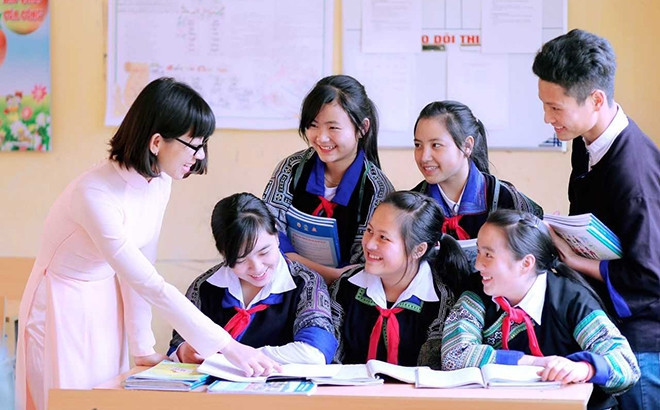
Teachers play an especially important role in ethnic minority and mountainous areas. Photo by DTPT.
If primary education builds the foundation, lower and upper secondary education determine whether young people can enter the skilled labour market.
This is also the stage where disparities in human capital become most visible.
After primary school, ethnic minority students face growing obstacles: schools are farther away, educational costs rise, family financial pressures increase and the risks of early employment, school dropout, labour migration and early marriage become more pronounced.
For girls in some disadvantaged communities, these barriers are even greater due to family expectations, traditional practices and safety concerns associated with travelling long distances to school.
Without strong policy intervention from Grades 6 through 12, achieving meaningful improvements in human resource quality will remain difficult.
The objective should not simply be to keep students in school but to provide every student with a clear pathway after lower secondary education - whether through upper secondary school, career-oriented upper secondary programmes, high-quality vocational education or integrated academic-vocational pathways.
Educational streaming only succeeds when students and their families can see genuine opportunities. If vocational education is perceived merely as a fallback option for disadvantaged students, streaming risks becoming a form of soft exclusion.
Conversely, well-designed vocational education that includes scholarships, dormitories, practical training, business partnerships, employment commitments and opportunities for further study can become a highly attractive pathway for ethnic minority youth.
Every ethnic minority student should therefore have an individual development pathway after lower secondary education. This may involve continuing academic study, pursuing vocational education, combining both, or joining skills programmes linked to local livelihoods.
Most importantly, no student should leave the education system without recognised skills, qualifications or a clear path forward.
A more modern language policy
One area requiring substantial reform is language policy in education.
For many years, policy discussions have focused primarily on strengthening Vietnamese language instruction for ethnic minority students. This remains both necessary and appropriate because Vietnamese is the country's common language and the primary tool for education, employment and social integration.
However, focusing exclusively on Vietnamese risks overlooking the important role of students' mother tongues.
Research in linguistic anthropology consistently shows that a child's first language is not an obstacle but a valuable cognitive and cultural asset. Children learn more effectively when education begins with the language and cultural environment they know best.
During preschool and the early years of primary education, appropriate use of mother tongues, bilingual learning materials, local teaching assistants, traditional stories, songs, images and indigenous knowledge can help children build confidence, understand lessons more effectively and transition successfully to Vietnamese.
The modern approach is therefore not to choose between Vietnamese and native languages, but to promote transitional multilingual education: the mother tongue serves as the foundation, Vietnamese becomes the national language of learning, while foreign languages and digital skills prepare students for future integration.
Such an approach also enables education to preserve rather than weaken cultural identity, allowing ethnic minority students to engage confidently with the modern world while remaining rooted in their own heritage.
Schools should become centres for human development
In ethnic minority and mountainous communities, schools are far more than places of instruction.
In many remote communes and border areas, schools represent the most important social institution.
Boarding schools, semi-boarding schools and multi-level schools in border regions should therefore evolve into a new generation of educational institutions.
They should become centres not only for academic learning and accommodation but also for healthcare, nutrition, psychological counselling, life skills education, sports, libraries, digital learning, career guidance and cultural preservation.
A successful boarding school should do far more than provide students with a safe place to live. It should enable them to learn better, stay healthier, build confidence, develop life skills and plan for the future.
Investing only in classrooms, dormitories and kitchens without strengthening teachers, student support staff, counsellors, cultural activities, sports and career guidance will limit the effectiveness of the boarding school model.
Investment in schools should therefore be viewed as investment in human development.
Teachers remain central to every reform
No education reform can succeed without capable and motivated teachers.
In ethnic minority areas, teachers play an even more vital role.
They do much more than teach. They connect families with schools, encourage children to remain in education, help students overcome language barriers, support their adjustment to boarding school life, identify early signs of dropout and accompany students through the emotional challenges of adolescence.
Teacher policy for disadvantaged areas should therefore extend beyond financial allowances.
Vietnam needs a strategic teacher development programme for these regions, covering recruitment, professional training, competitive incentives, official housing, career advancement opportunities, mentoring networks and long-term retention policies.
Particular attention should be given to training ethnic minority teachers, teachers who speak minority languages, preschool and primary teachers, STEM educators, foreign language teachers, technology teachers and vocational education instructors.
These professionals will ultimately determine whether education policy translates into meaningful learning outcomes.
Vocational training should be closely linked to local livelihoods
One of the major challenges facing vocational education in ethnic minority areas is that many programmes still focus more on delivering courses than producing measurable outcomes.
Learners may complete training without securing better employment, higher incomes or market-recognised skills.
Future vocational education should instead adopt a skills-cluster and value-chain approach.
Each locality should identify occupations aligned with its comparative advantages, including ecological agriculture, agricultural processing, sustainable forestry, community tourism, rural e-commerce, agricultural logistics, small-scale renewable energy, community healthcare, social services, machinery maintenance, green construction and basic digital occupations.
Vocational education cannot be separated from businesses, cooperatives, production facilities, markets or local development planning.
Public funding should also become results-oriented, measuring whether trainees complete programmes, secure employment, increase their income, continue their education or contribute back to their communities.
For ethnic minority youth, policymakers should consider introducing a "skills passport" that records educational achievements, vocational certificates, digital competencies, language skills, internships, employment and entrepreneurial experience.
Such a system would better reflect the demands of a rapidly changing labour market, where lifelong learning is increasingly essential.
From reporting data to actionable data
Effective policy depends on effective data.
Currently, much educational data are compiled by academic year, education level and locality. While useful, such reporting is insufficient for identifying risks faced by individual students.
Vietnam needs an integrated learner database linked to each student's unique identification number, enabling continuous tracking from preschool through primary school, secondary education, vocational training and employment.
Such a system should enable local authorities to identify students with prolonged absences, declining academic performance, unsuccessful transitions between education levels, risks of dropping out, early marriage or child labour.
When data reach the level of each individual learner, timely intervention becomes possible.
When data remain only in aggregated reports, many students have already left school before the system recognises the problem.
Investing in people means investing in the nation's future
The 2026–2030 period represents an important opportunity to redesign education policy for ethnic minority and mountainous areas so that it becomes more integrated, more modern and more accountable for measurable outcomes.
The central objective should not simply be expanding schools or increasing financial assistance, but investing in people.
Achieving this requires a comprehensive approach: early intervention during preschool, ensuring strong foundational skills in primary education, supporting successful transitions through secondary education, expanding upper secondary and vocational opportunities, modernising language policy, investing in teachers, developing next-generation boarding schools, applying digital technologies and building early warning systems based on student-level data.
If these goals are achieved, education for ethnic minority and mountainous communities will become far more than a social welfare policy. It will become a powerful engine of development.
Every ethnic minority student who receives a better education today could become tomorrow's teacher, engineer, local official, entrepreneur, technician, tour guide, agricultural specialist, healthcare worker, manager or community innovator.
The ultimate goal of education policy is not simply to bring children to school.
Its higher purpose is to equip them with the knowledge, skills, confidence and determination to move forward, build successful lives and contribute to the prosperity of their villages, their communities and the nation.
Dr. Ha Viet Quan
.svg)
