 Vietnamnet.vn

 Podcast


The statement comes as videos showing damaged iPhone Duo screens circulate on social media, raising concerns about the durability of Apple's new foldable device.
Component supplier responds amid growing controversy
Since the iPhone Duo went on sale, some users and product testers have reported screen damage. Notably, several cases appear to show failures occurring at roughly the same point along the device's fold, prompting questions about the durability of its hinge mechanism and display-support components.
Fine M-Tec, a company involved in the foldable display component supply chain, has responded to the growing scrutiny by denying responsibility for the reported problems.
According to South Korean technology publication The Elec, Fine M-Tec issued a statement on October 26 asserting that components supplied by the company were not responsible for the recently reported damage.
"The quality issues recently reported in certain products were not caused by defects in components supplied by our company," Fine M-Tec said.
Although the statement did not explicitly mention Apple or the iPhone Duo, its timing coincided with mounting public debate over the device's screen durability.
The company also urged the public not to assign blame before the actual cause of the failures has been established.
Fine M-Tec said it was considering legal action against individuals who made unsubstantiated allegations about the quality of its components.
The company specializes in manufacturing internal hinges and metal support plates for foldable OLED displays.
These components help distribute mechanical forces, support the display panel and reduce stress as a foldable device is repeatedly opened and closed.
Fine M-Tec has supplied components to Samsung Display, placing it within the broader foldable display supply chain.
However, a company's involvement in that supply chain does not necessarily mean its components are directly responsible for the problems reported with the iPhone Duo.
Suspicions focus on an internal hinge component
Videos and photographs shared by users and durability testers show that the iPhone Duo's display can develop damage along its central folding line.
Problems occurring in this area are not entirely unexpected for foldable devices, as the hinge and surrounding display components experience repeated mechanical stress during normal use.
What makes some of the reported incidents particularly notable is the similarity in the damage patterns.
In several cases, the damage appears to begin horizontally at a specific point along the fold before extending toward one side of the display.
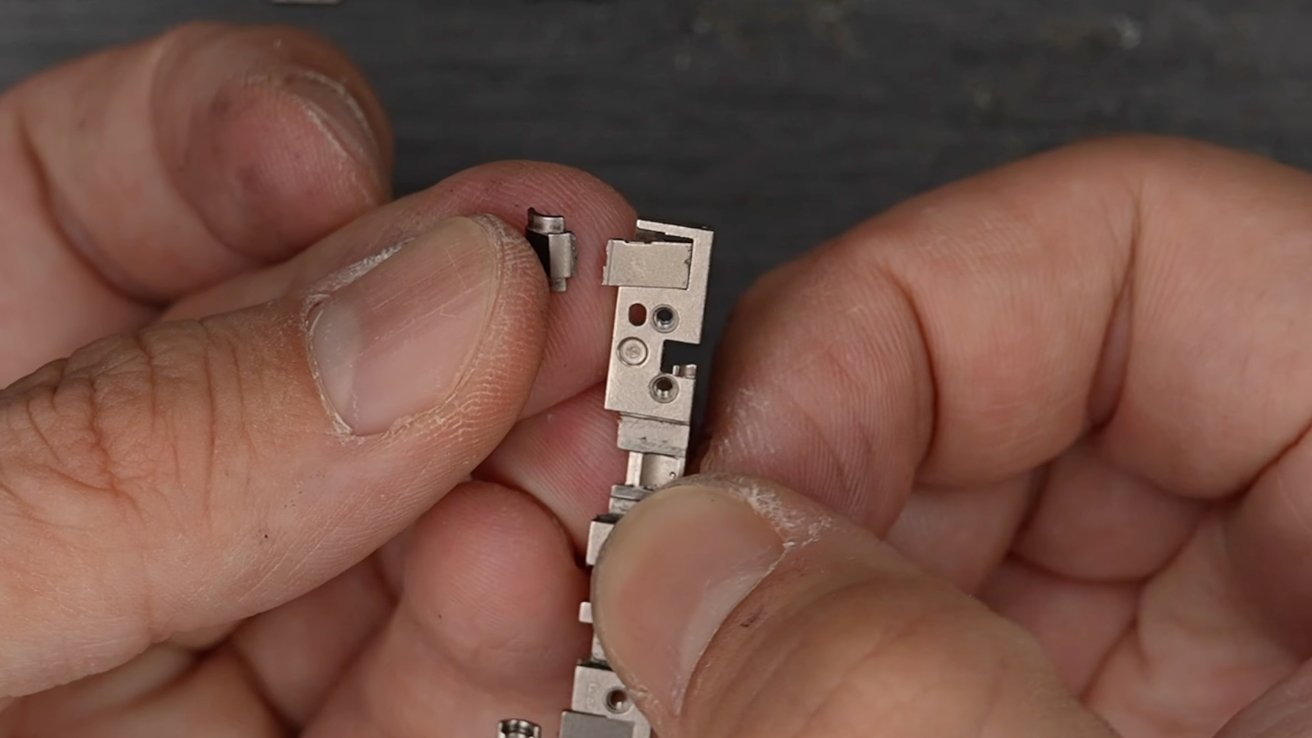
Closer inspections, including device teardowns, have raised questions about a particular component inside the hinge assembly.
A flat, plate-like element within the mechanism is suspected of potentially separating into two pieces during repeated folding and unfolding.
The component sits near the center of the display, where a small support plate comes close to other internal parts, including the cable connecting the device's two halves.
If a mechanical component breaks or fails to operate as designed, the resulting pressure on the surrounding display could become a factor worth investigating.
However, this remains a hypothesis based on preliminary device inspections rather than an officially established explanation for the screen failures.
Further technical evidence will be needed to determine whether the damage originates from the hinge, support plate, connecting cable, OLED panel or a combination of several factors.
Apple acknowledges reports, but affected devices appear limited
Amid growing complaints on social media, Apple has issued a brief response acknowledging that it is aware of reported cases of cracked iPhone Duo screens.
The company advised affected customers to contact AppleCare support for assistance and possible device replacement under the applicable service policies.
The total number of iPhone Duo units experiencing screen damage remains unknown.
However, preliminary information suggests that the issue has not yet been identified as a widespread problem affecting Apple's foldable smartphone.
According to AppleInsider, the publication contacted employees at 20 Genius Bar service counters in Apple Stores it was monitoring.
As of October 26, only four affected iPhone Duo devices had reportedly been returned across those locations.
The publication planned to continue its survey after Apple Stores in the United States opened for business.
Those figures should be interpreted cautiously.
The data reflects only devices reported at a limited group of stores and cannot be considered representative of all iPhone Duo units sold.
Nevertheless, the findings do not currently provide sufficient grounds to conclude that the device is experiencing a widespread foldable display defect.
For a newly introduced product with an unfamiliar design, hinge durability and the display's ability to withstand repeated mechanical stress are among the most important concerns for consumers.
In the case of the iPhone Duo, identifying the precise cause of the reported screen failures will be important not only for Apple but also for the component suppliers involved in its production.
Hai Phong

