 Vietnamnet.vn

 Podcast



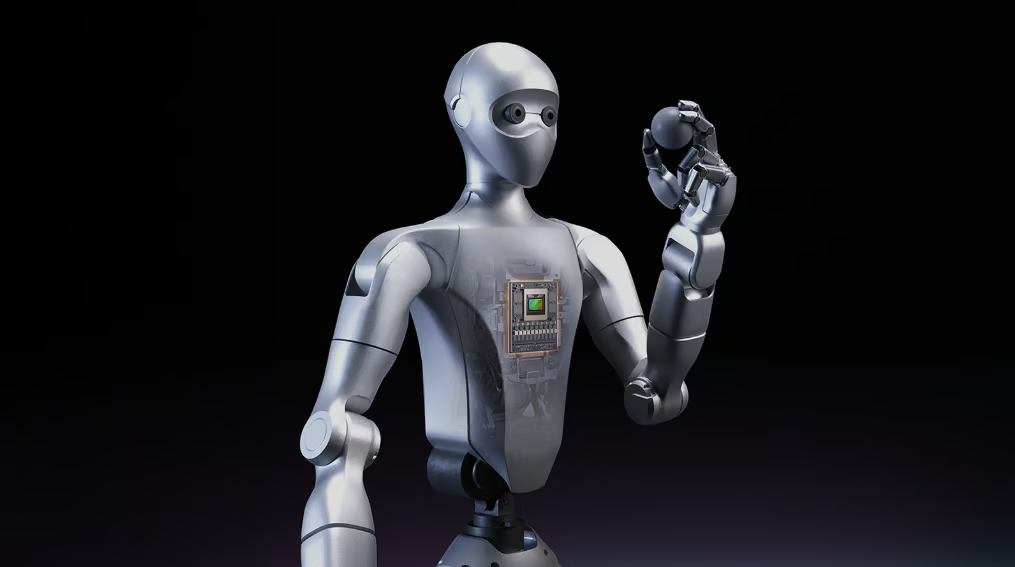
At GTC Taipei, Nvidia introduced the Isaac GR00T Reference Humanoid Robot, a humanoid robotics platform jointly developed with Unitree and Sharpa.
The system is designed as a standardized toolkit for universities, research institutions and companies developing the next generation of humanoid robots.
Rather than supplying AI processors alone, Nvidia is steadily expanding into software, development workflows and reference hardware to establish a common foundation for the humanoid robotics industry.
According to Nvidia CEO Jensen Huang, humanoid robots will become a key force driving the adoption of physical AI across large-scale industries in the future.
The new platform combines Unitree’s H2 Plus humanoid robot, Sharpa’s Wave tactile robotic hands and Nvidia’s Jetson AGX Thor T5000 processor.
The robot stands approximately 1.8 meters tall and weighs 68 kilograms. It features 31 degrees of freedom across the body and 22 degrees of freedom in each hand, enabling it to perform highly complex tasks.
The system is equipped with stereo vision cameras mounted on the head, wrist-mounted cameras and inertial sensors for motion tracking.
Nvidia said the Jetson AGX Thor T5000 processor, based on the Blackwell architecture, delivers up to 2,070 FP4 teraflops of AI performance, providing the computing power required for real-time robotic control and decision-making.
One of the primary goals of Isaac GR00T is to simplify the development process for humanoid robots. The toolkit includes Isaac Teleop for collecting demonstration data, Isaac Sim and Isaac Lab for simulation and training, and Isaac ROS for deployment on physical robots.
According to Nvidia, data remains one of the biggest challenges in robotics development. To address this, the company allows research organizations to maintain full control over training datasets, operational data and system logs to ensure security and data ownership.
Several organizations are expected to adopt the platform, including the Allen Institute for AI (Ai2), ETH Zurich, Stanford Robotics Center and the University of California San Diego.
Sharpa representatives said the partnership with Nvidia would help accelerate the transition of humanoid robots from laboratory environments into real-world workplaces.
Beyond Unitree, Nvidia revealed plans to collaborate with robot manufacturers in the United States, Europe and South Korea.
The company has also integrated multiple security mechanisms, including code authentication, secure boot and confidential computing technologies, to prevent robots from running malicious software or leaking sensitive data.
Unitree plans to begin selling Nvidia’s reference humanoid robot platform by the end of 2026.
Meanwhile, development workflows for the Unitree G1 robot will soon be released on GitHub and Hugging Face, allowing broader access for the global research community.
Du Lam
.svg)
