 Vietnamnet.vn

 Podcast



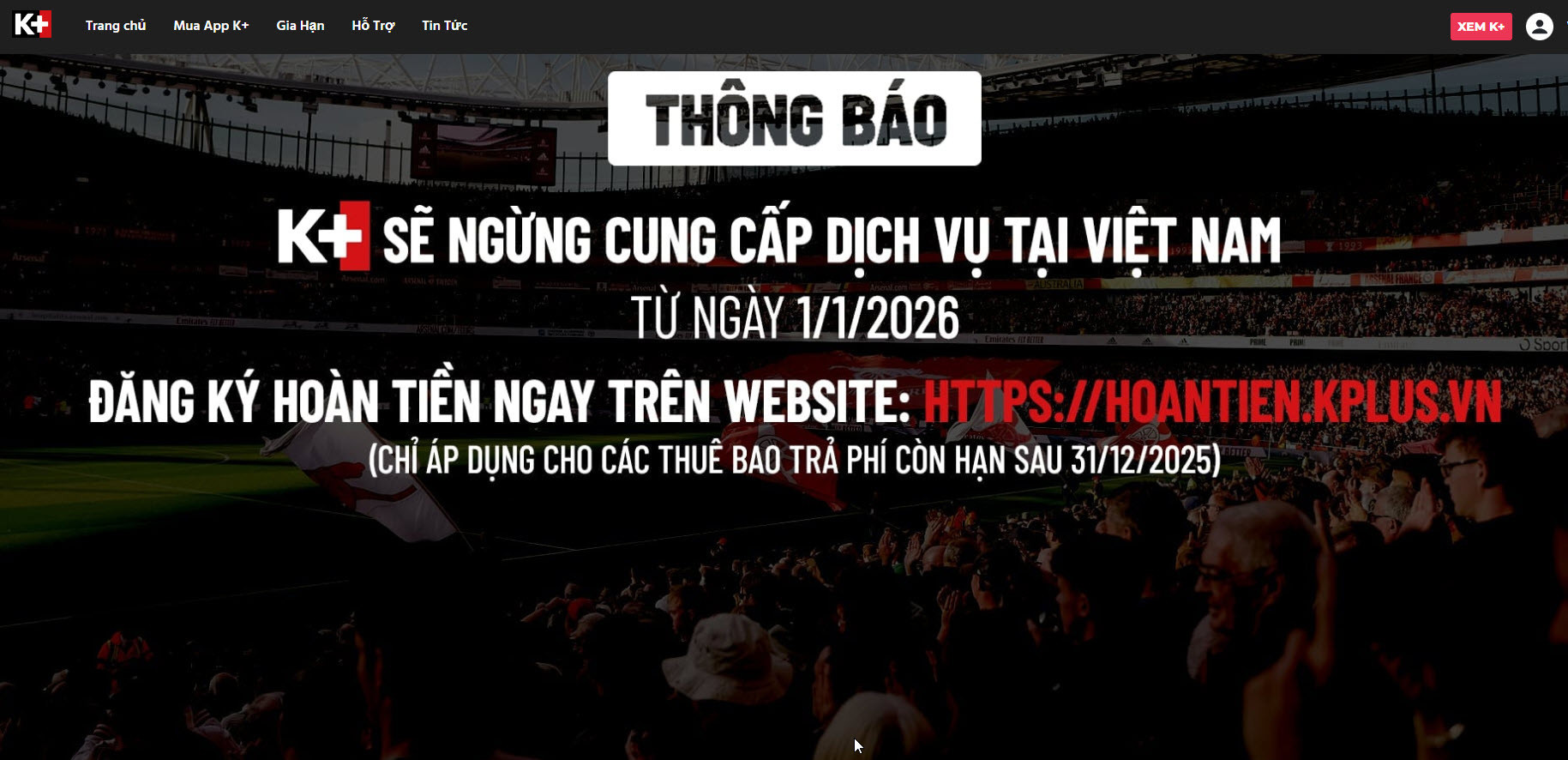
On December 8, Vietnam Satellite Digital Television (VSTV) released an announcement: “From January 1, 2026, we will stop providing pay TV services under the K+ brand in Vietnam. Customers using K+ receivers and satellite dishes can still watch 10 VTV channels and other local channels broadcast for free via satellite. To ensure customer rights, subscribers who have prepaid service beyond December 31, 2025 can request refunds at https://hoantien.kplus.vn by no later than December 31, 2025. We will complete verification and payment in January 2026.
Our customer service team is ready to support customers via hotline 1900 1592 and will continue to assist until January 31, 2026.”
Betting on the premier league but failing to build ecosystem
K+, from its inception, positioned itself as "the home of the UK Premier League," relying almost entirely on the planet's most expensive football copyright to attract and retain users.
For over a decade, this strategy was somewhat effective, but it also became a "blind spot" that made the business inflexible as the market changed. K+'s biggest problem was a business model overly dependent on the traditional satellite TV subscription package, which was constrained by fixed equipment, installation processes, maintenance fees, and an inflexible experience.
As the market shifted strongly towards OTT, with users moving from "passive viewing" to "on-demand viewing," K+ failed to keep pace with this change. The effort to bring content to mobile applications happened late, lacked breakthrough features, and failed to address the core limitations: the pricing model was uncompetitive, and the user experience was not smooth enough.
The second strategic mistake came from K+'s failure to develop a content ecosystem strong enough to reduce its dependence on the Premier League. While platforms like FPT Play, VieON, Netflix continuously invested in films, entertainment programs, exclusive content, and co-productions, K+ remained centered mainly around football and only invested very limitedly in self-produced content.
The inherently diverse user base gradually narrowed down to the "football fan" group, and even this loyal group was changing consumption habits. As the younger generation stopped watching football via traditional TV and switched to online platforms, K+ was slow to reposition itself as a true digital platform. The business's failure to diversify revenue streams caused financial pressure to swell, especially as Premier League copyright costs continuously escalated. The old model relying on subscription fees became obsolete when users had too many flexible and cheaper options.
More seriously, K+ made another strategic mistake: maintaining a monopolistic mindset for too long. Holding the entire Premier League copyright for many years helped K+ create a competitive advantage but simultaneously isolated itself from the possibility of market expansion.
Instead of implementing a wider distribution model through partners to increase revenue, reduce risk, and expand coverage, K+ continued to maintain the approach of "locking content within a small ecosystem." As the market changed, the monopoly model did not help them grow but became a barrier, making it difficult for the business to reach new users.
Copyright infringement problem pushes K+ into the abyss
If the strategic mistakes caused K+ to be slow in the digital transformation race, copyright infringement was the direct blow to the business's profits and viability.
For many years, Premier League football was widely pirated on social media, illegal websites, illegal IPTV applications, and even on cross-border platforms. A single match could be illegally broadcast on hundreds of streams, free of charge, with low latency, and easy accessibility, while users had to pay high fees to watch the copyrighted version on K+. The gap between "free" and "legally paid" was so large that it was no longer a matter of awareness but became an economic choice for the majority of the audience.
K+ was a direct victim of copyright infringement. In a market of nearly 100 million people where the number of paid subscribers watching copyrighted football only hovered around hundreds of thousands, a business model purely based on subscription fees could not balance the copyright costs, which were already in the tens of millions of dollars per season. K+'s collapse was not because of poor content, but because they could not win the economic war against illegal models that bore zero cost.
Thai Khang
.svg)
