 Vietnamnet.vn

 Podcast



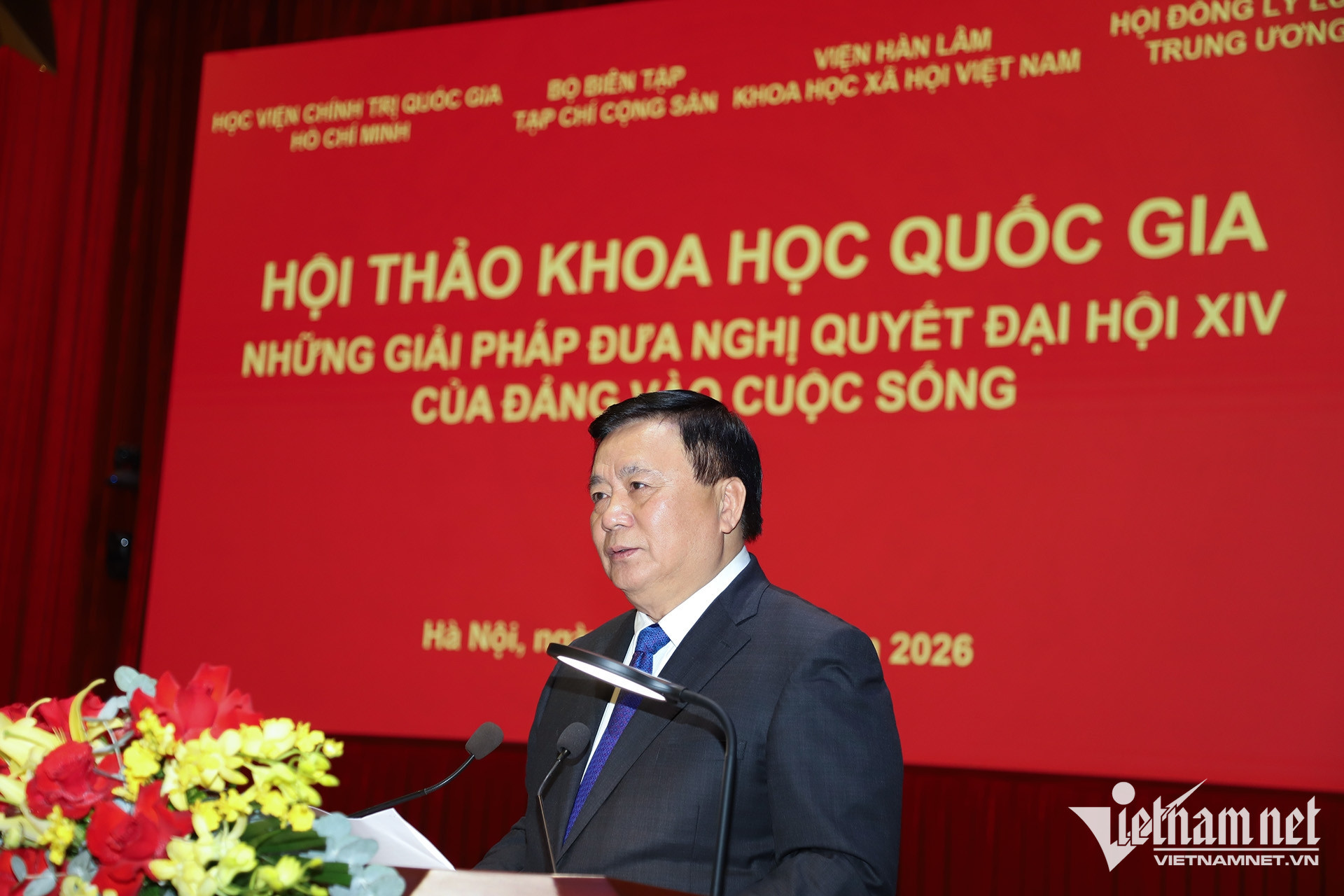
The Ho Chi Minh National Academy of Politics, the Communist Review, the Vietnam Academy of Social Sciences, and the Central Theory Council organized a national scientific conference titled "Solutions to bring the Resolution of the 14th Party Congress into life."
In his opening and keynote speech, Nguyen Xuan Thang, Chair of the Central Theory Council, noted that this is a special conference following the 14th Congress. He said that Party Chief To Lam's remarks at the congress delivered a powerful message regarding the implementation of the tasks specified in documents, resolving a long-standing weakness: organization and execution.
"We must ensure this document is not just a torch lighting the way but a guide to successfully implementing every target," he noted.
Thang said that at the closing session of the congress, Lam emphasized the principle of “saying it and doing it, doing it immediately, doing it right, doing it decisively, seeing it through to the end, and doing it effectively.” It was no coincidence that on the final day of the congress, the 14th-term Politburo issued Directive 01 on studying, learning, disseminating, and implementing the resolutions of the 14th Congress.
This demonstrated the spirit of an immediate shift from awareness to action, from resolutions to practice.
According to Thang, there are four points that need clarification. Actions must be highly specific for the entire term, for each year, and even for each month; tangible results must be taken as the sole measure. He warned that “if we only chase after documents, conferences, movements, and achievements, in the end, when we look back, there will be no real results.”
The Chair of the Central Theoretical Council affirmed the need to strengthen the leadership role of the Party, with the State acting as the enabler rather than doing everything itself. He particularly emphasized the relationship between Party leadership, State management, and the accompanying participation of the people and businesses.
It is necessary to avoid overextending; scopes must be clear, particularly focusing on decentralization and the delegation of power associated with power control and result evaluation.
Regarding implementation, he said it is necessary to establish inspection and supervision mechanisms for real-world implementation through a KPI-based evaluation system. The KPI (Key Performance Indicator) system does not need to be extensive, but it must be accurate and appropriate for the central, provincial, and commune levels.
Furthermore, he noted that there must be a mechanism to deal with those who do not work. He said: "If you don't work, step aside; if you can't do the job, you must be replaced immediately."
In execution, he emphasized paying attention to timing and progress without compromising quality. Leaders must also have KPIs because without them, a situation may arise where "you all keep working while I just stand and point fingers."
He raised the question of whether a personal action program for leaders is needed to organize political tasks at both central and local levels. He viewed this as a commitment, as the General Secretary said, before history, the people, and the Party.
Another point he mentioned was that some tasks are described beautifully but never executed, dragging on from year to year, because “everybody’s business is nobody’s business”.
Remuneration must be fair
Professor Ta Ngoc Tan, Standing Vice Chair of the Central Theory Council, recalled President Ho Chi Minh's words on personnel work: "Success or failure in everything depends on whether officials are good or bad."
He said that granting power to leaders must be tied to responsibility and ethics to select officials who are fully dedicated and capable, as the General Secretary stated: "they must have virtue, talent, and strength."
"Strength" here does not simply mean physical health but endurance, the ability to share the people's burdens, staying close to the work, and maintaining a sense of collective responsibility.
Personnel selection must be fair, objective and transparent, primarily based on standards. He stressed the need to handle the “illnesses” that President Ho Chi Minh warned about as early as October 1947 in the work Rectifying the Working Style.
Tran Thuong
.svg)
