 Vietnamnet.vn

 Podcast



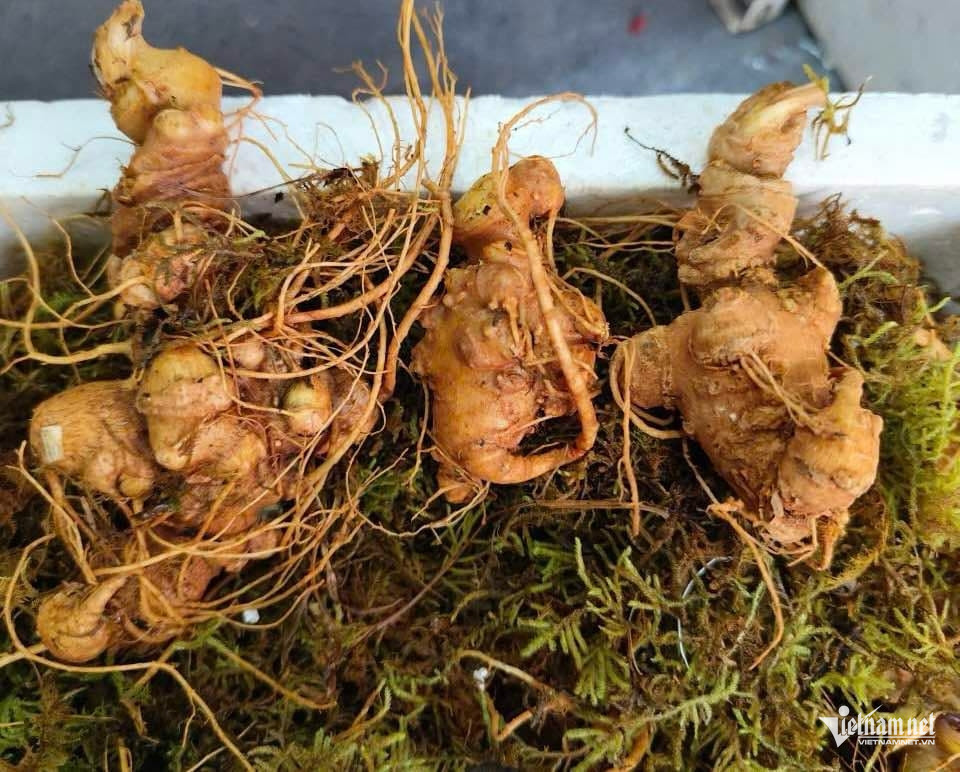
By combining indigenous knowledge with modern science and technology, local ethnic communities are cultivating medicinal plants under forest canopies, securing both livelihoods and biodiversity.
In 2003-2004, a biodiversity survey team for the Son La Hydropower project found a plant locals called ‘black ginseng Muong Te’ or ‘Lai Chau ginseng’. The name comes from the dark purple color when cutting fresh stems.
At the time, traditional medicine shops and herbal traders paid up to 10–15 times more for this plant than for common tam that (Panax notoginseng). While ordinary dried tam sold for VND0.5–1 million per kilogram, high-quality black tam fetched VND 7–20 million per kilogram.
Nguyen Van Thong, Secretary of the Lai Chau Ginseng Association and Technical Director at Hoa Ban Lai Chau, was a member of the survey team. He recalled being surprised by the e harvesting methods used by the local ethnic communities.
"Instead of uprooting the whole plant, they would break off just part of the root and re-bury the rest, keeping about 3-4 cm intact," Thong said.
"They said leave it, mark the base, return next year to harvest seeds for propagation. The remaining root continues growing, which allows to harvest more segments after a few years. This turns out how they conserve the gene and plant species. Thanks to the simple indigenous knowledge, the precious plant has been preserved through generations," Thong said.
In June 2004, the first scientific article by Associate Prof Dr Phan Ke Long on the rare plant was published.
In 2004-2005, some highland Lai Chau locals planted a total of hundreds of black ginseng trees in home gardens, but all were sold to Chinese traders.
Wanting to conserve the precious species, Thong and colleagues researched and sent samples for analysis and quality evaluation.
Results showed high active compounds like: Saponin R2 - MR2 (antioxidant, anti-aging, cell protection, especially skin cells); Saponin Rg1 (anti-fatigue, stress, alertness); Saponin Rb1 (essential nervous system inhibition, pain relief, liver cell protection); Saponin Rd (adrenal cortex activity promotion); Saponin Rh2 (cancer cell growth inhibition and tumor spread) and others.
Notably, Saponin content was much higher than wild ginseng, Vu Diep ginseng, and even Ngoc Linh ginseng.
Due to its narrow distribution, found only in the high mountains of Lai Chau, the plant was officially named Lai Chau Ginseng.
As of October 31, 2021, Lai Chau province had 25 businesses, cooperatives, and nearly 200 households cultivating the plant. On November 23, 2021, the provincial government approved the establishment of the Lai Chau Ginseng Association.
Development
According to the Lai Chau Investment Promotion and Financial Services Center, Lai Chau Ginseng is an endemic species with high medicinal and economic value. It holds great potential to lift ethnic minorities out of poverty.
In May 2024, the Lai Chau Provincial Party Committee issued Resolution No17 on the development of Lai Chau Ginseng through 2030, with a vision to 2035.
It is expected that by 2030, the province will produce 30 tons of ginseng annually, all certified under GACP-WHO or equivalent standards. By 2035, Lai Chau Ginseng, alongside Vietnamese ginseng, aims to become a national brand with high export value and international recognition.
The development plan sets a target of 3,000 hectares of ginseng cultivation by 2030, expanding to 10,000 hectares by 2045.
"Each household receives ginseng seedlings to plant in their backyard. After about six years, the company will buy the ginseng at market prices, giving the locals stable income," Thong explained.
Still, conservation remains his top priority. “We’ve received large orders from the Middle East, but we can't accept them due to limited supply. If everything is for sale, there’ll be nothing left to conserve,” he said.
The biggest challenge Thong faces now is securing capital for conservation and expansion.
"Current government support is VND200 million per hectare, which is far too low. For intensive cultivation that meets technical standards, we need VND9-10 billion per hectare in open land and VND6-7 billion per hectare under forest canopy," Thong said.
Despite the challenges, Thong remains committed to his mission of protecting and developing this precious ginseng species in the deep forests of the Northwest.
He estimated that Lai Chau has about 300,000 hectares of land suitable for growing ginseng, with potential expansion to neighboring provinces, up to a million hectares of sustainable ginseng cultivation under forest cover. For the highland communities, this means long-term, environmentally friendly livelihoods.
Binh Minh
.svg)
