 Vietnamnet.vn

 Podcast



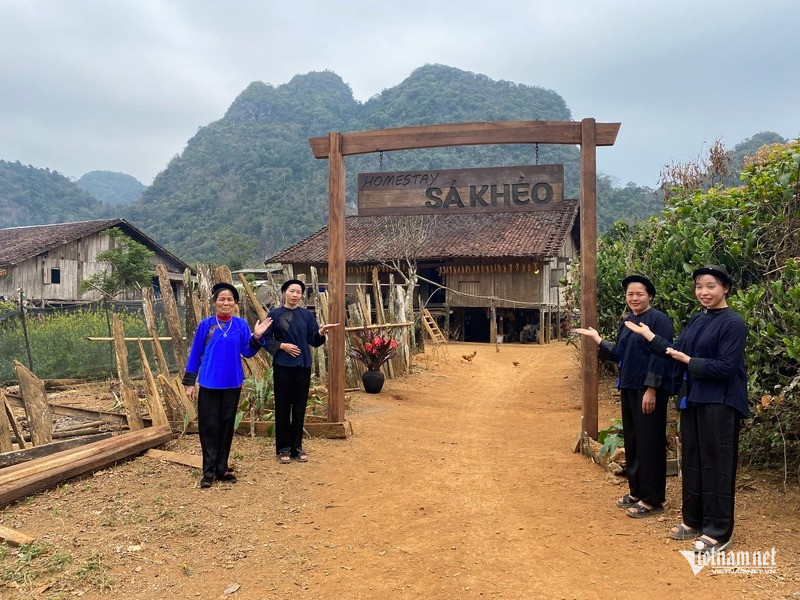
Rather than building new attractions or expanding on a large scale, they are turning stilt houses, bamboo forests, streams and the rhythms of local life into distinctive tourism.
Lan Nong residential area in Loi hamlet, Cai Kinh commune, sits within the core zone of the UNESCO Global Geopark Lang Son, where mountainous landscapes remain pristine alongside traditional stilt houses.
Lan Nong preserves the Nung cultural life through stilt architecture, attire, traditional cuisine, and the Nung language spoken daily across families and transmitted through generations.
In early 2026, an electricity project serving Lan Nong commenced with over VND2 billion in investment, delivering solar energy systems, storage batteries, and auxiliary equipment to all 13 households.
Le Thi Ly, 62, still remembers the years when people in Lan Nong lived by the light of kerosene lamps. Some households once had solar panels, but the electricity generated met only part of their needs.
“In the past, once it got dark, we mostly stayed around the house and everything was difficult. Now that we have electricity, life is completely different,” Ly said.
Electricity has arrived, roads have been opened, and telecommunications coverage is gradually connecting the area. These seemingly ordinary changes are altering how residents view the place they call home.
On August 17, after five months of construction, a 2.5km-long, 3m-wide road was concreted and put into use. The concrete road opened a route into the village, effectively widening the door connecting Lan Nong with the outside world.
The road not only shortens residents’ journeys out of the area, but also creates another route for people seeking out a place with the pristine beauty of Lan Nong.
Instead of thinking only about how to bring agricultural products out of the mountains, residents can now start thinking about bringing visitors into the mountains to create new livelihoods.
Interestingly, when they began considering developing tourism, residents did not want to change the village. They wanted to preserve what they already had - stilt houses, bamboo forests, streams, farmland and the simple lives of 13 households - and turn these into Lan Nong’s distinctive appeal. At a time when many tourism destinations are trying to create “green” spaces, a “slow” pace of life and “local” experiences, Lan Nong already has most of these elements.
In 2025, Lan Nong was selected to pilot a Net Zero-oriented tourism model involving 13 households.
In Lan Nong, there is almost no need to create a boundary between “living space” and “tourism space.” The area’s advantage lies in its pristine living environment, where residents’ lives remain closely connected to farming and nature.
Rather than pursuing large visitor numbers or expanding on a massive scale, the model aims to create a tourism space that is manageable for the community, with each household serving as one link in the destination.
Ha Vu Khoi, chair of the Cai Kinh Commune People’s Committee, said the model in Lan Nong is being developed in line with local conditions and will not make abrupt changes to residents’ living environment.
13 households work together on green tourism
In 2026, the model continues to be upgraded and refined, with greater coordination in infrastructure and operations, gradually taking shape as a sustainable, community-based tourism model.
Pham Van Huy, head of the Lan Nong Community Tourism Agricultural Professional Farmers’ Association chapter, said the village began developing community tourism in early 2026 with five homestays. Residents have received training in environmental protection linked to tourism development.
“Previously, everyone did things on their own, and keeping the environment clean basically meant keeping your own house clean. Once we applied the Net Zero standards, we realized that if we want to keep visitors coming back, the space beneath the stilt houses has to be as clean as the living room, and plastic waste has to be eliminated from the service process,” Huy said.
Some households have begun renovating their living spaces and using locally available materials to create simple areas for visitors to experience village life. Agricultural products, household items, courtyards, kitchens and verandas are being arranged more neatly to become part of the visitor experience.
Pham Thi Huong, Deputy Head of the Management Board of UNESCO Global Geopark Lang Son and Lang Son Tourism Promotion, explained that Lan Nong was chosen due to its well-preserved authentic environment, compact community size, and favorable conditions for executing sustainable practices from inception.
Thuy Hong
.svg)
