 Vietnamnet.vn

 Podcast



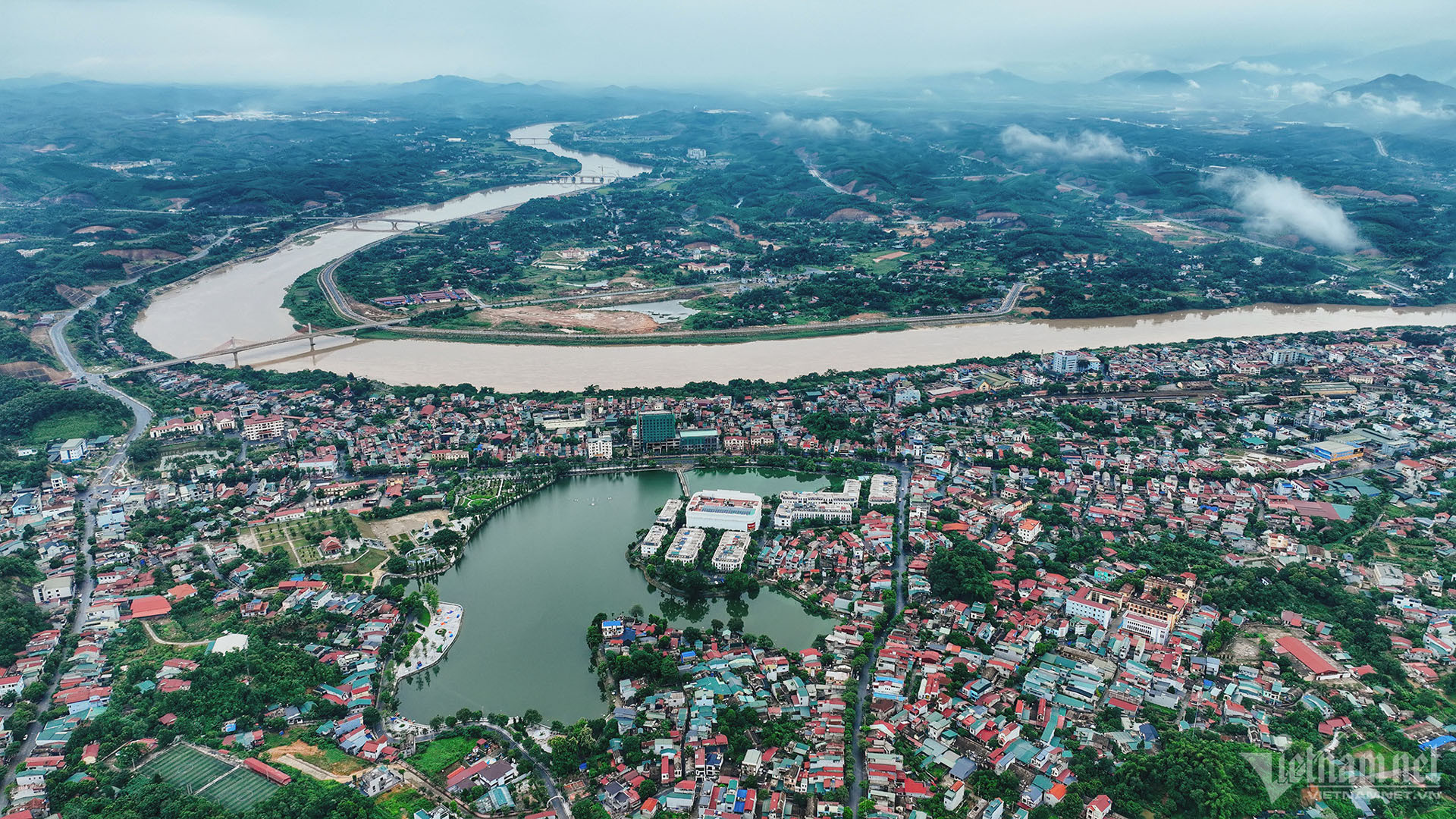
Lao Cai requires a united planning structure following the administrative merger. The Red River water management project is positioned as the foundation for establishing a macro legal framework toward a 2050 vision.
In early October 2025, at Kim Thanh Border Gate No2, parking lots were full. Container trucks queued for customs clearance. Trade flows moved smoothly. Supply chains remained seamless. The border trade economy is accelerating strongly. Despite heavy losses from natural disasters, the bustling trade offered the clearest proof of the vitality of a new economic entity.
The merger of Lao Cai and Yen Bai created a planning boundary of 13,256.92 sqm, comprising 10 wards and 89 communes. This was not a simple administrative addition. The space stretches from low-lying midland areas to border mountain passes, with a 181.951 km international border adjoining China’s Yunnan Province.
The Lao Cai Provincial People's Council approved Resolution No 05 on adjusting the Provincial Master Plan for the 2021-2030 period, with a vision to 2050, on February 9, 2026.
The plan reshapes spatial organization and bridge infrastructure gaps post-merger. Lao Cai takes the Red River dynamic axis as its center. The province focuses investment on two North-South poles, aiming to create a spillover effect and promote the development of three satellite economic regions.
Lao Cai province will allow the flexible conversion of urban agricultural land into construction land to meet high-tech infrastructure criteria while avoiding flood drainage corridors. Safe space is the basis for Lao Cai to adhere to Central government policies. Lao Cai is committed to shifting toward an in-depth growth model after experiencing heavy damage from natural disasters.
The province strives for an average GRDP growth rate of 11 percent per year in 2026-2030 according to Resolution 05. The industry-construction sector plays a leading role. Budget revenue aims to exceed VND32,000 billion. Average GRDP per capita is targeted at VND150 million.
An ASEAN gateway
The total investment capital for the 5-year plan (until 2030) is determined to be up to VND600,000 billion. State capital leads core infrastructure with VND171,000 billion (23 percent), while non-state capital accounts for VND429,000 billion (77 percent). The province aims to have over 18,000 businesses by 2030 which contribute over 72 percent of GRDP.
The province determines that economic growth goes hand in hand with social welfare. Lao Cai aims to raise average life expectancy to 75.5 years. Healthy life years should reach 68 years. The trained labor rate is targeted at 75 percent. The target happiness index is 72 percent. The multi-dimensional poverty rate is to decrease by 2.5-3 percentage points each year.
The planning repositions the strategic status beyond domestic boundaries. Lao Cai will be the growth pole of the Northern Midlands and Mountains region by 2030. The province will become a trade center between Vietnam, ASEAN, and Southwest China. By 2050, Lao Cai will be a Northern development center. The locality is establishing a transcontinental connection axis from ASEAN and China to Europe.
The strategic focus is to build the Border Gate Economic Zone into an international trade center, with the Cross-Border Cooperation Zone as the core. This area is proposed to apply specific mechanisms regarding tariffs, electronic customs, smart logistics, and cross-border payments.
Border gate policies combined with regional transport infrastructure create a major logistics axis. The standard-gauge railway line connecting directly to seaports is the physical premise. A total import-export value of $10 billion is the goal for 2030. The tourism industry will leverage infrastructure to attract over 15 million visitors. Expected revenue is VND70,000 billion.
Long-term vision
Lao Cai is removing bottlenecks in the very first year to implement the goal of mobilizing VND600,000 billion for the 5-year plan and heading toward the 2050 vision. Lao Cai province targets a 2026 GRDP growth of over 10 percent. The scale of the economy should reach over VND155,000 billion, aiming to attract VND90,000 billion in investment capital and VND23,500 billion in budget revenue. Import-export value is expected to reach $6.1 billion.
Investment focus is concentrated on vital transport infrastructure with projects such as the Lao Cai - Hanoi - Hai Phong railway, the expansion of the Noi Bai - Lao Cai expressway, and resolving flooding issues related to the Red River.
The private economy is identified as the driving force. According to Lao Cai Chair Nguyen Tuan Anh, Lao Cai has established a "target-based" mechanism for indicators. The province strives to add 1,000-2,000 new businesses each year. The investment environment will completely eliminate the "ask-give" mechanism.
Doan Bong
.svg)
