 Vietnamnet.vn

 Podcast



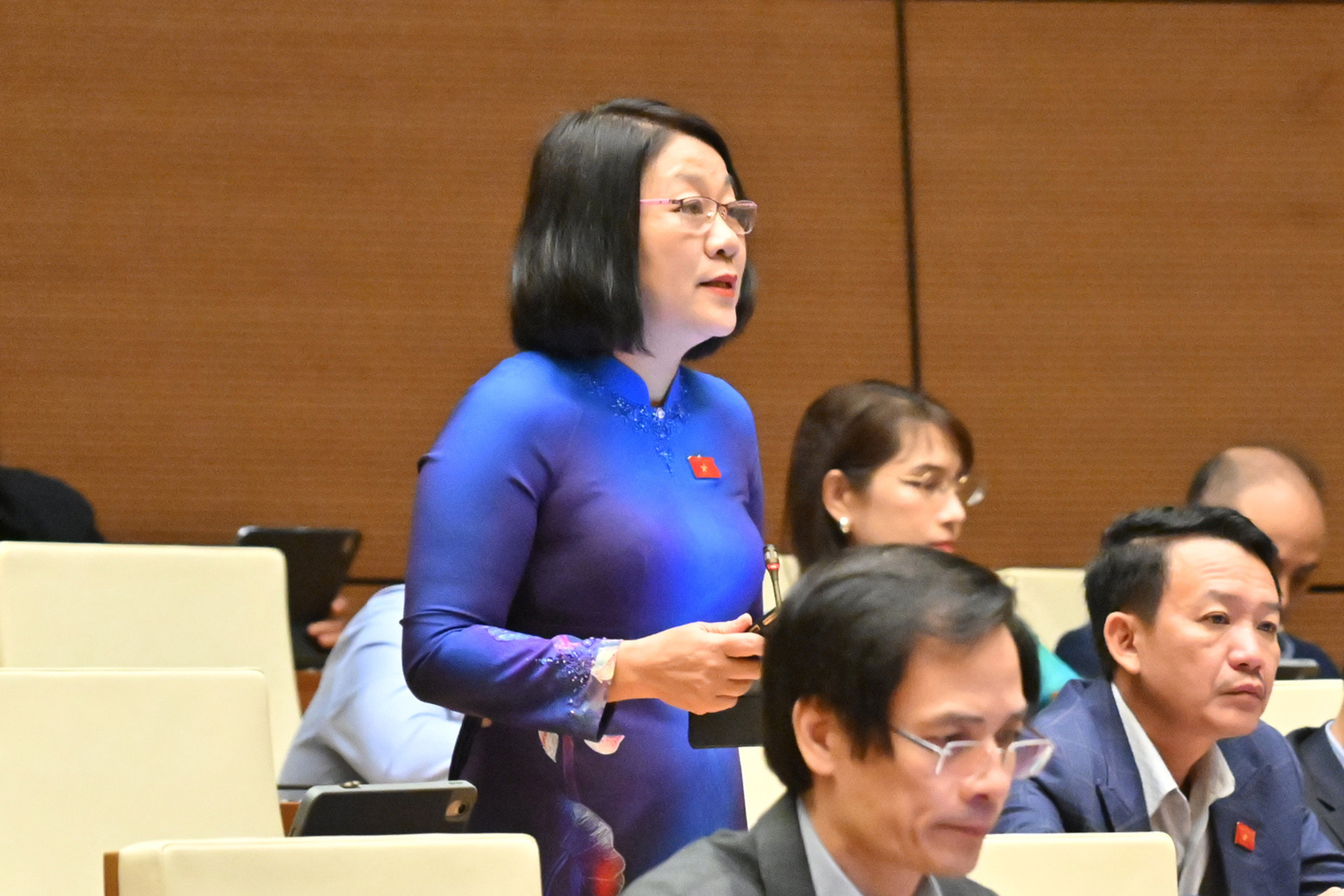
On November 20, Vietnam Teachers’ Day, the National Assembly devoted the entire day to discussing draft laws and draft resolutions related to education and training.
Nguyen Tam Hung, a delegate from HCMC, noted that the draft law amending several provisions of the Law on Education stipulates that the State will have a unified set of textbooks for nationwide use.
He proposed clarifying the mechanism of textbook selection, the accountability of the national appraisal council, and the procedures for correcting errors, since textbooks are essential teaching tools for teachers.
“If the appraisal, approval and correction processes are not transparent, teachers will feel pressure when having to explain issues to parents and students,” Hung said.
He also stressed the need for the Government to provide free textbooks starting from the 2026–2027 school year as a meaningful gesture of the Party and the State’s care for Vietnam’s education system.
Hung added that general school teachers currently bear pressure from school collections and expenditures beyond tuition fees.
He proposed adding a requirement to publicly disclose 100 percent of education-related service fees, including supportive services, to ensure teachers are not placed in a position where they must justify these fees on behalf of schools. Financial transparency, he said, is critical to protecting teachers’ dignity, mental well-being and time.
Citing the reality that secondary and high school teachers are under great pressure in career guidance work, the delegate proposed considering supplementing the responsibility of commune and provincial authorities in implementing career guidance, avoiding the situation of "shifting all obligations onto schools."
A better mechanism for educational autonomy
Nguyen Thi Tuyet Nga (Quang Tri) said, “We are very encouraged that the Central Committee has issued Resolution 71 on breakthrough measures for developing education and training, with strong orientations and major policy directions to remove bottlenecks and modernize education.”
She noted that policies already stated in Resolution 71 do not need to be repeated in the draft National Assembly resolution; instead, the draft should clarify mechanisms, resources and implementation roadmaps.
The draft resolution includes several policies such as special allowances for teachers, free textbooks, credit support, scholarships for doctoral students and investment in digital infrastructure. These policies are extremely important.
"However, the draft resolution lacks 'speaking numbers' and clear resources. It has not clearly institutionalized the specific mechanism and roadmap for implementation. Therefore, despite having high expectations, I am also very concerned about the difficulties and problems during practical implementation," Nga said.
Regarding investment incentives for education and training, the State will ensure a minimum expenditure of 20 percent. According to the delegate, this regulation is not a breakthrough at all, because this spending level was already stipulated in the National Assembly's Resolution 37 in 2004, and legalized in the Education Law.
"With such a spending level, the education budget over the past time has only ensured salary expenditures, while spending on educational activities remains very low," Nga stated.
Under Resolution 71, education in the coming time has many urgent, important, and breakthrough tasks. However, it is unclear about the resources to implement the tasks. "We understand that the budget 'pie' is limited, and 20 percent is a significant figure," the delegate saided.
According to the delegate, the draft needs to show clear financial mechanisms, investment mechanisms, and effective resource utilization. The education sector cannot rely solely on the state budget but must mobilize social resources.
Therefore, Nga believed that a specific, outstanding mechanism is needed to promote the socialization of education. However, the current problem is the lack of a complete legal framework for public-private cooperation in education, leading to legal risks for businesses investing in public schools.
“The most essential resource is internal capacity - human resources, governance and institutions. We must promote creativity and autonomy. Autonomy is not just a mechanism; it is a major resource that delivers faster and more effective results than direct financial investment,” she said.
Nga noted that implementing relevant laws is challenging because autonomy-related provisions remain vague with the general concept “in accordance with the law”.
She stressed that without superior mechanisms to remove bottlenecks and unify legal provisions on autonomy, the policy, although sound, will be hard to implement in practice.
Tran Thuong
.svg)
