 Vietnamnet.vn

 Podcast



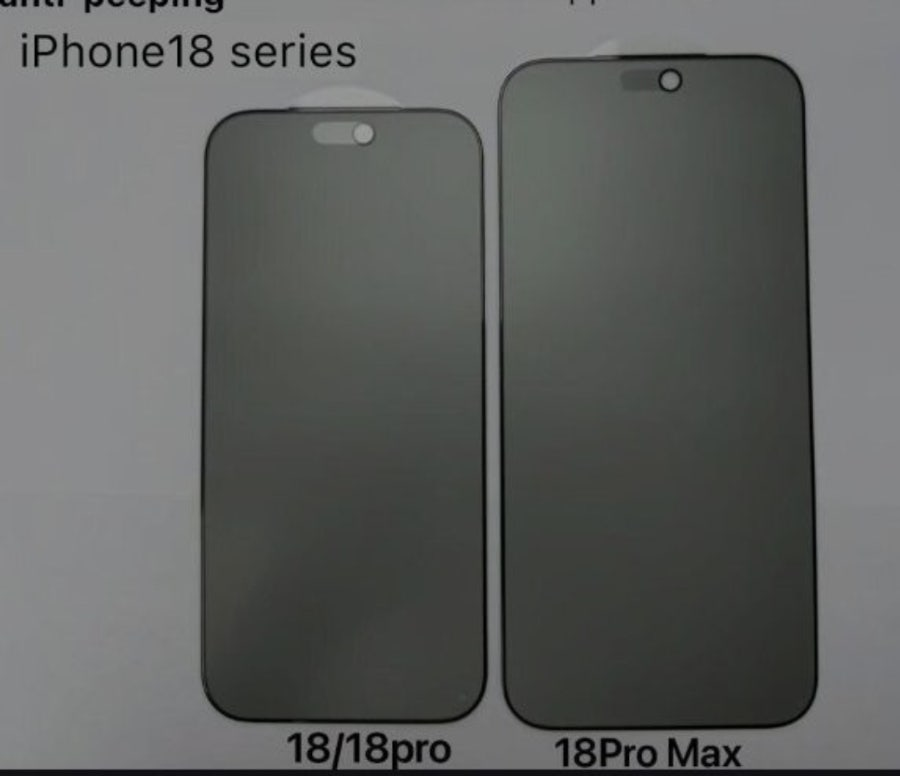
A new batch of leaked images showing tempered glass screen protectors for the iPhone 18 Pro and iPhone 18 Pro Max has surfaced, offering what could be the clearest evidence yet that Apple has achieved one of its most important design goals: significantly reducing the size of the Dynamic Island.
The move is widely seen as part of Apple's multi-year iPhone redesign roadmap. The transition is expected to begin with the iPhone 17 Pro Max, continue through the iPhone 18 Pro Max and eventually culminate with the rumoured iPhone 20 Pro Max - a device expected to feature a truly edge-to-edge display without any visible cutouts or holes.
According to multiple leaks, Apple is steadily moving closer to that ambitious vision.
A noticeably smaller Dynamic Island
The latest report includes images of tempered glass screen protectors said to be designed for the upcoming iPhone 18 Pro and iPhone 18 Pro Max.
The images appear to show a considerably smaller Dynamic Island compared with the iPhone 17 Pro and earlier generations.
While the change may not be dramatic enough to completely transform the look of the device, the difference appears significant enough for users to notice immediately.
There is still no confirmation as to whether the standard iPhone 18 models, expected to launch early next year, will receive the same design update.
Apple is widely expected to maintain a clear distinction between its Pro and non-Pro devices by reserving more advanced display technologies for premium models.
What makes the latest leak particularly interesting is that several reports only months ago suggested Apple was struggling to shrink the Dynamic Island on the iPhone 18 Pro Max.
Those difficulties were reportedly linked to the next-generation Face ID system. However, the newly leaked images suggest the company may have found a workable solution.
Under-display Face ID could be the key
Apple's long-term goal is to create a truly uninterrupted display, eliminating notches, camera holes and any other visual interruptions.
To achieve that, the company is believed to be developing a version of Face ID that sits beneath the display panel. If successful, the facial recognition hardware would be completely hidden from view, allowing the Dynamic Island to become significantly smaller or eventually disappear altogether.
Previous reports indicated that under-display Face ID technology still faced challenges involving recognition speed and accuracy.
Those concerns raised questions about whether Apple would need to delay deployment of the technology.
However, if the leaked screen protectors genuinely belong to the iPhone 18 Pro and iPhone 18 Pro Max, it could indicate that Apple has overcome some of the key technical barriers.
There is also another possibility. Apple may not yet be using under-display Face ID but could have found a new way to rearrange internal sensors and components, reducing the size of the Dynamic Island without fundamentally changing the underlying technology.
In that scenario, the change would represent a design refinement rather than a technological breakthrough.
Although a smaller Dynamic Island would mark another engineering achievement, questions remain about whether it would be compelling enough to encourage users to upgrade.
Since its introduction on the iPhone Pro lineup, the Dynamic Island has become one of Apple's most recognisable design features.
Unlike many Android manufacturers that rely on a simple camera punch-hole, Apple transformed the display cutout into an interactive space capable of displaying notifications, calls, navigation guidance, music playback and other real-time activities.
As a result, many users have grown accustomed to - and even fond of - the feature. If it eventually shrinks further or disappears entirely, some customers may actually miss it.
More importantly, most consumers tend to upgrade their smartphones because of improvements in battery life, camera performance, processing power or new AI capabilities.
A smaller Dynamic Island may be welcomed as a design improvement on the iPhone 18 Pro Max, but it is unlikely to become the primary factor driving sales.
Hai Phong
.svg)
