 Vietnamnet.vn

 Podcast



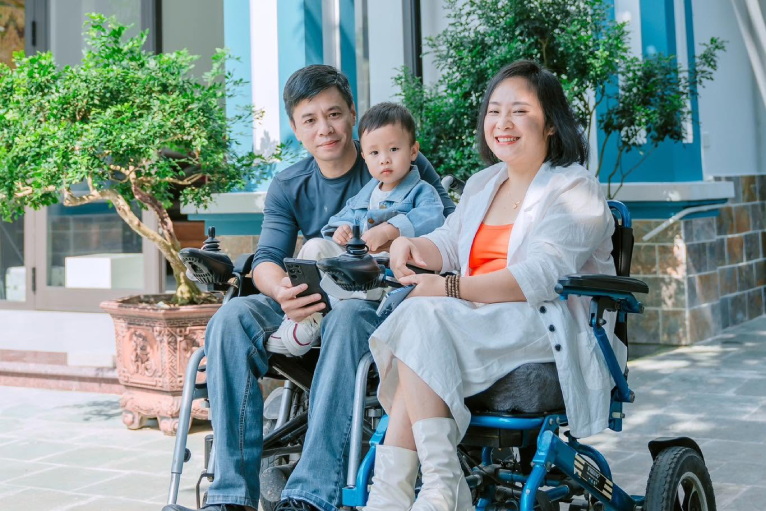
After an IVF journey filled with hardships and tears, joy finally arrived.
Meeting Nguyen Thị Thanh Loan, 40, and Bui Duc Hanh, 45, residing in Duy Tien (Ninh Binh), few would know that behind their happy smiles lies a tearful journey to welcome their firstborn child.
Hanh used to be a truck driver, but in an accident at the age of 25, he suffered a cervical vertebrae fracture that left behind sequelae making it difficult for him to even sit steadily. Loan had an accident when she was 3 years old, resulting in a spinal cord injury, a fractured pelvis, and a deformed spine, requiring her to move around in a wheelchair ever since.
Given their medical conditions, when the couple decided to have a child, the first thing they received was not encouragement but warnings. With a history of pelvic fractures, spinal deformities, her age of over 40, and multiple pregnancy risks, doctors cautioned that carrying a baby could endanger both mother and child.
Even so, they refused to abandon their dream and sought help from fertility specialists.
After a comprehensive evaluation, doctors advised that if they wished to have a child, they should begin treatment as soon as possible because advancing age would continue to reduce ovarian reserve and lower their chances of success.
From then on, every trip from Ninh Binh to Hanoi for fertility consultations, ovarian stimulation injections, egg retrieval procedures, and embryo transfer brought renewed hope despite the physical and emotional challenges.
Two IVF cycles
During the first IVF cycle, Loan produced two mature eggs. However, by the day of the egg retrieval procedure, both eggs had already been released naturally before they could be collected.
Refusing to give up, the couple began a second IVF cycle.
This time, Loan produced eight eggs. Meanwhile, Hanh faced another obstacle after initial tests showed poor sperm quality and low motility.
Following embryo culture, they obtained only four embryos, including two Day-3 embryos and two Day-6 embryos. Compared with many other couples undergoing treatment at the same time who produced dozens of high-quality Day-5 embryos, the outcome left Loan feeling discouraged.
On April 3, 2023, she underwent the transfer of two Day-6 embryos, one graded as good quality and the other as average quality.
Because traveling was difficult, the couple rented a room in Hanoi while waiting for the results. For nearly a month, they stayed together, encouraging each other through days of anxiety and uncertainty.
"The first time, I didn't even know how to use a pregnancy test. Another woman and I were waiting to test together. We kept waiting, then the second red line appeared... We hugged each other and cried with happiness," Loan recalled.
On December 5, 2023, the couple finally welcomed their first child.
Dinh Huu Viet, a master's degree holder and physician at the Hanoi Hospital of Andrology and Infertility, said spinal injuries, particularly spinal cord damage, can severely affect male fertility. Many patients cannot conceive naturally because of erectile dysfunction, ejaculation disorders, or poor sperm quality.
For patients who cannot ejaculate naturally, doctors can retrieve sperm directly from the reproductive tract or testicular tissue and cryopreserve it for fertility treatment.
"If the wife also has difficulty conceiving or her egg quality is poor, doctors can stimulate the ovaries, retrieve the eggs, and use the stored sperm to perform in vitro fertilization. Once healthy embryos are created, they are transferred into the woman's uterus to continue the pregnancy," Viet explained.
Statistics show that Vietnam's infertility rate is about 7.7 percent, affecting nearly one million couples, with the condition becoming increasingly common among younger people.
Around 50 percent of infertility cases occur in people under the age of 30. Secondary infertility accounts for more than 50 percent of all cases and has been increasing by 15-20 percent annually.
Men account for 40 percent of infertility cases, women account for another 40 percent, and the remaining 20 percent involve both partners or have no identifiable cause.
Phuong Thuy
.svg)
