 Vietnamnet.vn

 Podcast



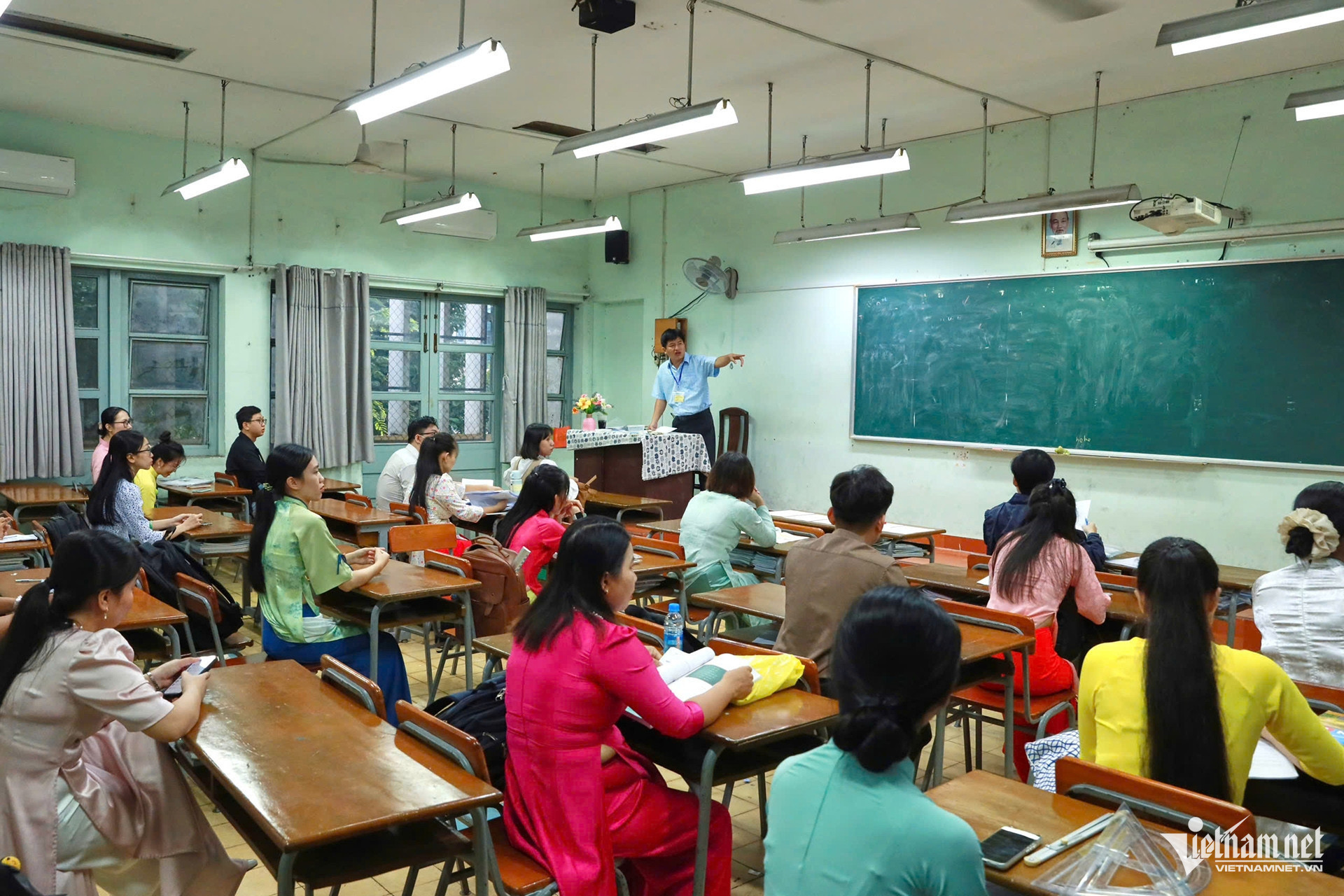
Previously, the Department of Education and Training was responsible for recruiting teachers for high schools and affiliated units, while the district People’s Committee recruited teachers from preschool to secondary schools under the 3-tier local government model. Since July 1, 2025, when the 2-tier model was applied nationwide, the structure of the education sector has changed, especially with the removal of the district education sub-departments.
In HCMC, prior to the transition to the two-tier model, there was a proposal to assign the Communal People's Committee to manage the organization and personnel of community learning centers and direct the recruitment of pre-school teachers according to the approved staff quota. The communal level would also determine the number of contracts for each position in educational institutions within its management scope.
Meanwhile, the Department of Education and Training still assumes the leading role or is delegated authority in recruitment, staffing, appointment, adjustment of professional titles, training and evaluation of teachers, administrators, and staff in public institutions. The department also manages training of personnel in non-public institutions and handles recognition, appointment, dismissal, rotation, rewards, and disciplinary measures for leaders of public schools.
The Ministry of Education and Training once requested provincial People’s Committees to decentralize and authorize the Department of Education and Training to lead recruitment, reception, reassignment, rotation, and transfer of teachers and staff in educational institutions. According to the ministry, given that commune-level civil servants responsible for education lack both numbers and management experience, assigning these tasks to the Department of Education and Training matches current capacity.
Assigning provincial/municipal departments to lead recruitment helps reduce intermediate administrative layers, improve recruitment quality (one exam but multiple school options), save costs, and expand opportunities for candidates. It also helps limit teacher surplus-shortage imbalances and ensure the structure of teaching staff across grade levels, subjects, and educational activities.
Huynh Thanh Phu, Principal of Bui Thi Xuan High School, believes that giving principals the authority to recruit teachers is a reasonable and necessary solution as education increasingly emphasizes workforce quality.
“Teacher recruitment is a professional work and carries the spirit of the school. It cannot be treated merely as an administrative procedure,” Phu said.
He said most commune and ward officials are administrative office staff, knowledgeable about local governance but lacking specialized expertise in education. If communes or wards lead recruitment, the process may become overly bureaucratic, rigid, and miss the sensitivity needed to select a teacher.
He gave an example: in the demonstration-teaching step, considered a test of candidates’ pedagogical ability, even if communes or wards invite teachers to assist evaluation, the final decision still lies with administrative leaders.
“This makes the recruitment environment no longer reflect the nature of an educational institution, because the administrative viewpoint differs significantly from that of the person directly running the school,” he said.
Phu argued that principals are the ones with the ability to “recognize talent” and understand which teachers are suitable for a subject, for school culture, and for the needs of each area. Principals are also accountable for educational outcomes, so they must have the authority to choose the right staff.
From his management experience, recruitment is not only about selecting strong candidates but selecting the right candidates, those who fit the students, the existing team, and the school’s development direction. This can only happen when recruitment authority is placed in the proper hands.
He proposed that principals establish a school-level recruitment council to ensure objectivity and transparency, while the Department of Education and Training supervises the entire process. This approach both maintains quality and reflects the spirit of school autonomy.
Nguyen Van Ngai, former Deputy Director of the HCMC Department of Education and Training, said any recruitment model will always have both strengths and weaknesses, and it is important to choose the method suited to the realities of each locality.
He explained that provincial/municipal Departments of Education and Training oversee the entire educational system of a province or city, from school networks to personnel situations. With this position, the department has a comprehensive view of the “surplus-shortage’’ situation in each subject and grade level, a problem that has persisted for many years.
If the department directly manages recruitment, it can balance needs overall, calculate the required number of teachers per grade level, and assign personnel appropriately.
However, it is an advantage which can also be a disadvantage. Provinces and cities cover large areas, with diverse needs, cultural characteristics, and varied teacher quality across regions. Centralized recruitment at the department level may lack local sensitivity and result in decisions that are procedurally correct but not aligned with actual school needs.
He suggested that, as district education sub-departments no longer exist, giving communes and wards greater recruitment authority may help ensure decisions reflect local realities.
Le Huyen
.svg)
