 Vietnamnet.vn

 Podcast



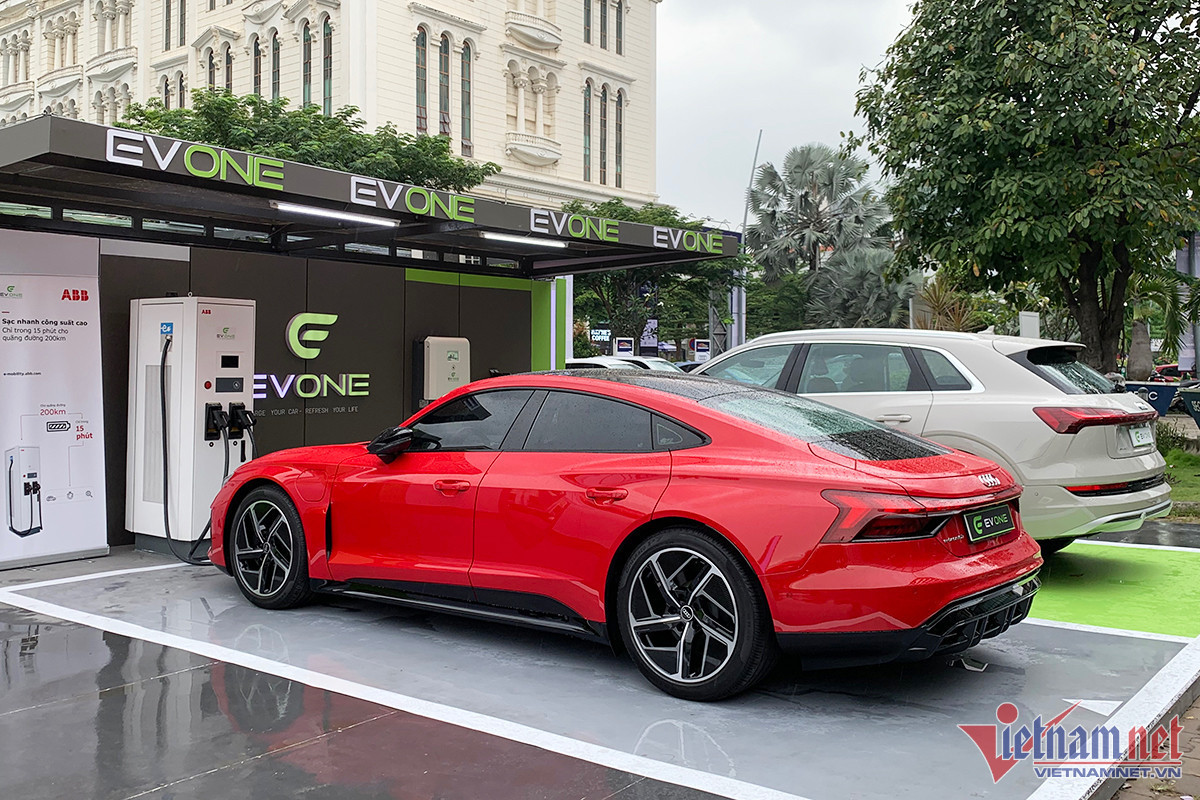
TC Group, VGX, TMT, and TASCO, along with multiple major enterprises, are entering the open charging network development race, while the Ministry of Industry and Trade gathers feedback to enact a national technical regulation that creates a unified framework for Vietnam's EV charging infrastructure.
Rather than building closed charging networks per individual brand, enterprises are partnering to invest in open models that permit a single charging pile to serve multiple EV brands, while allowing a single account to function across various charging stations.
The most recent operational model involves an interconnected open charging ecosystem marked by the launch of the VETC Charging Station platform in June 2026. Interconnected independent charging networks operate on a single platform, sharing account access for payment settlement.
By August, the platform had connected seven partners, including ChargeLink, EBOOST, ESKY, Ford Vietnam, Rabbit EVC, SmartCharge, and EV Charge, spanning 235 stations and over 350 charging piles across more than 30 provinces and cities.
Vehicle owners can locate stations, verify pile status, navigate routes, activate charging, and settle payments at stations across multiple operators through the unified VETC platform.
VETC reported that connected systems currently account for over 50 percent of the multi-brand charging station network.
Previously, the familiar traditional model involved a single operator constructing stations to allow vehicles from multiple brands to charge.
EV One had 73 stations nationwide by May 2026, serving over 10,000 regular EV clients, with plans to expand to over 600 charging heads by 2028.
Singapore's Charge+ is also expanding in Vietnam, aiming to establish 5,000 charging points by 2030.
Additionally, entities such as EverEV/EverCharge, EVG, DatCharge, and SolaEV participate at varying capacities, ranging from point-of-charge investment and operation to equipment supply and station management solutions.
Another trend features automakers directly investing or partnering with infrastructure enterprises to build shareable charging networks.
For instance, in 2025, TMT Motors developed TMT-EGREEN within its own ecosystem while orienting services toward multiple automakers, aiming for 30,000 charging piles by the end of 2030; between May and June 2026 alone, the company imported 570 piles for deployment.
Tasco Auto and Ford Vietnam are also sharing infrastructure, projecting the formation of a synergistic network exceeding 89 charging points by the end of this year.
Earlier, Porsche partnered with Charge+ to develop 17 cross-country DC fast-charging stations, while THACO Auto directly invested in charging stations for BMW EVs alongside partnering with Charge+ for network expansion.
In June 2026, BYD Vietnam executed a partnership agreement with FUTA EV POWER to broaden charging infrastructure access.
Most recently, on September 16, TC Group entered the sector by signing a memorandum of understanding with Vietnam Green Energy Infrastructure JSC (VGX) to develop EV charging infrastructure.
Vietnam set to introduce common standards for EV chargers and charging stations
Alongside the market’s rapid development, state agencies are developing a unified technical framework for EV chargers and charging stations. The Ministry of Industry and Trade is seeking broad public feedback on a draft circular introducing a national technical regulation (QCVN) on EV charging posts and charging stations.
Under the draft, chargers that have been manufactured, imported or put into operation before the regulation takes effect, tentatively on July 1, 2027, may continue to operate and be installed for 12 months. Existing charging stations must complete a review within six months and rectify any non-compliant items within 24 months.
The draft covers AC, DC and combined AC/DC charging posts, with requirements for protection against electric shock, overloads and short circuits, electromagnetic compatibility, and additional requirements specific to DC chargers. It also requires technical information labels and user instructions to be provided in Vietnamese.
The technical requirements are based on TCVN 13078-1:2020, equivalent to IEC 61851-1:2017; TCVN 13078-21-2:2020, equivalent to IEC 61851-21-2:2018; and TCVN 13078-23:2020, equivalent to IEC 61851-23:2014.
This establishes a common technical foundation for EV chargers and charging stations. However, whether a vehicle can use another brand’s charging station will still depend on the communication protocol, connector, power capacity and compatibility configuration of the vehicle and charger, as well as the payment method.
One provision with a direct impact on users concerns metering and billing. Metering equipment must comply with legal requirements, while the system must display electricity consumption, unit prices, service fees, charging time and the total amount payable, and be capable of storing and retrieving data.
Hoang Hiep
.svg)
