 Vietnamnet.vn

 Podcast



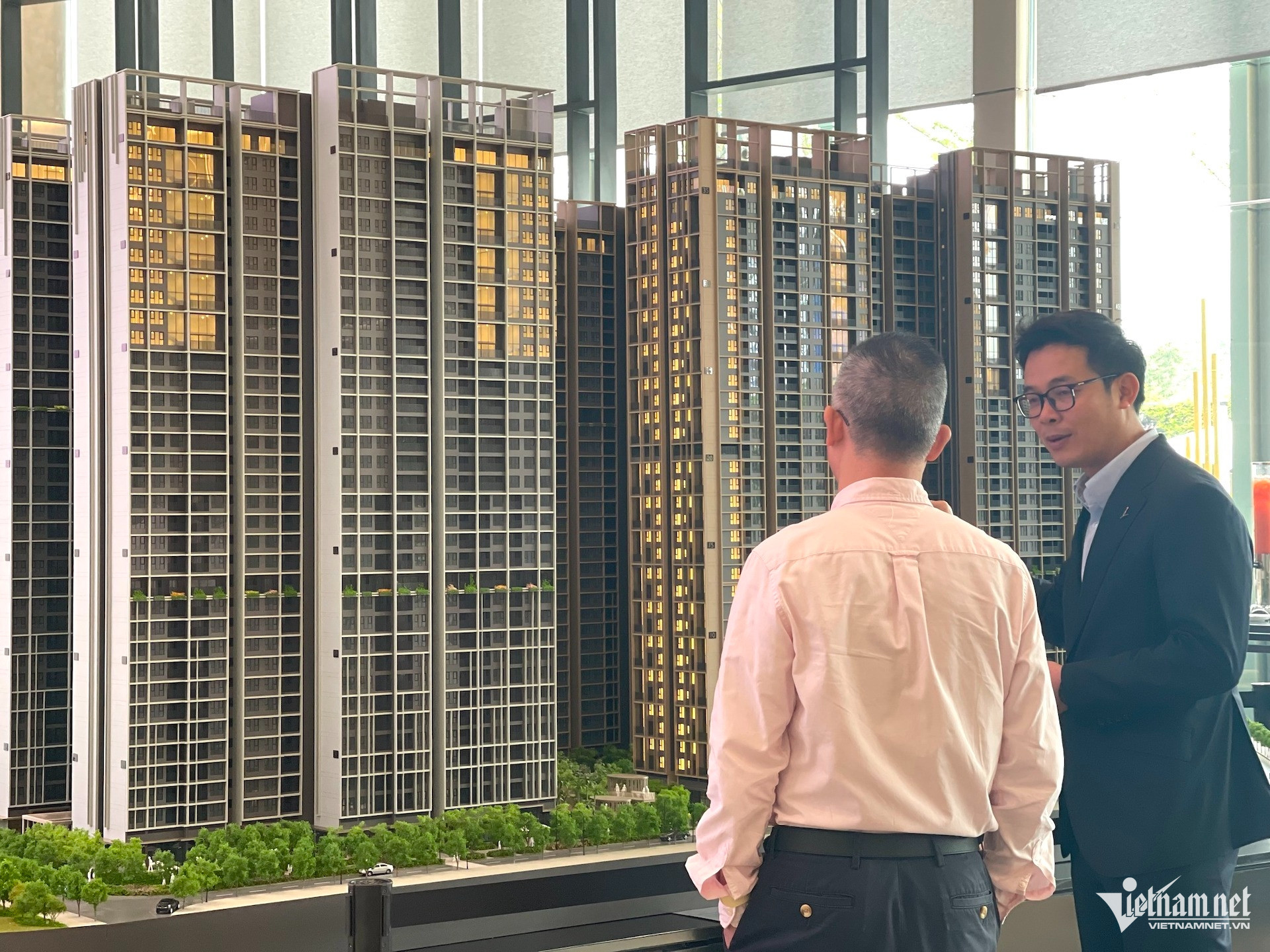
Supply spans multiple segments, from social housing and resettlement housing to high-end commercial apartments.
In early February, the Hanoi People’s Committee and a consortium of investors held groundbreaking ceremonies for the North Thang Long Urban City multi-functional project and another multi-functional urban area in Thu Lam and Dong Anh communes. These are among the first projects implemented after the city approved a plan to develop multi-functional urban zones, part of a strategy to restructure the capital’s spatial layout toward a multi-polar, multi-center model.
The North Thang Long Urban City project is developed by a consortium including Handico, Sunshine Group, and Thai Nam Land. The project covers more than 699 hectares, located across Phuc Thinh, Thien Loc, and Me Linh areas at the northern gateway to the capital city. It is expected to accommodate around 240,000 residents.
Notably, the housing structure is designed to be diverse, with a focus on resettlement housing, social housing, official housing, and high-quality temporary housing at affordable prices.
The second multi-functional urban project is developed by Tuong Lai Song Hong Group, covering about 696 hectares across three land plots in different urban subdivisions.
The first plot spans about 360 hectares in Thu Lam commune under subdivision E2-3. The second plot covers 23 hectares in Dong Anh under subdivision XB-2. The third plot, 313 hectares, also falls under subdivision XB-2, adjacent to Ring Road 3, the Hanoi–Thai Nguyen expressway, Viet Hung auction area, and the Co Loa historical site.
The project is expected to be implemented over nearly four years, from Q1 2026 to Q3 2029. Land clearance and construction will be carried out simultaneously to quickly provide resettlement housing and stabilize residents’ lives.
Alongside large-scale urban developments, the social housing segment has also shown positive signals from the beginning of the year.
In Q1 2026, a social housing project in the Ha Dinh new urban area (Thanh Liet ward) is expected to begin taking purchase applications. According to Hanoi’s Department of Construction, the estimated selling price is about VND25 million per sqm. At this price, a 70 sqm apartment would cost around VND1.75 billion.
Another project, Tan Lap social housing in O Dien commune, developed by Asia Star Real Estate Development JSC, is expected to accept applications from May 1 to May 15, with prices around VND29 million per sqm (excluding taxes, fees, and maintenance costs). Rental prices are estimated at about VND430,000 per sqm per month.
In addition, the Department of Construction announced a social housing project on land plot No.1 in Ngoc Hoi commune, developed by Mechanical and Construction JSC No.7. The expected selling price is about VND24.7 million per sqm (including VAT). With sizes ranging from 40 to 59 sqm, apartment prices range from about VND988 million to over VND1.4 billion.
Under the city’s housing development plan for 2026–2030, Hanoi aims to complete around 120,000 social housing units.
In the commercial housing segment, in early March, Sunshine Group simultaneously broke ground on three projects in Hanoi: Noble West Lake Hanoi, Sunshine River Park, and Sunshine Continental.
Among them, Noble West Lake Hanoi is the largest, located within the Ciputra urban area (Phu Thuong ward), covering nearly 6 hectares with 12 towers of 40 floors each.
The other two projects include Sunshine River Park in Phu Thuong ward, featuring 25 above-ground floors and three basement levels with a total floor area of nearly 134,000 sqm, and Sunshine Continental in Tu Liem ward with 30 floors and three basement levels.
These three projects are expected to add thousands of apartments to market supply in the coming period.
According to Savills, new apartment supply in Hanoi in 2026 could reach around 18,454 units, the highest level since 2021. Most new supply will be in the Grade A and Grade B segments, reflecting the market’s trend toward higher product standards.
Regarding prices, Savills experts believe that in the short term, primary prices are likely to maintain an upward trend. Notably, secondary market prices have already surpassed primary prices across most apartment segments, indicating strong demand for ready-to-move-in properties with completed living environments.
Hong Khanh
.svg)
